What to read on MahaRERA before you pay a booking amount
A booking amount is the last opportunity to change your mind in a property purchase. All the details a promoter has promised about the project are already public before you make your payment. This includes information about the land, dates, flats, encumbrances, and complaints. Here are nine things to read, in the order that will influence your decision.
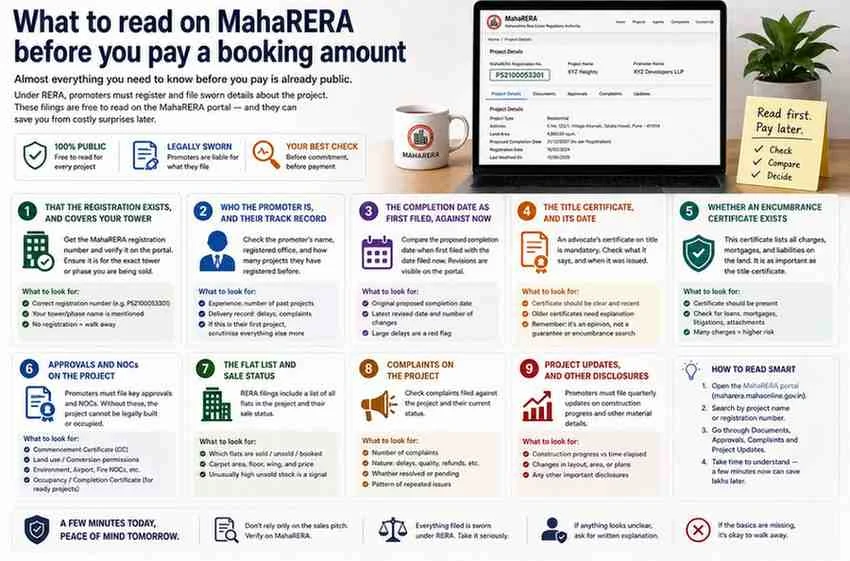
A booking amount is the cheapest point in a property purchase to reconsider your decision, and it is the last chance. After this, you will receive an allotment letter, then an agreement, then pay stamp duty. Each step makes it more expensive to walk away than the last one.
Almost everything you need to know beforehand is already public. Under the Real Estate (Regulation and Development) Act, a promoter cannot advertise or sell a project in Maharashtra without registering it and filing sworn details: the land, approvals, flats, dates, and finances. These filings are available on the MahaRERA portal, free of charge, and sworn, which makes them more reliable than what you might hear during a meeting.
This site lists them for Pune, project by project, along with any additional calculations. Here is what to focus on, in the order that will genuinely impact your decision.
1. Confirm that the registration exists and covers the tower you are being sold
Start with the registration number. A MahaRERA registration number looks like
P52100053301. Ask for it and look it up instead of just accepting a screenshot.
The common pitfall is not usually a fake number. It is often a real number for a different phase. Large developments register tower by tower or phase by phase, and each gets its own registration, dates, flat list, and completion promise. A brochure for "the project" covering six towers may rely on the registration of just one tower. Ensure that the tower you are purchasing, by name, is included in the certificate.
If a project is being marketed without any registration, the process ends there. Marketing an unregistered project is illegal, and none of the protections listed below apply.
2. Identify the promoter and see if they have built anything before
The register gives the name of the promoter and their registered office, which can be surprising for those in Pune.
3251 of the 3970 promoters behind the projects listed here have registered exactly one, which leaves 719 with a second project you could compare it against. For nine builders in ten there is no track record on this register to check, because this is the record.
This is one of the most useful yet least discussed facts about the market. Well-known names represent only a small fraction of what is available. Most projects are created by companies formed for that specific project, meaning there is no history of delivery to check, since the project you are considering is that record.
This does not mean you should walk away; it reflects how the industry operates. Many single-project promoters deliver successfully. However, it is essential not to rely on unverified reputations. If a promoter has completed previous projects, examine the dates and delays, as this is real evidence. If they lack a delivery history, weigh the other items on this list more heavily, especially the title and encumbrances.
3. Compare the first filed completion date with the current filed date
Every registration includes a proposed completion date. Promoters can change this date, and those changes are visible.
Of the 5543 Pune projects listed on this site, 3918 have changed their completion date since registering. That is 71 percent. The biggest single change on record here is Neuleaf Techd, which moved by 12 years.
It is helpful to compare two dates instead of just one. The date originally filed shows what was promised at the launch. The date filed now reveals what is being promised today. If a project has gone through multiple revisions, it conveys something about the project that no brochure will.
Understand what each date commits anyone to. The RERA date is a public commitment to the authority. The date in your agreement for sale provides you with legal recourse, while the date given in the sales office does not guarantee anything. These three dates are often different, which is discussed in what a MahaRERA completion date truly means.
4. Review the title certificate and its date
Two documents about ownership are required for registration: a certificate from an advocate confirming the title of the land, and Form B, which is the promoter's own sworn declaration about the project. Read both. On the title certificate, pay attention to two things separately: what it states and when it was issued.
A title certificate offers a professional opinion as of a specific date. A clean certificate from four years ago does not address any charges created since then. If the date is old, inquire about any developments regarding the land since that time. Remember that a title certificate is an opinion about ownership rather than a guarantee, that the advocate who wrote it was engaged and paid by the promoter, and that it is not the same as a search of the encumbrances.
Of the 5543 Pune projects listed on this site, 5533 carry a title report and 5531 a Form B. Both are conditions of registering, so a gap is a gap in what has been read off the register rather than a project that skipped one.
The actual purpose of the title papers and the common misconceptions about them are discussed in what title papers actually prove.
5. Check if an encumbrance certificate has been filed
This is the most critical piece of information on this list, yet the answer is usually no and few people check.
Only 22 of the 5543 Pune projects listed on this site have filed it. On the other 5521, the promoter's sworn answer in Form B is the only statement about encumbrances there is.
The distinction matters because the two documents do different work. An encumbrance certificate is a search of the register for any charges on the land, such as mortgages, liens, attachments, and pending lawsuits. Form B is the promoter telling you what they say is there. One is evidence and the other is testimony, and on almost every project here you only have the second.
Construction financing means that most projects have a lender with a charge on the land, which is standard and not a defect. What matters is that the charge is disclosed, that your flat will be released from it upon payment, and that the release method is included in your agreement. Inquire about the current encumbrance status, and if the amount you are considering warrants it, have a lawyer conduct an independent search. This is relatively inexpensive compared to the booking amount.
6. The land details: survey numbers and boundaries
The filing specifies the survey numbers for the plot and what exists on each of its four sides. This is the least exciting information on a project page but incredibly useful if you are serious about the purchase.
The survey number links to the revenue record, so you can use it to obtain the seven-twelve extract and confirm land ownership. The boundaries help you verify on-site that the plot you viewed is the same one that was registered. It may seem cautious, but it is essential to ensure the marketing office is not on a different plot than the tower.
The revenue village mentioned in the filing is also important, because it determines whether you fall within PMC or PCMC limits, which impacts stamp duty. This is typically several percent higher inside those limits compared to outside, and the boundary does not align with postal addresses.
7. The carpet area of your flat in square metres as filed
The register includes the carpet area in square metres for every unit. Locate your flat's entry and check the number.
RERA carpet area refers to the net usable space within your walls, excluding the balcony, shaft, and common areas. This is a legally defined term and is the only area measurement in the filing. A sales office may state built-up or saleable area, which is usually thirty to fifty percent larger. Both terms can describe the same flat accurately while implying very different values. Make sure to get onto a carpet basis before making any comparisons. Carpet area versus super built-up area explains the differences between the two.
Also, verify the filed number against what you have been shown, as promoters can misfile this data. Of the 275,529 rates the Pune filings on this site yield, 757 were set aside because they sit more than two and a half times away from their own project's median. That is about one in 364. Almost all of them are a carpet area filed wrongly, not a flat that genuinely sold at that price. If the carpet area listed differs from what is shown in your brochure, ask about it before you pay, not afterward.
8. The number of flats that have actually sold
Promoters report the counts of sold and unsold flats quarterly, and this number can provide more insight than the sales pressure you feel in the room.
1366 of the 5144 Pune projects here that declare a unit count have not registered a single sale, and the median project across all of them has sold 28 percent of its flats. An empty project is normal on a register this fresh rather than a warning in itself.
Assess this information carefully from both angles, as it is easy to misinterpret. A project with no sales is often just newly launched. The flats could still be on the market, and the register captures it early. It also means every unsold flat is available, which puts you in a stronger negotiating position than you will be told you have.
A sustained lack of sales on an older registration is the signal worth taking seriously, because a promoter's construction funding depends on collections. Compare the sold count against the registration date and the construction stage. Few sales on a two-year-old registration is a different matter from few sales on a project registered last quarter.
9. Complaints on record
MahaRERA publishes the complaints filed against each project.
729 of the 5543 Pune projects listed on this site carry a complaint, 3194 in total, and Godrej Meadows accounts for 98 of them. A project with none is a project nobody has complained about, which is not the same as a project with nothing wrong.
Read this in both directions, as it is easy to over-interpret. The absence of complaints is weak evidence, while the presence of them is strong evidence, though you have to read them to find out what they are evidence of. A single complaint may be one aggrieved buyer with an unusual grievance. A pattern of complaints about possession, or about changes to the sanctioned plan, describes how the promoter behaves when things go wrong. Where complaints exist, read the orders rather than the count. How the process works from the other side is covered in how to complain to MahaRERA.
Two things the register will not tell you
Whether the price is fair. The register records what flats have sold for, not what yours should cost. Registered rates for every Pune locality with enough evidence to support one are on the locality pages, and what a square foot of carpet actually costs across Pune explains what those rates can and cannot support.
Whether the building is any good. Nothing in a filing addresses construction quality, water supply, the reputation of the contractor, or what the site is like at eight in the morning. The register is the floor of due diligence, not the ceiling. Visit at an inconvenient hour, and speak to someone who has already bought.
Before you write the cheque
Get the registration number and read the filing yourself rather than being read to. Ask for the reckoner value of your specific flat so you can budget the duty, which is covered in what the government says your flat is worth. Ask what the booking amount is called, whether it is refundable, and on what terms, in writing. And do not pay anything until the registration number on the receipt matches the registration number of the tower you intend to live in.
Where these numbers come from
Every figure quoted above is counted from promoters' own filings with MahaRERA for the Pune projects listed on this site. They are read off the public register and recalculated with each update, so they describe the register as of the date at the top of this page. Nothing is estimated or supplied by a builder.
This is a description of what is on the public register and how to read it. It is not legal advice on your purchase. For a transaction of this size, have an advocate who handles Maharashtra property work read the title, the encumbrances, and the agreement before you are committed.