The RERA project account — where 70% of your money is supposed to go
Seventy percent of what you pay a promoter has to sit in a separate bank account for that project's land and construction. It is not a lockbox that stays shut until possession, and it is not the escrow a sales office implies. Here is what the Act asks for, what the other thirty percent pays for, and what you can read on MahaRERA before you part with any money.
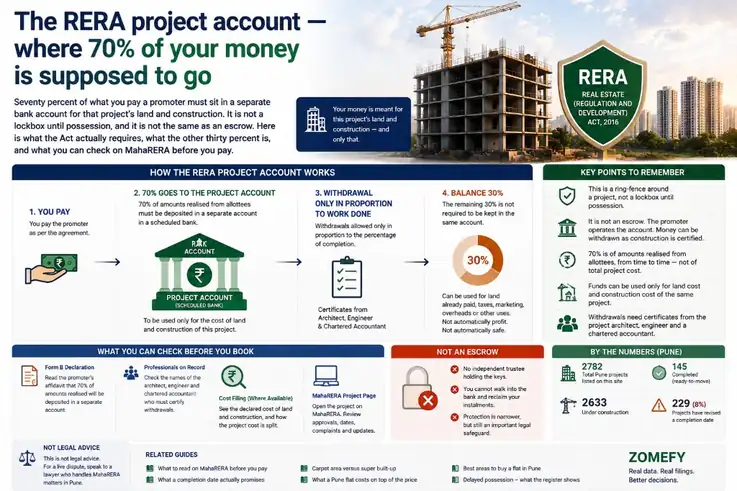
Sales offices are fond of the word escrow. It suggests your money is being held somewhere safe by somebody neutral until the building exists. That is not what MahaRERA set up.
What the Act asks for is narrower and more specific: a separate bank account for the project, and a rule about seventy percent of what buyers pay into it. The account is real, and the rule is one of the few hard limits standing between your instalments and a promoter running four sites at once. It is also routinely described in a way that would not survive a reading of the section.
So this is the machinery, in the order it actually works. None of it replaces having an advocate read your agreement.
What the Act actually says
The sentence that matters is section 4(2)(l)(D) of the Real Estate (Regulation and Development) Act, 2016. At registration the promoter declares, on affidavit, that seventy percent of the amounts realised for the project from the allottees, from time to time, will be deposited in a separate account with a scheduled bank, to cover the cost of construction and the land cost, and will be used for no other purpose.
Three things in that sentence go missing by the time it reaches a WhatsApp group.
The first is what the seventy percent is measured against. It is seventy percent of money received from buyers — not of the project's total budget, and not of the promoter's own capital. If buyers have paid ten crore rupees into a project so far, seven crore of that is the slice that belongs in the project account until it is drawn out lawfully.
The second is what the money may be spent on. Land and construction, for that project, and nothing else. Paying for a different tower, a sister company or last year's land purchase somewhere else is precisely what the section exists to prevent.
The third is who holds it. This is a separate account, not a trust with your name attached. The promoter opens it, the promoter operates it, and certificates are what are supposed to govern withdrawals. A scheduled bank is the venue, not the guardian.
Maharashtra turned the same idea into procedure in the 2017 registration rules: deposit the seventy percent as receipts come in, and withdraw only in proportion to completion, against certificates.
Form B, on the MahaRERA filing, is where a promoter swears to all of this. The guide to title papers walks through that affidavit clause by clause. The seventy percent sentence is easy to read past, because it looks like boilerplate sitting among the land declarations, and it is the legal hook for everything below it.
It is not a lockbox until possession
This is the misunderstanding that causes the most needless panic, and occasionally the most misplaced confidence.
Money is meant to leave the account as work is certified. A project that is half built should already have drawn roughly the eligible share for the land and construction it has paid for. If every rupee stayed put until handover, the building would have to be financed from somewhere else entirely, and the Act does not assume the promoter has that money lying around.
So "seventy percent in escrow" does not mean that seventy percent of what you have paid is still in the account the month before you get your keys. It means seventy percent of receipts should have passed through that account and been spent on this project, in step with certified progress.
Which turns the useful question around. A shrinking balance is normal. A project where large sums have been drawn while the site has barely moved is the pattern worth asking about.
What the other thirty percent is, and is not
The remaining thirty percent is not the builder's fee, whatever the sales desk suggests.
Promoters use it for the things the ring-fence does not cover in the same way: land bought before the project registered, taxes, marketing, salaries and overheads, interest on borrowing, or simply working capital the company can move without a chartered accountant certifying it first. Much of that is ordinary business. None of it carries the protection the seventy percent carries.
Two versions of this circulate in Pune, and both are wrong in opposite directions. One holds that the thirty percent is the promoter's margin while the seventy percent waits for you until handover, which misreads the whole withdrawal mechanism. The other holds that because seventy percent is ring-fenced, the rest must be safe too. If anything, the thirty percent is the part with the fewest rules attached to it.
How money is supposed to leave the account
Withdrawals are tied to the percentage of the project completed, not to how many flats sold that weekend. Three professionals have to certify it, each on their own prescribed form:
- the architect, on physical progress, in Form 1
- the engineer, on the construction and its cost, in Form 2
- the chartered accountant, on costs incurred and how much may be drawn, in Form 3
Those three are named on the project's filing, and this site prints them on a project page where they have been harvested, with a line explaining that they certify progress before money can leave the project account. One name on one filing tells you nothing. The same name recurring across a builder's lapsed registrations is worth a question.
The chartered accountant's cost table is the public cousin of the same process. It sets out estimated land and construction cost against what has actually been incurred. It is not a bank statement, and it does not show the account balance. It is the promoter's certified account of where the money was supposed to go.
Of the 5563 Pune projects listed on this site, 5556 have a cost filing from the register: estimated land and construction, and how much has been spent so far. On 3348 of those, buyers are expected to fund at least half the project.
Read that table the way it is built, or it will mislead you. Land is usually paid for early and shows as largely settled almost at once. Construction is spent over years. A project can therefore look a third of the way through its budget while the building itself is barely out of the ground, and that gap is exactly what a "forty percent complete" slide is designed to smooth over.
What the rule does not do for you
It does not make the bank your counterparty. If the project stalls, you cannot present your receipts at the branch and collect a refund. Your remedy runs against the promoter, through your agreement and through MahaRERA, including section 18 where the date in the agreement is missed.
It does not physically stop a promoter who intends to divert money. It makes diversion a contravention with penalties attached, which is a different thing. Inspections and complaints exist because the account can still be misused.
It does not replace section 13, which is the rule that a promoter cannot take more than ten percent of the cost as an advance without a registered agreement for sale. Money collected in breach of that is its own problem, quite separate from where it later landed.
And it does not merge phases. A township marketed under one brand is often a dozen registrations, each with its own account, its own dates and its own unit list. Paying into Phase 1 gives you nothing in Phase 3. Check that the registration number on your paperwork is the tower you are actually buying; the checklist before you pay a booking amount begins at exactly that point.
What to check before you pay
Nobody will hand you a live ledger for the project account, and this site does not pretend to have one. The public half of the job still takes an afternoon.
- The registration number. Look it up on MahaRERA rather than accepting a screenshot. A project being marketed without a current registration is one where none of this machinery applies.
- Form B. Find the declaration that seventy percent of buyers' money goes into the separate account for land and construction. If it is missing, or the newest Form B is years old on a project still selling, that is a question worth asking out loud.
- The professionals. Architect, engineer and chartered accountant, with registration numbers where they have been filed. Their certificates are what release the money.
- The cost filing. Land against construction, estimated against incurred, and how much of the build is expected to come from buyers rather than from the promoter or a lender. A project funded mostly out of customer receipts has to keep selling in order to keep building, and you are entitled to know that before you join the queue.
- Your own agreement. The account rule lives in the Act; your payment schedule, parking, extra charges and the date that actually binds live in the agreement. A brochure line about "RERA escrow" is not a substitute for reading those clauses.
Have an advocate who works on MahaRERA matters read the agreement itself. The register is free to search, which makes an independent reading cheap. The expensive mistake is treating a slogan as a receipt.
If the building stalls
Delayed possession means the completion date on the latest filing has passed. Diversion of project money is a different allegation altogether: that receipts meant for this building were spent elsewhere.
The two often travel together, and they need different evidence. A delay complaint rests on the date in your agreement and the register. A complaint about the account rests on payment trails, the certificates filed, and what the promoter can show was spent on this project.
735 of the 5563 Pune projects listed on this site carry a complaint, 3223 in total, and Godrej Meadows accounts for 98 of them. A project with none is a project nobody has complained about, which is not the same as a project with nothing wrong.
A complaint on file is not a finding that anything was diverted. It records that somebody took a formal step, and it should be read as exactly that.
Where these numbers come from
Every count on this page comes from promoters' own MahaRERA filings for Pune, read from the public register and updated as it changes. The seventy percent rule itself is in the Act and in Maharashtra's rules. This site cannot see inside anybody's bank account, and does not claim to: what it publishes is the cost filing and the professionals named on it. You can verify any project by searching its registration number on the MahaRERA portal, and every project page here carries that number.
This explains how the Act and the Maharashtra rules work. It is not legal advice on your purchase, and it is not a statement that any particular promoter has complied with them. Before you pay, have an advocate read the documents themselves.
Common questions
- What is the RERA 70% project account?
- Under section 4(2)(l)(D) of the Real Estate (Regulation and Development) Act, 2016, a promoter has to keep seventy percent of the amounts realised from allottees, from time to time, in a separate account with a scheduled bank. That money can be spent only on the land cost and the construction cost of the same project.
- Is the RERA project account an escrow?
- People call it escrow, but in law it is a separate project account that the promoter opens and operates. There is normally no independent trustee holding the keys, and money leaves the account as construction is certified. If the project stalls, you cannot walk into the branch and claim your instalments back from it.
- What happens to the other 30% of my payment?
- It does not have to sit in the ring-fenced account. It can go towards land already bought, taxes, marketing, overheads, loan repayments or general company use. That does not make it the builder's profit, and it does not make it safe. The seventy percent is the protected slice; the rest is the one with fewer rules around it.
- How does a builder withdraw money from the 70% account?
- Maharashtra's rules allow withdrawals in proportion to how much of the project is complete, and only after certificates from the project architect, the engineer and a chartered accountant. Those are the professionals named on the MahaRERA filing, and a withdrawal is meant to follow work done rather than a good weekend of bookings.
- Can I check the project account before I book a Pune flat?
- Not as a bank statement, because no public site has one. You can read the promoter's Form B declaration that the seventy percent will be deposited, the professionals whose certificates release the money, and the cost filing that splits land from construction. Ask for the registration number and open the project on MahaRERA yourself as well.