How to complain to MahaRERA, and what happens next
Knowing that section 18 entitles you to interest on a delayed flat is not the same as collecting it. The complaint is filed online, costs five thousand rupees, and does not need a lawyer. What it does need is the paperwork, and an understanding that an order in your favour is not the same as being paid.
The guide to completion dates sets out what section 18 gives you when a flat is late: a full refund with interest if you walk away, or interest for every month of delay if you stay, at the State Bank of India's highest marginal cost of lending rate plus two percent.
That is the entitlement. This is the machinery, and it is a different subject. Buyers lose on procedure far more often than they lose on merits.
What the register already shows
729 of the 5543 Pune projects listed on this site carry a complaint, 3194 in total, and Godrej Meadows accounts for 98 of them. A project with none is a project nobody has complained about, which is not the same as a project with nothing wrong.
Read that number for what it is. The register records complaints filed against a project, which is a measure of how many buyers took a formal step, not a measure of how much went wrong. Most delays never become complaints. Every project page on this site prints the count, and a zero should be read as an absence of evidence rather than evidence of absence.
For context on the other side of it: 3918 of the 5543 projects here have moved their completion date since registering.
Filing is genuinely straightforward
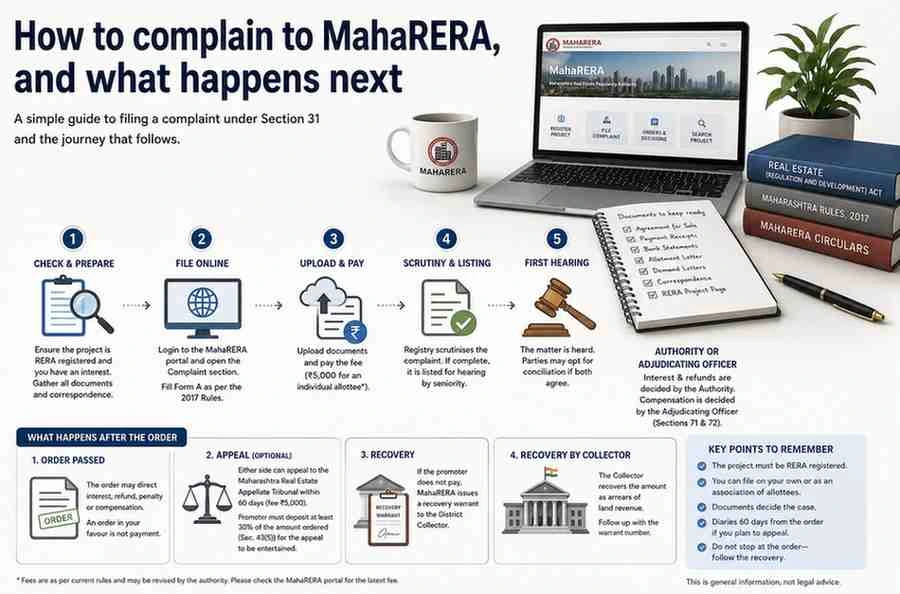
A complaint under section 31 of the Act can be brought by any aggrieved person with an interest in a registered project. You do not need a lawyer to start, a single buyer can file on their own agreement, and an association of allottees can file together.
It is online only, on the MahaRERA portal. You create an account, open the complaint section for a registered project, and complete Form A, which is the format prescribed by the Maharashtra rules of 2017. You upload your documents, you pay the fee — ₹5,000 for an individual allottee at the time of writing, though the authority can revise it and the portal is the place to check — and the registry scrutinises what you have filed.
If the registry finds the complaint incomplete it comes back to you to fix rather than being thrown out. Once it clears, it goes to a bench and is listed for hearing by seniority, under the order MahaRERA set in circular 34 of 2021.
Two conditions catch people. The project must be RERA registered — this route does not exist for an unregistered one, where your remedy is a consumer forum or a civil court. And you must be able to show your interest in it, which in practice means the agreement and the payment record.
Conciliation, and when to use it
At the first hearing, if both sides agree, the matter can go to the conciliation forum instead of being argued. This is a separate track with its own application, its own fee and a bench drawn from both promoter and allottee representatives. A settlement there is signed by both parties and uploaded, and if the promoter then does not honour it, you can go back to MahaRERA and the authority takes the agreed terms into account.
It is worth taking seriously when what you want is a date, a fix or a discount, and the promoter is still trading and still wants the relationship. It is worth declining when what you want is money from somebody who has stopped paying anybody, because conciliation cannot be imposed and a promoter with no intention of settling can use the detour.
Neither side can be forced into it. Declining is not held against you.
Authority or Adjudicating Officer
These are two different forums and the difference decides where your claim belongs.
The Authority handles compliance: directions to the promoter, interest for delay under section 18, refunds, penalties for breaching the Act. This is where most delay complaints go.
An Adjudicating Officer, under sections 71 and 72, decides compensation — loss beyond the statutory interest. The rent you paid while waiting, a quantifiable loss caused by the delay. The officer is required to weigh the disproportionate gain to the promoter, the loss caused to you, and the repetitive nature of the default.
The distinction matters because a claim filed in the wrong place costs months. Interest for delay is not compensation; it is a statutory rate applied to your payments. If you want both, say so and say which is which.
The two steps nobody plans for
The appeal. Either side may appeal to the Maharashtra Real Estate Appellate Tribunal within sixty days of the order, on a fee of ₹5,000 under rule 9. Sixty days is short. If you intend to appeal, diarise it the day the order arrives.
There is a real protection built into this. Under section 43(5), a promoter appealing an order cannot simply appeal to postpone paying: the Tribunal will not entertain the appeal unless the promoter first deposits a substantial part of the amount ordered — not less than thirty percent of any penalty, or that proportion of the total of penalty, interest and compensation as the Tribunal directs. It exists precisely because appealing to delay payment was the obvious tactic, and it is the single most useful provision in this part of the Act for a buyer who has already won.
The recovery. An order in your favour is not money in your account. Where a promoter does not pay, the amount is recoverable as arrears of land revenue, which means MahaRERA issues a recovery warrant to the District Collector, and the Collector's office does the collecting. This step has a reputation for being slow, and buyers who assumed the order was the end of it are the ones most often surprised by it. Follow the warrant. Ask for its number. Take it to the Collector's office yourself rather than waiting to be contacted.
What decides these cases
The documents. A MahaRERA hearing is short, and it turns on what you can put in front of the bench.
Assemble, before you file: the registered Agreement for Sale, every payment receipt and bank statement showing the money leaving your account, the allotment letter, the demand letters the builder sent you, all written correspondence about the delay, and the project's own RERA page showing the filed completion date and any revision to it.
That last one is free and it is the part buyers most often omit. If a promoter has quietly moved the completion date on the register, that is their own filing saying so, and it is on the public portal. Every project page here links to it.
Put your grievance in writing to the promoter before you file, and keep the reply or the absence of one. It is not a legal precondition. It shortens the argument about whether the promoter knew.
What to do
Check that the project is registered and pull its registration number. It is on the project page here and it is what the complaint form asks for first.
Read your agreement's possession clause again, including any grace period, before you assert a date. The date that matters is the one in the agreement, not the one on the RERA filing, and a grace period you overlooked will be the first thing raised against you.
Decide what you actually want — refund and exit, or interest and stay — and be consistent about it. Buyers who ask for both in the alternative, and then argue for whichever seems to be going better, are easier to disbelieve.
Work out whether you are claiming interest, compensation, or both, and file accordingly.
Consider filing as an association if several buyers are affected. One complaint, one fee, and a set of facts that is harder to characterise as an individual misunderstanding.
Diarise sixty days from any order.
Do not stop at the order. Ask about the recovery warrant, and follow it to the Collector.
Where these numbers come from
The project counts, complaint counts and completion-date changes above are taken from promoters' filings with MahaRERA, read off the public register and updated as they change. None of it is estimated or supplied by a builder. You can check any project by searching its registration number on the MahaRERA portal, and each project page here gives you that number.
The procedure, the fees and the sections are from the Act, the Maharashtra rules of 2017 and MahaRERA's own circulars, and they are the position as at the date on this page. Fees in particular are set by the authority and can be revised, so confirm the current amount on the portal rather than on this page before you pay.
This describes how the process works. It is not legal advice on your dispute. You can file without a lawyer and many do, but if the sum is large, if the promoter is insolvent, or if you are heading for the Tribunal, get an advocate who does MahaRERA work.