What a MahaRERA completion date truly means
The date on a project's RERA registration is not the date the builder must give you possession. Understanding the differences among these dates is crucial, as it can save you a significant amount of money. Almost nobody in a sales office will explain it clearly.
Walk into any sales office in Pune and ask when you can take possession. You will usually get a confident answer with a month and a year. But when you ask where that date is recorded, the conversation loses clarity.
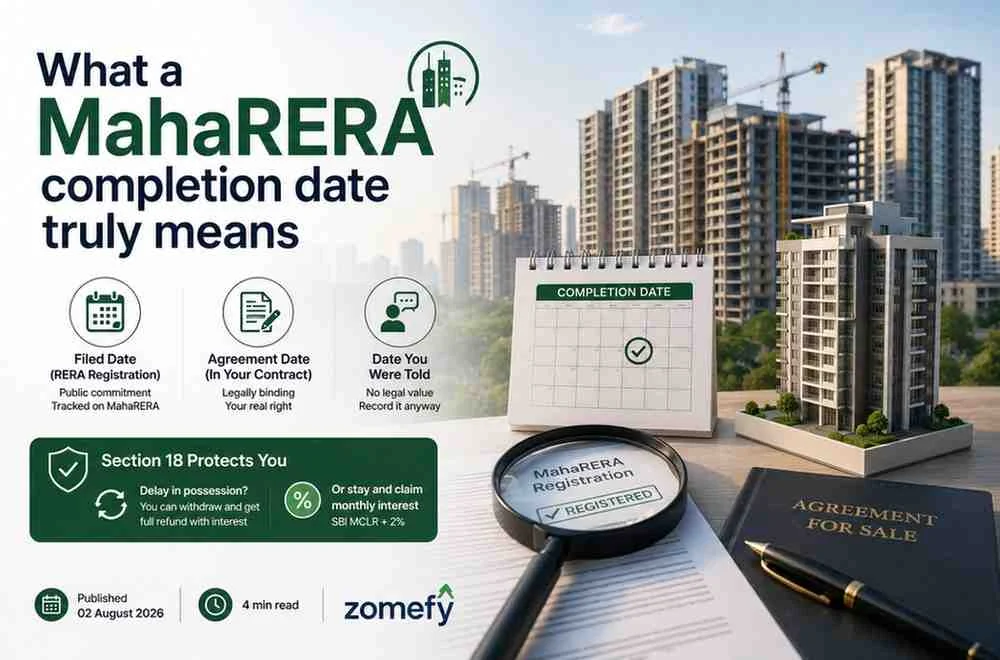
There are three different dates involved. They rarely match, and only one of them gives you a legal right.
The three dates
-
The filed date. When a promoter registers a project with MahaRERA, they state a completion date. This is a public commitment, and it is tracked on this site. A promoter can change it, and these changes are visible in the filing.
-
The agreement date. This is the date listed in your Agreement for Sale, the registered document you sign and pay stamp duty on. This date is the most important one. Section 18 of the Real Estate (Regulation and Development) Act relies on this date, not on the RERA filing.
-
The date you were told. This holds no legal weight. Write it down anyway, including the name of the person who provided the information.
The gap between the filed date and the agreement date can lead to losses for buyers. It is common for the agreement to show a later date than the filing, or include an extra grace period of six to twelve months, or define "completion" in terms of receiving the occupancy certificate rather than you getting the keys.
What section 18 actually gives you
If the promoter fails to hand over possession by the date in your agreement, you have a choice.
You can withdraw and request a full refund, including interest, from the date you made your payment. Alternatively, you can stay and claim interest for each month of delay until you get possession.
The interest rate is not negotiable. It is not the small amount stated in most builder agreements. Under the Maharashtra rules, it is the highest marginal cost of lending rate from the State Bank of India plus two percent. For a seventy-lakh flat, that translates into significant money for each month of delay.
Two common misconceptions exist here. First, this right belongs to you regardless of your agreement. A clause limiting the builder's liability to ten rupees per square foot per month does not override the law, and MahaRERA has rejected such clauses. Second, you do not need to make a choice immediately, but delaying your claim can be used against you. It is best to put it in writing early.
Why the filed date still matters
If the agreement date holds legal weight, why should you care about the filing?
Because the filing gives you the only forward-looking evidence before you sign anything. A promoter who has already pushed the completion date told you something important. If a promoter has done this on several projects, their pattern reveals even more.
Of the 5543 Pune projects listed on this site, 3918 have changed their completion date since registering. That is 71 percent. The biggest single change on record here is Neuleaf Techd, which moved by 12 years.
These revisions are not hidden; they just are not included in the brochure.
What to actually do
Before you pay any booking amount, look up the RERA number. It should be displayed on all advertisements, billboards, and websites as required by MahaRERA order 46C/2025, along with a QR code. If a project is being marketed without this information, that is a serious issue. Section 3 of the Act outright prohibits marketing an unregistered project.
Check whether the completion date has been changed. Review the promoter's other projects and take note of any complaints.
When you receive the draft agreement, locate the possession date and read the surrounding text. Look for a grace period, a definition of possession tied to the occupancy certificate, and a force majeure clause that is too broad. Request that the grace period be removed. It often can be if you ask before payment.
Compare it with the filed date. If the agreement states a later date than the RERA registration, ask for an explanation in writing. There may be a valid reason. Their response, or lack of one, will reveal a lot about who you are working with.
Keep all receipts and every email. A section 18 claim relies heavily on documentation. Buyers who receive interest are those with a clear paper trail, not those scrambling for records.
A note on grace periods
Grace periods are the most effective tool in a builder's contract. A twelve-month grace clause does not just push back your possession by a year; it also delays the start of your interest entitlement by a year. The clock under section 18 begins when the agreed date, including the grace period, passes.
MahaRERA generally supports grace periods that are clearly stated and agreed upon, while rejecting those that are buried or unclear. Examine the clause carefully. If it exists, account for it because it is real.
Where these numbers come from
All figures here come from the promoters' MahaRERA filings, sourced directly from the public register and updated as they change. None are estimates or provided by a builder. You can verify any project by searching its registration number on the MahaRERA portal. Each project page on this site tells you the specific number to look up.
This information outlines how the Act works, but it does not serve as legal advice for your specific agreement. For ongoing disputes, consult a lawyer who specializes in MahaRERA matters.