What a project's title papers actually prove
Every registered project has an advocate's report on the title to its land. Having one is a condition of registering rather than a verdict on the title, and the document that says what is charged against the land is usually the one missing.
Ask a sales office whether the title to the land is clear and you will be told the project is RERA registered. That sounds like a yes. It is not one.
Registration means the promoter filed the documents the law asks for and the authority accepted the filing. Nobody at MahaRERA rules on who owns the land. The papers are published so that you can read them, and almost nobody does.
What is on the file
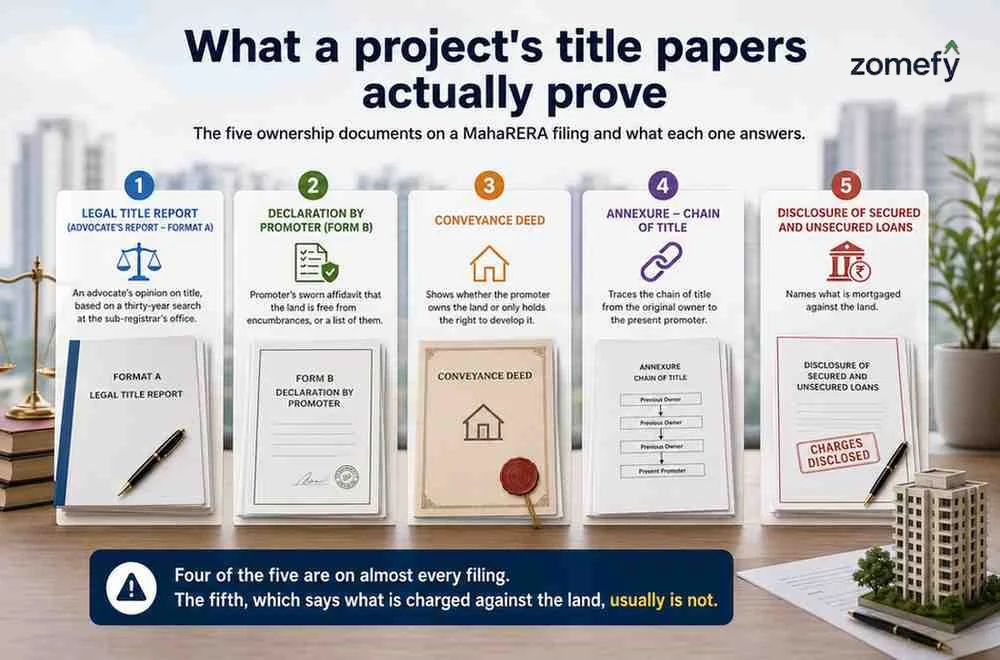
A Pune filing carries up to five documents bearing on ownership.
The legal title report is an advocate's opinion on who holds the land. The conveyance deed shows how it came to them. Form B is the promoter's own sworn declaration. The annexure traces the chain of title backwards through earlier owners. The disclosure of secured and unsecured loans names what is charged against the land.
Every project page on this site lists which of these are on file, the date each was filed, and the promoter's own filename for it.
The title report is written to a prescribed format
MahaRERA does not accept a free-form letter. Since circular 28/2021 the report must follow Format A, on a practising advocate's letterhead, and rule 3(2) of the Maharashtra rules requires it with every registration.
The format tells you what the advocate had to look at: the 7/12 extract or property card as on the date of application, the mutation entry, and a search of thirty years at the sub-registrar's office. That last one is the substance of the exercise. Three decades of registered transactions on that land, read by somebody qualified to notice a gap.
The report ends in an opinion, and the prescribed wording is worth knowing exactly. The advocate states that the title is clear, marketable and without encumbrances — and the format then adds, in brackets, if any encumbrances please mention.
That bracket is the whole point. Reports come back saying the title is clear and marketable except as disclosed below, and then disclose a mortgage, a pending suit, or a co-owner who has not consented. A report that discloses problems is not a failed report. It is a correct one, and it is still a perfectly valid filing.
So two things follow. The advocate who wrote it was engaged and paid by the promoter, which does not make the opinion wrong but does tell you whose question it answers. And having one on file proves an advocate looked and the authority accepted the filing. It does not mean the title is clear.
Of the 5605 Pune projects listed on this site, 5598 carry a title report and 5596 a Form B. Both are conditions of registering, so a gap is a gap in what has been read off the register rather than a project that skipped one.
Form B is sworn, and that changes what it is worth
Form B is not a covering letter. Under section 4(2)(l) of the Act it is a declaration supported by an affidavit, signed by the promoter, stating four things:
- That the promoter has legal title to the land, with authenticated documents proving it if the land belongs to somebody else.
- That the land is free from all encumbrances — or, if it is not, the details of every encumbrance, including any right, title or interest and the name of any party in or over that land.
- The time period within which the promoter undertakes to complete.
- That seventy percent of what buyers pay goes into a separate bank account, to be used only for land and construction.
Read the second one again. The promoter is not saying the land looks fine. They are swearing an affidavit about it. If the land is mortgaged and Form B does not say so, that is a false affidavit rather than an oversight, and it is the single most useful sentence on the whole filing.
The fourth point is the one buyers hear described as escrow, usually inaccurately, and it has a guide of its own: where the RERA project account is supposed to put your money.
Form B is also refiled when a project applies for an extension, so the newest one is the one that governs.
The document that names what is charged against the land
Alongside Form B, the rules ask for the details of encumbrances on the land: dues, litigation, and any mortgage or charge created against the project land, whether by the promoter or a third party. A promoter can satisfy this instead with a no-encumbrance certificate from an advocate of ten years' standing, or from a revenue officer not below the rank of Tehsildar.
This is the document that answers the question you actually care about, and it is the one most often absent.
Only 22 of the 5605 Pune projects listed on this site have filed it. On the other 5583, the promoter's sworn answer in Form B is the only statement about encumbrances there is.
There is a real protection here, and it has limits worth understanding. Section 11(4)(h) says that once the promoter has executed an agreement for sale for your flat, they cannot mortgage it or create a charge on it — and that if they do it anyway, that charge does not affect your rights as the buyer. Tribunals have applied this to hold that a lender's security taken after your agreement ranks behind you.
Note what that protects and what it does not. It bites on a charge created after your agreement for sale. A mortgage that already sits on the land before you sign is an existing encumbrance, and the answer to that one is to see it released, or at minimum to see your flat specifically released from it in writing, before you pay.
Filed once, or filed four times
The register keeps the older versions when a promoter refiles a document, and this site counts them.
2510 of the 5605 Pune projects listed on this site have at least one document behind the current one. The deepest is Ganga Asmi Wing 3, where the conveyance deed sits on top of 77 older versions.
Refiling is ordinary. Deeds get corrected, a scan is unreadable, a name is misspelled. But a document that has been replaced three times is a document that kept changing, and the reason is a fair thing to ask about.
Conveyance means two different things
Both matter, at opposite ends of the project.
Conveyance to the promoter is the question of whether the builder owns the land at all. Many do not. They hold development rights under an agreement with the landowner, which is entirely lawful — the rules expressly provide for it, and require the development or joint-development agreement, the owner's consent, and a title report on the owner's title as well. It is not a problem. It is a different structure, and it means the person you are buying from is not the person on the 7/12 extract. Find out which arrangement you are in.
Conveyance to your society is the other end. Under section 17, once the building has its occupancy certificate the promoter must execute a registered conveyance deed and transfer the common areas to the association of allottees — within the period local law specifies, or within three months of the occupancy certificate if it does not. Under section 19(11) you have to turn up and take part in registering it.
Promoters have historically simply not done this, which leaves societies holding flats in a building on land that still belongs to the builder years after everyone moved in. Maharashtra has a remedy for that, and it was tightened recently. The Maharashtra Ownership Flats (Amendment and Validation) Act, 2025, in force from 31 December 2025, inserted section 11A into MOFA: where the promoter of a RERA-registered project fails to convey under section 17, the allottees or their association can apply to the Competent Authority — the District Deputy Registrar of Cooperative Societies — for a unilateral deemed conveyance in their favour. It operates retrospectively from 1 May 2016, which settles years of argument about whether the older MOFA route was available to RERA projects at all.
If you are buying into an older completed building, ask whether conveyance has happened. If you are buying off plan, know that this is the machinery waiting at the far end.
What to do before you pay anything
Open the project's page on the register and read the newest Form B. Find the encumbrance paragraph. It either says the land is free of them or it lists them. That is a two-minute job and it is the highest-value thing on this page.
Read the title report's opinion paragraph, and read to the end of the sentence. The words that matter come after "except".
Ask for the thirty-year search report the format is based on. It is referenced in the title report by date and by whoever conducted it.
Ask whether the promoter owns the land or holds development rights. If it is the second, ask for the development agreement and the landowner's title report, both of which the rules require to be filed.
Check the filing dates against the registration date, and check whether a document has older versions behind it. A title report from years ago on a project still selling today is an old opinion, not a current one.
If there is a mortgage on the land, get it in writing that your flat will be released from it, and do not rely on section 11(4)(h) to cover a charge that predates your agreement.
Have your own advocate read the papers. Everything above is on a public website for free, which makes an independent reading cheap. The report on the file was written for the promoter.
Where these numbers come from
Every figure here comes from promoters' filings with MahaRERA, read from the public register and updated as it changes. None of it is estimated or supplied by a builder. This site records that a document of a given kind was filed on a given date under a given filename; it does not read the contents of any of them, and nothing here should be taken as a statement about whether a particular title is clear. You can verify any project by searching its registration number on the MahaRERA portal, and each project page here gives you that number.
This describes how the Act and the Maharashtra rules work. It is not legal advice on your purchase. Before you sign, have an advocate who does MahaRERA work read the actual documents.