What a square foot of carpet actually costs across Pune
These are not asking prices. The registered agreement values from tens of thousands of completed sales in Pune, reduced to a rate per square foot of carpet area. The city median is one number, but it is the least useful one here, because the two ends of Pune are more than ten times apart.
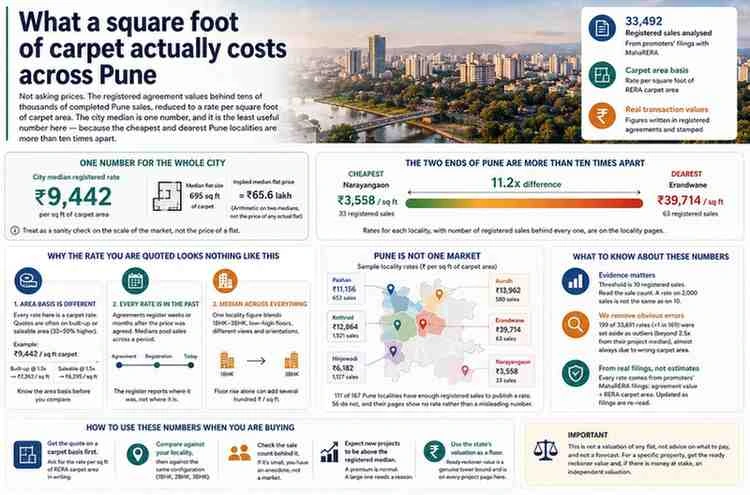
There are two types of price numbers associated with Pune property, and they do not compare.
The first is an asking price. This includes a builder's rate card, a portal listing, or a number in a brochure. It reflects what someone hopes to get. It costs nothing to state, and there is no requirement for it to resemble a completed transaction.
The second is a registered agreement value. This is the amount recorded in a sale agreement, signed by both parties, stamped, and filed. Someone has paid duty on it. This is the actual price at which a flat changed hands.
This site has 274,772 of the second kind, taken from promoters' filings with MahaRERA, divided by the RERA carpet area on the same filing. This gives a rate per square foot of the floor area you can walk on. It is the most reliable price signal for Pune, but it still does not tell you what your flat will cost. This piece covers both parts of that statement.
One number for the whole city
The median registered rate across every sale on this site is ₹9,283 per square foot of carpet area.
The median flat here is 686 square feet of carpet, so the median rate puts it at about ₹63.6 lakh. That is arithmetic on two medians rather than the price of any actual flat, but it is the right order of magnitude for what a mid-market Pune flat has been changing hands at.
Treat this as a sanity check on the market's scale and nothing more. A citywide median for Pune is similar to an average temperature for India. It is real arithmetic, but it does not describe any specific place.
The two ends of Pune are more than ten times apart
The cheapest is Phursungi at ₹549 a square foot, on 50 registered sales. The dearest is Erandwane at ₹27,279, on 434. That is 49.7 times the rate for the same square foot of floor, inside one city.
That single fact is more informative than any average. It shows that the term "Pune property rates" has no specific meaning: whatever number follows either pertains to a specific locality or is essentially meaningless. It also means the most important factor affecting what you pay per square foot is not the builder, the amenities, or the finish. It is where you draw the circle on the map.
Rates for each locality, along with the number of registered sales behind each rate, are on the locality pages. The historical trend over time is found in the Pune registered-price index.
Why the rate you are quoted looks different
There are three reasons, all straightforward rather than suspicious.
Every rate here is a carpet rate. RERA carpet area measures the net usable floor space inside your walls. Sales offices often quote prices based on built-up or saleable area, which adds a premium for shared space, typically between thirty and fifty percent. Divide a carpet rate by 1.3 and it appears about three-quarters as large; divide by 1.5 and it looks like two-thirds the size. So a quoted rate well below the figures here is not necessarily a good deal, and one above them is not necessarily expensive. Without knowing which area a rate is based on, you cannot draw any conclusions about it. This is the main issue of carpet area versus super built-up area, and it is the most common way a buyer in Pune is misled without any dishonesty.
Every rate here is in the past. An agreement is registered weeks or months after the price is settled, and the medians on this site represent sales over time rather than a single day. In a changing locality, the register reflects where it was, not where it currently stands. New launches price against where the builder believes the locality is headed.
Every rate here is a median across all configurations. One locality figure combines one-bedroom and three-bedroom flats, second floors and twenty-fourth floors, as well as flats facing the road and those facing the garden. A sales office charges separately for each of these factors. Floor rise alone can create differences of several hundred rupees per square foot between the lowest and highest prices in the same tower.
What a median cannot endure
A median needs enough evidence beneath it. 163 of the 195 Pune localities on this site have a sufficient number of registered sales to support a median; 32 do not, and their pages show no rate rather than a figure based on three agreements.
The threshold is 10 registered sales. This is intentionally low, because the alternative is to remain silent about most of the city. That is why every rate on this site shows its sale count next to it. A rate based on two thousand registered sales and one based on ten are different types of information dressed in the same notation, and only one would remain valid after another dozen transactions.
Pay attention to the counts. Where they are low, view the number as an indication of the order of magnitude, not as a market rate.
There is another caution to consider. Promoters file these figures themselves, and some may incorrectly report carpet area, leading to a rate that is nonsensical in a specific direction. Of the 275,529 rates the Pune filings on this site yield, 757 were set aside because they sit more than two and a half times away from their own project's median. That is about one in 364. Almost all of them are a carpet area filed wrongly, not a flat that genuinely sold at that price.
How to use these numbers when buying
Get the quote based on carpet area before comparing anything. Request the rate per square foot of RERA carpet area, and ask for written confirmation. If the response is in built-up or saleable area, ask for the loading and do your own calculation. Everything else in this list depends on this step being correct.
Compare against your locality, not the city average. Then compare the configuration. The locality pages break down rates by the number of bedrooms, as prices for a three-bedroom and a one-bedroom in the same area can vary significantly, often by hundreds of rupees per square foot.
Check the sale count behind the comparison. If it is small, you may only have an anecdote instead of a meaningful market insight.
Expect a new project to be priced higher than the registered median, and ask by how much. Registered sales in a locality are historical, while a new launch is priced based on projections. A premium is usual. A large premium indicates a belief about the locality's future that is worth considering.
Use the state's valuation as a baseline. The government publishes a value for every property, and stamp duty is charged on whichever is higher between that value and your purchase price. This number provides a genuine lower limit on the market, and it is available on the project pages here. What that valuation is and how far it sits from the market is covered in what the government says your flat is worth.
Where these numbers come from
Every rate on this site comes from a promoter's filing with MahaRERA: the agreement value for a sold flat, divided by the RERA carpet area on the same filing. No estimates, models, or information supplied by builders for publication are used, nor are figures taken from listing portals. If any figure represents the site's own calculations based on the register rather than something explicitly stated, the page indicates this.
Rates are updated as the filings are reviewed. Figures on this page are recalculated with each update, ensuring they reflect the register as of the date at the top, not the date they were originally written.
This reflects what completed sales in Pune have been registered at. It is not an assessment of any particular flat, not advice on what to pay, and not a forecast. For a specific property, obtain the ready reckoner value for that unit and, if money is involved, seek an independent valuation.