What the government says your flat is worth, and what buyers actually pay
Maharashtra publishes a value for every property in the state. It sets the minimum for your stamp duty, promoters report it against every unsold flat, and few people check it. For the Pune projects listed here, the valuation is about two-thirds of what buyers actually registered, except in cases where it is not, and those instances can lead to extra costs.
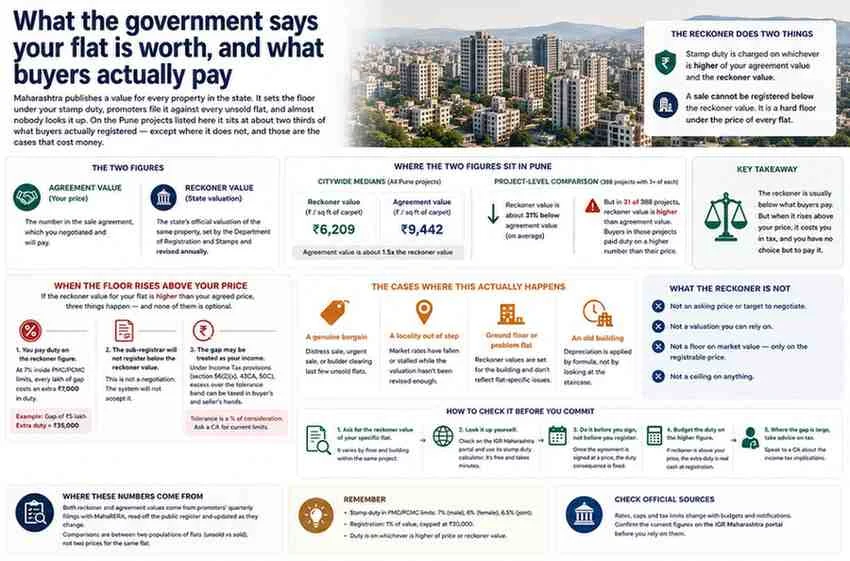
Maharashtra publishes a value for every property in the state. This is not an estimate; it is an official number, updated yearly and categorised by locality, building type, and sometimes floor. This document is called the Annual Statement of Rates, and it is commonly referred to as the ready reckoner.
Two things follow from this, and most buyers find out both of them too late.
Stamp duty is charged on whichever is higher, either your agreement value or the reckoner value. Since a sale cannot be registered for less than the reckoner value, it sets a firm base price for every flat in the state.
This is one of the few claims about Pune property that can be independently verified, as promoters file a reckoner value for every unsold flat in their MahaRERA returns. This site holds those filings alongside the agreement values for flats that have sold.
What the two figures are, precisely
The agreement value is your price. It is the number in the sale agreement that you negotiated and will pay.
The reckoner value is the state's valuation of the same property. You did not negotiate this; the builder did not set it, and it does not change based on market movements this quarter. It is determined by the Department of Registration and Stamps and updated annually.
The reckoner is not an opinion on what the flat is worth to you. It exists to help the state collect duty based on a number that holds up when a declared price seems unrealistic. For many years, people tried to evade duty by declaring a low price in the deed and paying the difference in cash.
Where the two figures sit in Pune
Across the 4175 Pune projects here that have filed one, the median state valuation is ₹6,260 a square foot of carpet. The median rate buyers actually registered is ₹9,283 — about 1.5 times it.
In most cases, everything aligns comfortably. The state's valuation sits well below the market rate, your agreed price is higher, and the duty simply reflects your price. Most buyers typically do not think about the reckoner because it rarely impacts them.
Citywide medians can be blunt tools, though, and a better test is within a single building. Here, we compare what sold with the state's valuation of unsold units. Promoters file an agreement value for sold flats and a reckoner value for unsold ones, never both for the same unit, so the comparison must be made for each project individually.
Across the 2831 Pune projects listed here that have filed at least three of each, the reckoner value sits about 29 percent below what buyers actually registered. But not everywhere: on 274 of the 2831, the reckoner sits above what buyers agreed, and every buyer in those buildings paid duty on a number higher than their own price.
Those exceptions are why this page exists.
When the floor rises above your price
If the reckoner value for your flat is higher than your agreed price, three things happen, and none of them are optional.
You pay duty on the reckoner figure. At seven percent within PMC or PCMC limits, every lakh of difference means an extra ₹7,000 in duty. For a ₹5 lakh gap, that amounts to ₹35,000 in tax on money you never paid.
The sub-registrar will not allow the document to be registered below the reckoner value. This is not up for negotiation with an official. The system simply will not accept it.
The gap may be considered your income. Under tax rules regarding property transfers below the stamp duty value, if the reckoner exceeds the consideration by more than the tolerance band, the excess can be taxed as income for the buyer under section 56(2)(x), as well as for the seller under section 43CA or 50C. The tolerance is a percentage of the consideration, which has changed more than once. If you are close to that limit, consult a chartered accountant instead of relying on a blog.
That last point often surprises people. You bought a flat at a low price, and the state can treat the discount as taxable income.
The cases where this actually happens
It is not random; the gap occurs in predictable situations.
A genuine bargain. This could be a distress sale, a seller who needs to finalise a deal quickly, or a builder clearing out the last few unsold flats at the end of a project. The better the deal you negotiate, the closer you get to the reckoner value.
A locality where the reckoner does not match the market. The reckoner gets revised annually, but local real estate markets do not always change at the same pace. If market rates have dropped or stalled while the reckoner held steady, the two values can diverge. Evidence suggests this has happened in a few Pune localities.
A ground floor unit or a flat with issues. Reckoner rates are set for a building and adjusted in a basic way. A flat that the market discounts for a particular reason, such as poor light, facing a wall, or being above a substation, will still carry the valuation assigned to the whole building.
An older building. While the reckoner applies depreciation based on age, it does so through a formula rather than considering the actual condition.
How to check it before you commit
Ask the builder for the reckoner value of your specific flat, not just the project. Reckoner rates vary by floor and by building within the same development, so a project-wide figure is not what your duty will be calculated on.
Look it up yourself. The rates are public and can be found on the IGR Maharashtra portal, which also has a stamp duty calculator that compares the two values for you. It takes only a few minutes and costs nothing.
Check before you sign, not before you register. Once the agreement is set at a price, the duty implication is fixed. The moment to discover if your flat's value exceeds your price is while you are still discussing it.
Budget for the duty at the higher figure. If the reckoner exceeds your price, the extra duty is a genuine cash requirement during registration, and it is not something a lender will cover.
If the gap is significant, seek advice on the tax implications instead of assuming stamp duty is your only cost.
What the reckoner is not
It is not an asking price nor does it represent what the flat should be worth. Promoters file it as a required valuation against unsold stock, not as an indication of what they will actually sell it for. Treating it as a target and asking a builder to match it is a misunderstanding of a tax-related document.
It is not a valuation you can use for lending or investment purposes. Banks conduct their own evaluations. The reckoner is designed for administrative ease across millions of properties, not for precise evaluations of your flat.
It is not a limit on the market. It sets a baseline for the registrable price. Flats may have market values lower than their reckoner value; however, sales cannot be registered below that reckoner value.
And it is not a cap on anything. If the state values your flat at two-thirds of what you paid, it does not mean you overpaid. In fact, paying more than the reckoner is the norm rather than the exception.
Where these numbers come from
The reckoner and agreement values on this site come from promoters' quarterly reports filed with MahaRERA. These are derived from the public register and updated as changes occur. If any comparison on the site is based on calculations rather than figures filed by a promoter, it is noted, and since promoters never report both values for the same unit, every comparison here involves two groups of flats instead of two prices for a single flat.
Stamp duty rates, the registration cap, and the income tax tolerance bands do not come from the register. They are set by the State of Maharashtra and the Union government, and they change with budgets and notifications. Everything above reflects the position as of the date on this page. What the three charges on a Pune purchase add up to in total is set out in what a Pune flat costs on top of the price. Where these valuations sit against the rates buyers have actually registered across the city is covered in what a square foot of carpet actually costs across Pune.
This explains how the reckoner works. It is not tax advice on your purchase, and the treatment of joint ownership, resale, redevelopment, and gifted property all differ from the straightforward case above. For anything with money at stake, ask an advocate or a chartered accountant who handles Maharashtra property work.