What a Pune flat costs on top of the price
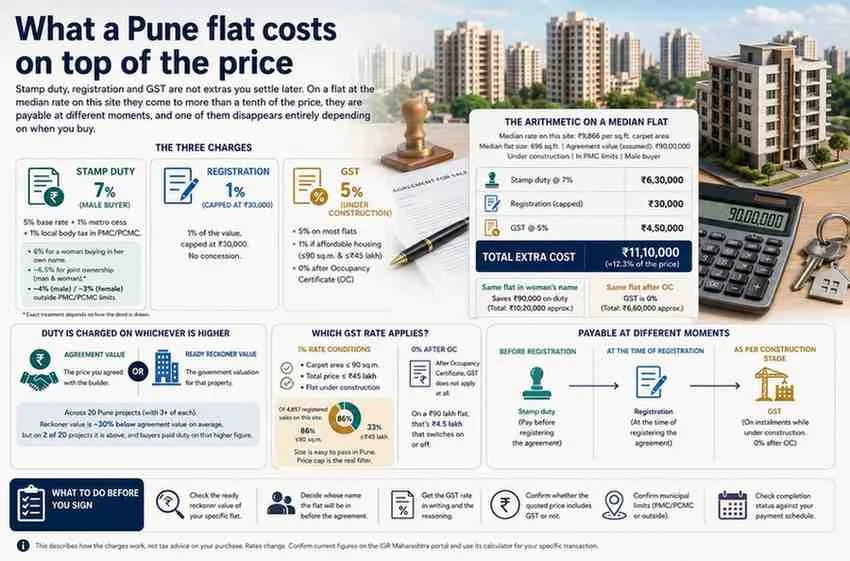
Stamp duty, registration and GST are not extras you settle later. On a flat at the median rate on this site they come to more than a tenth of the price, they are payable at different moments, and one of them disappears entirely depending on when you buy.
Every price on this site is the number written into a registered agreement. It is not what the flat cost the person who bought it.
Stamp duty, registration and GST sit on top, they are calculated on three different bases, and they fall due at three different moments. On a flat at this site's median rate the three together run past a tenth of the agreed price. That is not a rounding error at the end of a spreadsheet. It is the difference between a budget that works and one that does not, and it is routinely left out of the conversation in a sales office until the paperwork stage.
The three charges
Stamp duty is a state tax on the instrument, paid before you register. In PMC and PCMC limits it is seven percent for a male buyer: a five percent base rate, one percent metro cess and one percent local body tax. A woman buying in her own name pays six percent, the concession applying to the base rate only. Held jointly by a man and a woman it is generally taken at six and a half, though the exact treatment depends on how the deed is drawn and is worth confirming rather than assuming.
Outside those municipal limits the rate drops sharply — gram panchayat land is in the region of four percent for a man and three for a woman. Several projects on this site are on the wrong side of that boundary from their own postal address, which is one reason the locality pages name the revenue village rather than trusting the pincode.
Registration is one percent of the value, capped at ₹30,000. Above ₹30 lakh, therefore, it is simply a flat thirty thousand rupees. There is no concession on it, and unlike stamp duty it does not vary by who is buying.
GST applies only while a flat is under construction. Five percent on most of them, one percent if it qualifies as affordable housing, and nothing at all once the project holds its occupancy certificate. No input tax credit passes to you in either case.
What the duty is actually charged on
Not on your price. On whichever is higher of the agreement value and the government's ready reckoner value for that property.
Most buyers never notice this, because in a rising market the agreed price is the higher of the two and the duty simply follows the price. It matters in the cases where it is not — a flat bought at a genuine discount, a distress sale, a builder clearing unsold stock at the end of a project — where you can find yourself paying duty on a valuation several lakh above what you actually handed over.
The register lets this be checked rather than assumed, and the answer for Pune is reassuring with an edge to it. Promoters file an agreement value against every sold flat and a ready reckoner value against every unsold one, never both against the same unit, so the two have to be compared project by project.
Across the 2831 Pune projects listed here that have filed at least three of each, the reckoner value sits about 29 percent below what buyers actually registered. But not everywhere: on 274 of the 2831, the reckoner sits above what buyers agreed, and every buyer in those buildings paid duty on a number higher than their own price.
Ask for the reckoner value for your specific flat before you budget the duty. It is a public figure, it is available on the IGR Maharashtra portal, and the sub-registrar will apply it whether or not anybody mentioned it to you.
Which GST rate you land on, and why it is probably five
The one percent rate has two conditions and both must hold. The carpet area must be no more than 90 square metres, and the total price no more than ₹45 lakh.
The ninety is worth pausing on. The notification sets sixty square metres for metropolitan cities and ninety everywhere else, and its list of metropolitan cities is Delhi NCR, Bengaluru, Chennai, Hyderabad, Kolkata and the whole of the Mumbai region. Pune is not on it. Buyers here are frequently quoted the sixty figure by people who have read a Mumbai article.
That makes the size test easy to pass in Pune and the price cap hard.
Of the 274,772 registered sales on this site, 80 percent are flats of 90 square metres or less, so the size test is barely a test in Pune. Only 30 percent also come in at or under 45 lakh. The price cap is what decides this, not the floor plan.
The ₹45 lakh is the total consideration, not the base rate times the carpet area, so floor rise and parking and the rest of it count toward the cap that decides your rate. A flat priced at ₹44 lakh before extras and ₹47 lakh after them has moved from one percent to five, and the extras cost you four percent of the whole price on the way past.
The occupancy certificate is the switch
GST is charged because an under-construction flat is legally a construction service being sold to you. Once the project has its occupancy or completion certificate, what is being sold is immovable property, which sits outside GST under Schedule III of the CGST Act. Zero, not exempt-with-conditions.
On a ₹90 lakh flat that is ₹4.5 lakh, turning on and off according to a certificate. Two flats in the same building, the same price, bought a month either side of the OC, differ by four and a half lakh in tax.
This cuts both ways and it is not free money. A ready flat with its OC is usually priced higher precisely because the builder knows the buyer is saving the GST, and buying before completion is what gets you the earlier price and the construction-linked payment plan. The point is not that one is cheaper. It is that the sticker prices of an under-construction flat and a ready one are not comparable numbers, and most people compare them anyway.
If you are buying anywhere near completion, ask when the OC is expected and what happens to the GST on instalments falling due after it. Instalments paid before the certificate carry the tax. There is nothing improper about a builder collecting it — they owe it — but the timing is worth having in writing.
The arithmetic on a median flat
The median registered rate across the 274,772 sales on this site is ₹9,283 per square foot of carpet area, and the median flat is 686 square feet. Call it a round ₹90 lakh agreement value, under construction, in PMC limits, bought by a man.
- Stamp duty at seven percent: ₹6,30,000
- Registration, above the cap: ₹30,000
- GST at five percent: ₹4,50,000
₹11,10,000, or a shade over twelve percent on top of the price. The same flat in a woman's sole name saves ₹90,000 on the duty. The same flat after its occupancy certificate loses the GST line entirely and comes to ₹6,60,000.
None of that includes what your lender charges to process the loan, the society's formation and share money, the advance maintenance most builders ask for, or the legal fee for having somebody read the agreement. Those are smaller and they are real.
What to do before you sign
Ask for the ready reckoner value of your specific flat, not the project. If it is above your agreed price, your duty is calculated on the reckoner figure and your budget needs to say so.
Establish whose name the flat is going in before the agreement is drafted rather than after. One percent of a Pune flat is a meaningful sum and the concession is not available retrospectively.
Get the GST rate in writing along with the reasoning. If a builder is charging five percent on a flat you think is under both limits, ask which test they say it fails. If they are charging one percent, check it yourself, because you are the one exposed if the department disagrees later.
Ask whether the quoted price includes GST. "₹90 lakh all inclusive" and "₹90 lakh plus taxes" are four and a half lakh apart and both get said in the same tone of voice.
Confirm the municipal limits. Seven percent inside PMC or PCMC and roughly four outside is a three percent swing on a boundary that does not follow the postal address. The revenue village on the filing is the reliable indicator, and it is on every project page here.
Check the completion status against your payment schedule. Instalments falling after the occupancy certificate should not attract GST.
Where these numbers come from
The prices and carpet areas here are taken from promoters' filings with MahaRERA, read off the public register and updated as they change. None of it is estimated or supplied by a builder.
The tax rates are not from the register. Stamp duty, the metro cess, the local body tax and the registration cap are set by the State of Maharashtra and change with state budgets and notifications; GST rates are set by the GST Council. Everything above is the position as at the date on this page. Confirm the current figures on the IGR Maharashtra portal before you rely on them, and use its own calculator for your specific transaction.
This describes how the charges work. It is not tax advice on your purchase, and the treatment of joint ownership, resale, redevelopment and PMAY-linked purchases all differ from the straightforward case above. For anything with money at stake, ask an advocate or a chartered accountant who does Maharashtra property work.