What to consider before buying a flat in Pune
The factors that actually decide whether a flat works for you — why buy, budget, area, availability, waiting period, view and orientation, neighbours you cannot pick, builder quality, and the register checks that outlive any sales pitch. Keep this open while you shortlist.
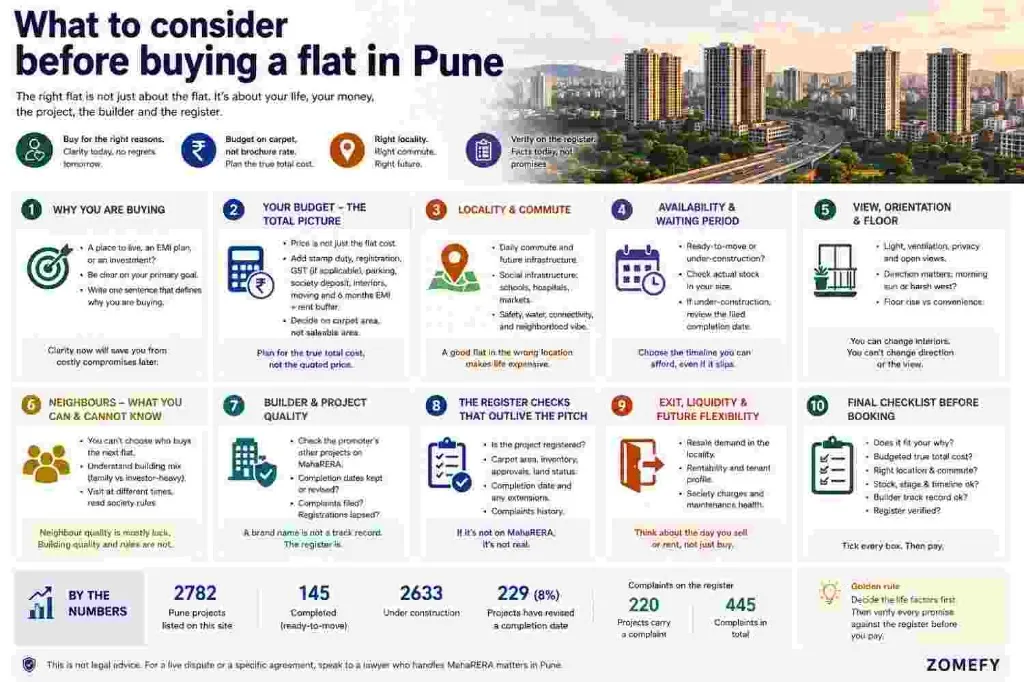
This is the page to keep open while you shortlist. Portals optimise for listings. Sales offices optimise for closing. You need a decision order that still works five years from now — when rates have moved, the brochure is gone, and only the flat and the society remain.
Everything below is written for Pune primary-market and ready-possession buys that show up on MahaRERA. Resale from an individual seller adds title and society NOC steps this piece only flags; it does not replace a lawyer.
Related deep-dives when you need them:
- What to read on MahaRERA before you pay
- Carpet area versus super built-up
- What a Pune flat costs on top of the price
- Best areas to buy a flat in Pune
- Delayed possession — what the register shows
- What a completion date actually promises
1. Why you are buying — write it down before you visit a site
A flat is not one product. It is three different products wearing the same brochure:
- A place to live — commute, schools, parents, noise, light.
- A forced savings plan — EMI instead of rent, with interest cost attached.
- An asset you might sell or rent — liquidity and tenant demand matter.
If you cannot say which of those is primary, the sales office will choose for you. Typical traps:
- Buying for "investment" in a pocket with thin resale and high society charges.
- Buying for living in a project whose only advantage is a launch discount and a completion date three years out.
- Stretching EMI to the bank's maximum when one income is uncertain.
Write one sentence: We are buying so that ___ by ___. Revisit it when a "limited units" pitch arrives.
2. Budget — the number that includes the boring costs
Start from monthly comfort, not from the bank's sanction letter. Sanction is a ceiling, not a target.
Build a total cash number
| Layer | What to include |
|---|---|
| Ticket | Agreement value on carpet, not the brochure rate on saleable area |
| Tax and duty | Stamp duty, registration; GST on under-construction where it applies |
| Parking and deposits | Covered parking if extra, society deposit, utility deposits |
| Making it liveable | Basic interiors, curtains, appliances, moving |
| Time buffer | Six months of EMI plus rent if possession can slip |
The median flat here is 686 square feet of carpet, so the median rate puts it at about ₹63.6 lakh. That is arithmetic on two medians rather than the price of any actual flat, but it is the right order of magnitude for what a mid-market Pune flat has been changing hands at.
City context on this register: the median registered rate across priced agreements sits around ₹9,283 per sq ft of carpet (274,772 agreements on file). That is a description of deals already done, not your quote.
Rules that keep you solvent
- Decide on carpet area and total outflow, never on "₹X per sq ft all-in" without asking which square feet.
- Keep a 20–25% cash buffer beyond down payment for the table above.
- If under-construction, price the risk that you pay EMI and rent together — delayed possession is common enough to plan for, not rare enough to ignore.
Open configuration pages (and locality × BHK pages) for registered median tickets in your size — "under ₹X lakh" bands where the data supports them — instead of trusting an asking range on a listing portal.
3. Area — locality is a lifestyle contract
Locality decides commute, weekend noise, school runs, and how easy the flat is to exit later. Brand towers in the wrong pocket still feel wrong every Monday.
What to lock before you fall for a sample flat
- Commute at your real hour — not the Sunday site visit.
- Daily infrastructure — water tanker dependence, power cuts, flooding history, hospital and school distance you will use.
- Future supply — a pocket with endless launches can stay "always new" and soft on resale; that is fine for living, worse for exit timing.
- Registered rates — 163 localities on this site already publish a median from enough agreements; 32 do not yet. Thin data is not the same as a bargain.
Use localities, compare two areas, and the best-areas guide to shortlist — then visit, do not skip the visit.
4. Availability — does your size actually exist?
Wanting a 3 BHK in a pocket that mostly filed 1 and 2 BHKs wastes months.
Check, in order:
- Configuration stock — unsold count and carpet band on the locality × BHK page (for example 2 BHK in Wakad).
- City-wide shape — 2 BHK / 3 BHK hubs show where unsold inventory concentrates.
- Project unit list on MahaRERA — floor, carpet, sold flag. Sales office "availability" should match the register.
1366 of the 5144 Pune projects here that declare a unit count have not registered a single sale, and the median project across all of them has sold 28 percent of its flats. An empty project is normal on a register this fresh rather than a warning in itself.
If nothing fits, that is information. Stretching to a wrong size because it is the only flat left is how people resent a home.
5. Waiting period — ready now versus filing a date
| Path | You gain | You accept |
|---|---|---|
| Ready to move | See the flat, society, water pressure; no construction wait | Higher ticket; resale negotiation; check OC and society health |
| Under construction | Usually lower entry; choice of floor and view early | Time risk; EMI + rent; change orders; date slippage |
On this register today: 846 completed, 4668 still building. Of the 5543 Pune projects listed on this site, 3918 have changed their completion date since registering. That is 71 percent. The biggest single change on record here is Neuleaf Techd, which moved by 12 years.
Practical rule: if you must move in under 12 months, prefer ready or a project whose filed completion is already behind you only if OC and fit-out reality check out. Do not buy a verbal "almost ready."
6. Side, view and orientation — what you can still choose
You rarely control who lives next door. You often still control which stack and facing you buy.
Prefer, all else equal
- Daylight and ventilation — corners and longer external walls beat a dark middle stack facing a shaft.
- Lower permanent noise — internal garden / courtyard / club-facing often beats an arterial road, a school PA system, or a wedding-lawn podium that runs late.
- Heat — west glass without shading cooks afternoon rooms in Pune; check overhangs and whether you will live with AC always on.
- Privacy — tower-to-tower distance matters more than a brochure "garden view" that is another living room at 12 metres.
Treat as trade-offs, not trophies
- Club / amenity view — pretty by day, event noise by night.
- Main road view — light and "open", with horns and dust.
- Lower floors on garden — mosquitoes, less breeze, easier for elderly.
- High floors — view and breeze, more lift dependence, wind noise.
Visit the actual flat or mirror flat at the hour you will be home. Sample flats are lit and staged for a reason.
7. Neighbours — what you cannot pick, and what you still can
You do not get a veto on the next allottee. Anyone who promises "only families like you" is selling comfort, not a contract.
What you can influence
- Building mix — investor-heavy inventory often means more rentals and turnover; not bad, just different. Read sold vs unsold and how long the project has been selling.
- Age of society — older societies have visible maintenance culture; new ones are a bet on the first committee.
- Rules — pet policy, tenant screening, festival and music rules (ask for draft bye-laws where they exist).
- Complaint pattern — clusters of MahaRERA complaints can signal process failure that spills into living stress. 729 of the 5543 Pune projects listed on this site carry a complaint, 3194 in total, and Godrej Meadows accounts for 98 of them. A project with none is a project nobody has complained about, which is not the same as a project with nothing wrong.
- Evening visit — parking fights, horn use, and smoking in corridors show up after 7 pm, not at noon with the sales manager.
What you must accept
Personality, politics, and the family that buys after you. Design for building quality and distance (thicker walls, decent planning) rather than fantasy neighbours.
8. Builder quality — brand is optional; track record is not
3251 of the 3970 promoters behind the projects listed here have registered exactly one, which leaves 719 with a second project you could compare it against. For nine builders in ten there is no track record on this register to check, because this is the record.
Read the promoter like a credit file
On each shortlisted project and on the builder pages:
- How many projects delivered vs still open.
- Whether completion dates were kept, revised, or allowed to go overdue.
- Complaint count and what they were about (possession, quality, refunds).
- Whether the legal promoter entity matches the brand on the hoarding.
A first-project SPV is normal in this market. It is not a reason to walk away by itself — it is a reason to lean harder on title, escrow, and the written agreement date.
9. Other factors that decide regret later
Work through these before you negotiate price. Price is the wrong first variable.
Product and papers
- Carpet vs loading — carpet guide. Same "rate", different home.
- Title and encumbrance — title papers. No clean chain, no booking.
- Approvals — commencement certificate; for ready, occupancy certificate. Ask to see them, not summaries.
- Floor plan efficiency — carpet wasted in long corridors and dead corners; measure furniture against the real plan.
- Parking — one dependent space per flat is not the same as two stacked puzzle lifts you will hate daily.
Money and exit
- Loan — bank valuation can come in below agreement value; keep margin.
- Resale / rent demand — ask three local brokers what actually sold in 12 months in that society, not what is listed.
- Society charges — high amenities raise monthly outgo forever.
- Ready reckoner and stamp — government value vs what buyers paid.
Livability
- Water source and tanker frequency in summer.
- Mobile and broadband reality inside the flat.
- Flood lines and hill-cut slopes after rains.
- Distance to something you use weekly — not the mall on the brochure map.
10. A one-page checklist before the booking amount
Print this. Tick it offline.
Intent
- [ ] Written reason for buying (live / invest / both — with priority)
- [ ] Latest move-in deadline you can survive if the date slips
Money
- [ ] Total cash including duty, GST if any, parking, interiors, buffer
- [ ] EMI at stressed rate (rate +2%) still sleeps-at-night
- [ ] Ticket checked against carpet and against registered locality medians
Place
- [ ] Locality shortlist ≤3; commute tested at peak
- [ ] Size exists unsold on register, not only in the pitch
Time
- [ ] Ready vs under-construction chosen deliberately
- [ ] Filed completion date read; revisions and overdue status checked
Unit
- [ ] Stack, floor, facing seen (or true mirror flat)
- [ ] Noise and light checked at evening
- [ ] Parking type accepted
People and promoter
- [ ] Builder page reviewed for delays and complaints
- [ ] Society / mix expectations set (no fantasy neighbours)
- [ ] MahaRERA registration matches the tower being sold
Papers
- [ ] Nine MahaRERA reads done
- [ ] Agreement possession date and delay clause understood
- [ ] Lawyer reviewed for anything you do not understand
If more than two boxes stay empty because "the discount ends tomorrow," the discount is doing its job — on the seller.
How to use this site with this checklist
| Question | Where |
|---|---|
| What did buyers pay in this locality / BHK? | Locality and configuration pages |
| What is still unsold? | Project inventory; city 2 BHK / 3 BHK hubs |
| Can I move sooner? | Ready to move |
| What is still building? | Under construction |
| Who is late? | Delayed possession |
| Who is this promoter? | Builders |
Figures on this site come from promoters' MahaRERA filings and rebuild as those filings change. They are not asking prices and not advice to buy any one project.
What this article is not
Not investment advice. Not a ranking of "best" societies. Not a substitute for a site visit, a bank valuation, or a lawyer on your agreement. It is a durable order of questions — so the brochure never sets the agenda for you.
Common questions
- What should I check before buying a flat in Pune?
- Start with why you are buying, a total budget (flat plus stamp, GST where due, interiors and EMI buffer), locality and commute, whether stock exists in your size, ready-to-move versus waiting, orientation and noise, the promoter's delivery record, and the MahaRERA filing for carpet area, dates and complaints. This guide walks those in order.
- Is it better to buy ready-to-move or under-construction?
- Ready-to-move removes construction risk and waiting; under-construction usually costs less per foot and ties you to a filed completion date. On this register there are 846 completed projects and 4668 still under construction. Choose the timeline you can actually fund if the date slips.
- How do I judge a builder if I cannot trust the brochure?
- Prefer the promoter's other MahaRERA projects — completion dates kept or revised, complaints filed, and how often registrations lapse. A brand name is not a track record; the register is. Open the builder page for every promoter on your shortlist.
- Can I choose good neighbours when buying a flat?
- You cannot pick who buys the next flat. You can choose building age and mix (family vs investor-heavy stock), visit at evening noise hours, read society rules where they exist, and avoid projects with heavy complaint clusters. Neighbour quality is mostly luck; building quality and rules are not.
- What budget should I plan beyond the quoted flat price?
- Add stamp duty and registration, GST on under-construction where applicable, parking if extra, society deposit, interiors, moving, and six months of EMI plus rent if possession can slip. The quoted rate is usually on saleable area; decide on carpet. See the guides on top-of-price costs and carpet versus super built-up.