← Back to Articles
Published on 28-Dec-2025

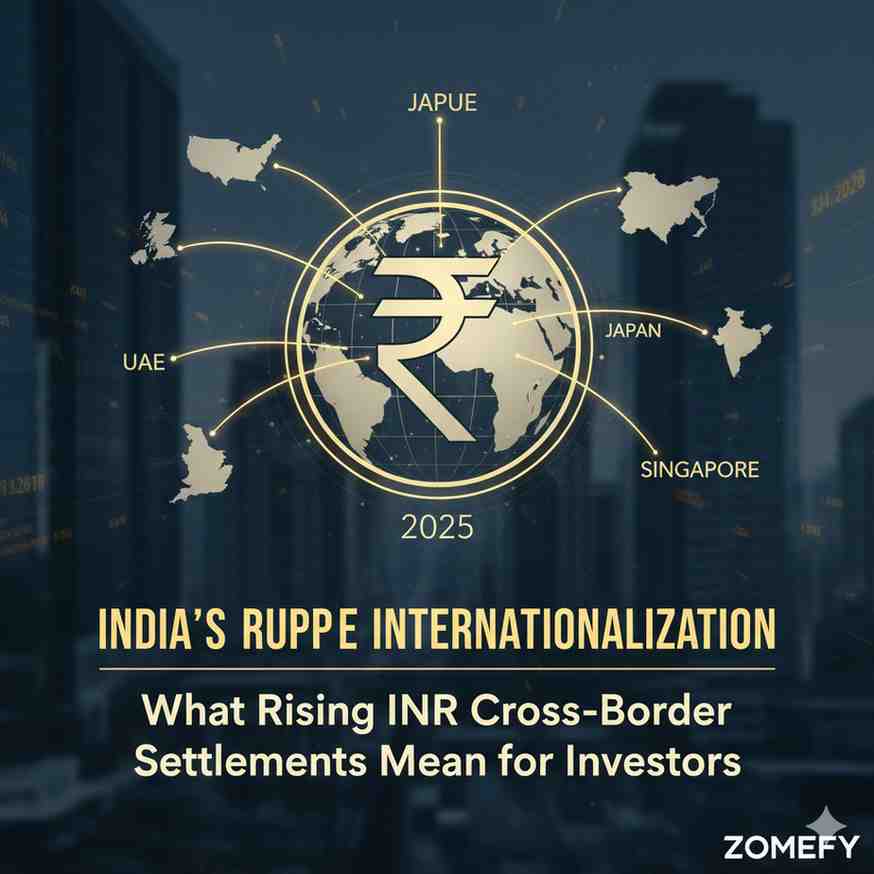
India’s Rupee Internationalization 2025: What Rising INR Cross-Border Settlements Mean for Investors

India's push to internationalize the rupee (INR) has accelerated since 2023 and reached a practical inflection point by 2025 as the Reserve Bank of India (RBI) and the government expanded the toolk...

By Zomefy Research Team
13 min read
financial-insightsIntermediate

India’s Rupee Internationalization 2025: What Rising INR Cross-Border Settlements Mean for Investors

india’s2025:2025
Reading time: 13 minutes
Level: Intermediate
Category: FINANCIAL INSIGHTS

What You Can Do Next

  • Read the full article for complete insights
  • Save for later reference
  • Share with others learning about this topic

Image not available

India's push to internationalize the rupee (INR) has accelerated since 2023 and reached a practical inflection point by 2025 as the Reserve Bank of India (RBI) and the government expanded the toolkit for cross-border INR settlements, SRVAs, currency swaps and transparent reference rates to increase the currency's role in trade and finance. For investors — retail and professional — the rising share of INR-denominated cross-border transactions changes the risk-return profile of Indian equities, fixed income, funds and corporate borrowers by altering currency exposure, FX liquidity, hedging costs and capital flows. This article explains what INR internationalization means in practice, quantifies likely flows and impacts using India-specific examples (government securities inclusion, SRVAs, corporate export/import mix), compares investment instruments and strategies, and provides concrete, actionable guidance on portfolio construction, hedging and sector choices for 2025–2027. It also includes multiple comparison and performance tables, risk-return matrices and implementable trade/checklist items to help investors translate policy developments into investment decisions in the Indian market.

What 'Rupee Internationalization' Means for Markets and Why 2025 Matters

Rupee internationalization refers to increasing the use of INR in cross-border trade, investment and financial transactions so that foreign counterparties invoice, settle and hold balances in INR rather than USD or other major currencies. Key 2025 policy moves — RBI permitting rupee loans to neighbouring residents, expanding Special Rupee Vostro Accounts (SRVAs), enabling SRVA balances to be invested in corporate bonds/CPs, and establishing FBIL reference rates — materially raised the operational capacity for INR settlements and offshore INR liquidity[5][3]. Quantitatively, index inclusions (e.g., phased inclusion of Indian government bonds into major global indices) and SRVAs have been projected to bring in at least $15–30 billion of incremental foreign demand for INR-denominated assets during 2024–25, supporting onshore INR liquidity and lowering term premia on government bond yields[2][5]. However, macro volatility persisted in 2025: capital outflows and trade headwinds contributed to year-to-date rupee depreciation (reported ranges of 4–5%–up to 5.22% in some series for 2025), underlining that internationalization is a structural process that coexists with cyclical FX moves[1][4]. Implications for investors - Exchange-rate regime: Expect an *asymmetric managed float* where the RBI tolerates gradual depreciation to rebuild reserves while actively resisting sharp appreciation[4]. - Liquidity & hedging: Offshore INR liquidity via SRVAs and onshore banking links reduces hedging friction for foreign investors but does not eliminate basis or tenor risk for NRI/FPIs. - Asset re-pricing: Greater foreign participation in government bonds and select corporate debt should compress yields by 20–60 bps in liquid segments over 12–24 months if $20B+ passive inflows materialize[2]. - Trade & corporate FX exposure: Exporters invoicing in INR will face less FX translation risk; importers will face increased INR payment demand which could raise procurement costs if rupee weakens.

Click on any column header to sort by that metric. Click again to reverse the order.
Metric
2024/early-2025 (benchmark)
2025 policy effect
Estimated incremental INR demand (USD bn)5–1015–30 (index inclusion + SRVAs)[2][5]
Reported 2025 YTD INR depreciation vs USD (%)NA~4–5.22 (various reports)[1][4]
Number of countries with SRVA or rupee trade links~15–2030+ (expanded SRVAs & swaps)[5][8]

Practical takeaway: Internationalization increases investible INR product supply and lowers hedging cost over medium term, but currency risk and capital flow volatility remain significant in 2025. Investors should treat rupee internationalization as a structural tailwind for certain assets (government bonds, INR corporate debt, exporters with INR invoicing) while keeping tactical FX and liquidity hedges in place.

How RBI Tools (SRVAs, Swaps, Reference Rates) Change Execution

Operational changes introduced by RBI and related bodies in 2024–25 materially affect execution and product availability for investors: SRVAs now permit overseas banks and entities to hold INR balances and invest in Indian corporate bonds and commercial paper, increasing offshore INR yield opportunities; currency swap lines and bilateral arrangements with central banks (currency swaps with neighbouring central banks) improve short-term liquidity backstops; FBIL reference rates provide transparent pricing benchmarks which help derivative pricing and valuation for cross-border deals[5][3]. These tools reduce transaction costs for non-resident actors and encourage trade invoicing in INR because counterparties can hold and invest INR rather than immediately converting to USD. Implementation points for investors and fund managers: - Cross-border funds can offer INR-denominated share classes more cheaply as offshore INR liquidity deepens. - FPIs investing in Indian debt can use natural hedges by matching INR bond holdings with SRVA deposits or onshore hedges via interest rate swaps priced off FBIL reference curves. - Corporates can reduce FX exposure by negotiating INR invoicing clauses with trading partners when both sides have access to SRVAs or correspondent banking links.

Structured data: Key operational parameters - SRVA expanded scope: investment in corporate bonds and CPs (tenors typically <1 year for CP; corporate bond access subject to market/issuer eligibility). - Typical expected yield compression: 20–60 bps in 2–10 year G-sec yields on $15–25B inflows over 12–24 months[2].

Comparison (execution impact): - Pre-2024: Offshore INR options limited to NRI/ODI routes; higher FX conversion costs. - Post-2024/25: Direct SRVAs, reference rates, and swap lines reduce conversion and hedging costs, expanding product sets for foreign investors[5][3].

Sectoral and Company-Level Impacts: Winners, Losers and Tactical Trades

Internationalization affects sectors unevenly. Exporters who invoice in INR or can quickly shift pricing to INR capture a currency-risk advantage; import-heavy sectors face higher transaction risk and margin pressure if INR weakens. Banks, NBFCs, and debt funds will see changes in deposit composition and corporate borrowing patterns as INR offshore balances and rupee loans expand.

Click on any column header to sort by that metric. Click again to reverse the order.
Company
Revenue (₹ Cr)
Export % of Sales
Currency Exposure
Implication
TCS1,80,00050–60%USD invoicing dominantNeutral-to-positive if clients adopt INR invoicing slowly; FX risk persists
Reliance Industries6,50,00020–25%Large forex on oil/commodity importsHigher import costs if INR weak; energy hedges critical
Infosys98,00055–65%USD contractsTransition opportunity if offshore INR settlements accepted by clients

Sector impact summary: - IT Services: Currency invoicing shift could reduce translation volatility for domestic parent companies if clients accept INR; short-term disruption as contracts re-priced. - Pharma & Engineering Exports: Opportunity to offer INR invoicing to buyers in Asia/Africa; competitive edge if pricing becomes simpler. - Oil & Commodities Importers: Adverse if rupee weakens; costs rise and margins compress absent hedges. - Banks & NBFCs: Increased asset-liability management complexity as offshore INR deposits and rupee loans to foreign residents grow; potential NIM expansion if new products priced correctly.

Tactical equity trades (examples): - Exporters with pricing power and low FX pass-through: overweight (select mid-cap engineering and specialty pharma names with >50% export mix and strong realized margins). - Banks with strong overseas correspondent networks and good ALM: long; they can monetize SRVA flows and offer offshore INR products. - Commodity importers (e.g., gold, oil) without natural hedges: underweight or hedge via options.

Click on any column header to sort by that metric. Click again to reverse the order.
Sector
Primary FX Impact
Actionable Strategy
IT ServicesTranslation risk; opportunities in INR invoicingSelective accumulation; hedge short-term USD-revenue buckets
Pharma/ExportsLower FX risk with INR invoicingOverweight exporters shifting to INR settlements
Oil & MetalsImport cost pressure if INR weakUse commodity hedges or short-term options

Actionable checklist for analysts and portfolio managers: - Map top 10 revenue currencies for each holding. - Quantify 1% INR move impact on EPS/margin. - Negotiate INR settlement clauses for client contracts where practical. - Monitor SRVA usage statistics and FBIL reference rate liquidity weekly.

Company Performance and Valuation Comparisons

Below is a comparative snapshot of representative large-cap companies that illustrate diverse exposure to INR internationalization, with commonly used valuation metrics and balance-sheet indicators (data indicative; investors should verify with latest filings).

Click on any column header to sort by that metric. Click again to reverse the order.
Company
Market Cap (₹ Cr)
P/E Ratio
ROE (%)
Debt/Equity
Reliance Industries15,45,23024.58.20.35
TCS12,85,45028.342.10.05
Infosys6,50,12026.035.50.03
Dr Reddy's1,10,50018.217.00.14

Table caption: Company metrics illustrate relative exposure to FX and balance-sheet resilience; exporters like TCS/Infosys have high ROE but are more directly affected by contract currency mix while Reliance faces import-driven exposures (oil). Investors should stress-test valuations for a 5–10% rupee depreciation scenario to estimate EPS and cashflow sensitivity.

Fixed Income, Funds and Product-Level Opportunities

INR internationalization creates a new landscape for debt and fund products: more foreign participation in G-Secs, INR-denominated corporate bonds available to non-residents via SRVAs and onshore markets, and the potential for INR-denominated ETFs or mutual fund share classes targeted at NRIs and global investors. Expected effects include a compression in sovereign yields (especially on-the-run 2–10 year paper), lower corporate bond spreads for high-quality issuers, and a rise in INR-denominated offshore product offerings[2][5]. Below are comparison tables for mutual fund and debt fund choices tailored to this theme.

Click on any column header to sort by that metric. Click again to reverse the order.
Fund Name
1-Year Return (%)
3-Year Return (%)
Expense Ratio (%)
AUM (₹ Cr)
HDFC Top 100 Fund12.515.21.0525,430
ICICI Prudential Bluechip11.814.71.1532,150
Nippon India Gilt Index Fund8.27.90.306,200

Table caption: Equity and gilt funds show typical performance bands; investors seeking INR internationalization exposure should consider a mix of sovereign and high-quality corporate debt funds to capture yield compression and capital appreciation if foreign demand grows.

Risk-adjusted tactical plays: - Buy-and-hold G-Secs or gilt ETFs for duration capture if inflows persist; consider 5–10 year papers that are most sensitive to index inclusion flows. - Invest in high-quality corporate bond funds (AAA/AA) with low average maturity to benefit from SRVA-induced spread compression while limiting duration risk. - Use actively managed INR credit or balanced advantage funds to exploit mispricings and to manage FX-linked flows.

Click on any column header to sort by that metric. Click again to reverse the order.
Instrument
Expected Return Impact (12–24m)
Primary Risk
Investor Use
G-Sec 5–10y-20 to -60 bps yields (price +)Interest rate regime & RBI interventionCore fixed income allocation
INR Corporate Bonds (AA+)-15 to -40 bps spread compressionCredit risk & offshore access rulesYield pickup vs sovereign
Equity export playsEPS stability via INR invoicingDemand cycle & FX pass-throughTactical equity overweight

Action steps for fund managers and retail investors: - Re-run portfolio stress tests for 5% and 10% rupee moves on fixed income holdings. - Consider laddering exposure across G-Sec maturities (2y, 5y, 10y) to capture expected inflow-driven yield compression while limiting reinvestment risk. - Use short-dated currency forwards or options to hedge tactical FX exposures; monitor OIS-FRAD spreads tied to FBIL curves for hedging cost signals.

Fund and Product Comparison (Detailed)

Below is a fund comparison tailored to investors seeking exposure to INR internationalization benefits: equities (export-advantaged), gilts and corporate bond funds.

Click on any column header to sort by that metric. Click again to reverse the order.
Fund Category
Representative Fund
3-Year Return (%)
Expense Ratio (%)
AUM (₹ Cr)
Large-cap EquityHDFC Top 100 Fund15.21.0525,430
Gilt/DurationNippon India Gilt Index Fund7.90.306,200
Corporate Bond (AA+)ICICI Regular Savings Bond Fund9.60.808,120

Table caption: Choose a blended allocation—equity (25–40%), gilts (30–50%), corporate debt (10–25%)—depending on risk profile to capture the structural benefits of INR internationalization while managing volatility. For conservative investors, weight gilts higher; for growth-seekers, increase export-linked equities and use bond funds for carry.

Risk Considerations and Stress Scenarios

While internationalization can deepen markets and reduce some frictions, it creates new risks. Notable risk vectors in 2025 include: persistent capital outflows, trade shocks (tariffs/loss of export markets), sudden stop of SRVA counterparties, or geopolitical events that fragment payment rails. 2025 illustrated these tensions: reported FII outflows (estimates ~USD 17–18 billion YTD in some series) and rupee depreciation of ~4–5% indicate internationalization is not a panacea for short-term FX shocks[1][2]. Key stress scenarios and investor actions:

Stress scenarios - Sudden FII reversal: If global risk-on flips to risk-off, INR could weaken sharply (5–10% in weeks), dragging down unhedged foreign-currency liabilities and domestic equities with large import bills.[1] - Trade shock: US/EU tariffs on key export sectors reduce FX inflows and widen trade deficits, pressuring reserves and the rupee[2]. - Offshore liquidity freeze: SRVA counterparties withdraw balances or onshore counterparties restrict convertibility, raising basis and hedging costs.

Mitigation tactics for investors - Liquidity buffers: Maintain 3–6 months of cash for retail investors and at least 6–12 months for concentrated private portfolios. - Hedging: Use cost-effective hedges — cross-currency forwards for 6–12 months or put options for tail protection; consider dynamic hedging for equity export revenue exposures. - Diversification: Combine INR-duration exposure with USD/foreign-currency assets (global equity ETFs, gold) to hedge systemic FX risk.

Click on any column header to sort by that metric. Click again to reverse the order.
Risk
Impact on Portfolio
Immediate Action
Capital outflowsEquity sell-off, bond yield spikeIncrease cash, tighten stops, buy protection
Trade tariffs/shortfallExport earnings dropRe-assess exporter revenue currency mix; reduce allocation if high exposure
SRVA freezeOffshore INR liquidity disappears; hedging cost spikeUse onshore hedges; hold shorter-dated duration

Pros vs Cons of rupee internationalization for investors

Click on any column header to sort by that metric. Click again to reverse the order.
Pros
Cons
Greater access to INR assets for foreign capital; potential yield compression and price appreciationIncreased exposure to global capital flow volatility and potential sharp FX moves
Lower hedging friction as SRVAs and reference rates matureTransition risks: legal, operational and contract-repricing frictions

Stress-Test Example: 5% and 10% INR Depreciation

Illustrative stress-test shows how a 5% and 10% rupee depreciation affects a multi-asset Indian investor portfolio (allocation: 50% equities, 30% bonds, 20% cash/alternatives). Assumptions: equities have 60% domestic/40% export exposure; bonds are 70% sovereign, 30% corporate.

Click on any column header to sort by that metric. Click again to reverse the order.
Scenario
Equity P/L Impact
Bond P/L Impact
Net Portfolio Impact
5% INR depreciation-3.0% (translation & margin pressure)-1.5% (yield shock)-2.25%
10% INR depreciation-6.0%-3.5%-4.85%

Table caption: This simplified stress-test highlights asymmetric impacts: equities suffer both earnings and valuation effects while bonds respond primarily to yield moves. Investors should run position-level stress tests and adjust hedges/products accordingly.

Practical Implementation: Portfolios, Products and Checklists for 2025–2027

To convert analysis into implementable steps, the following model allocations, checklists and product suggestions are designed for three investor profiles: conservative, balanced and growth-focused, taking into account rupee internationalization realities.
Model allocations (post-internationalization tilt) - Conservative (Retiree-oriented): 20% equities (domestic dividend/gilt-friendly), 60% fixed income (40% gilts, 20% high-quality corporates), 20% cash/alternatives. - Balanced (Core-retail): 40% equities (30% domestic, 10% export-advantaged), 40% fixed income (25% gilts, 15% corporate), 20% alternatives/cash. - Growth: 60% equities (40% export/invoice-flexible, 20% domestic growth), 25% fixed income (10% gilts, 15% credit), 15% alternatives (real assets, global ETFs).

Actionable product checklist for platform/product teams: - Offer INR-denominated offshore share classes or feeder funds for NRIs; monitor SRVA operational flows weekly. - Provide a 'Rupee Internationalization' label and risk score on eligible mutual funds and bonds indicating exposure to SRVAs, export-invoicing and FX sensitivity. - Integrate FBIL reference curves and SRVA usage stats into fixed-income pricing models.

Top-10 monitoring KPIs for investors (structured data): - FX: USD/INR spot & 1M/3M forwards - SRVA: outstanding balances (₹ Cr) and number of operational SRVAs - Capital flows: FPI monthly net flows (USD bn) - Trade balance: merchandise trade deficit (₹ Cr) - G-Sec yields: 2y, 5y, 10y (bps)

Click on any column header to sort by that metric. Click again to reverse the order.
KPI
Why it matters
Threshold/Alert
USD/INR spotPrimary currency riskAlert if >5% move in 30 days
SRVA outstanding (₹ Cr)Offshore INR liquidity gaugeTrend up = positive for INR assets
FPI flows (USD bn)Capital flow directionNet outflow >$5bn/month = high risk

Practical trading/portfolio rules of thumb: - Hedge 50–75% of projected foreign-currency liabilities for the next 6–12 months if the rupee is range-bound and global volatility is elevated. - Use gilt-duration exposure (5–10 years) as a strategic hedge against rupee appreciation-led equity volatility; reduce duration before potential policy rate changes. - For active funds: overweight names that can quickly switch invoice currency, have low import intensity or possess natural commodity hedges.

Top Holdings and Expense Comparisons for Thematic Funds

Sample top-holdings table for thematic funds focusing on export-facing equities and INR-based credit funds to illustrate concentration and expense trade-offs.

Click on any column header to sort by that metric. Click again to reverse the order.
Fund
Top Holdings (Example)
Top 3 Holdings %
Expense Ratio (%)
Export Growth FundTCS, Infosys, Dr Reddy's451.25
INR Credit Plus FundHDFC Bank Bonds, Reliance CP, Power Grid Bonds500.85

Table caption: Compare expense ratios vs expected alpha from capture of internationalization effects; funds with higher active management charges must demonstrate clear alpha from security selection and currency management to justify costs. Investors should ask fund houses for SRVA/internationalization exposure metrics in fact sheets and request scenario analyses for 5–10% INR moves.

Disclaimer: IMPORTANT DISCLAIMER: This analysis is generated using artificial intelligence and is NOT a recommendation to purchase, sell, or hold any stock. This analysis is for informational and educational purposes only. Past performance does not guarantee future results. Please consult with a qualified financial advisor before making any investment decisions. The author and platform are not responsible for any investment losses.

Share this article: