← Back to Articles
Published on 09-Jan-2026

Zepto 2025: Dark Stores, Subscription Loyalty and the New Economics of Indian Quick Commerce

India's quick commerce sector has undergone a seismic transformation, with Zepto emerging as one of the most aggressive players reshaping the landscape of instant delivery.

By Zomefy Research Team
15 min read
startup-unicornIntermediate

Zepto 2025: Dark Stores, Subscription Loyalty and the New Economics of Indian Quick Commerce

financial insightsinvestment strategymarket analysis
Reading time: 15 minutes
Level: Intermediate
Category: STARTUP UNICORN

What You Can Do Next

  • Read the full article for complete insights
  • Save for later reference
  • Share with others learning about this topic

Image not available

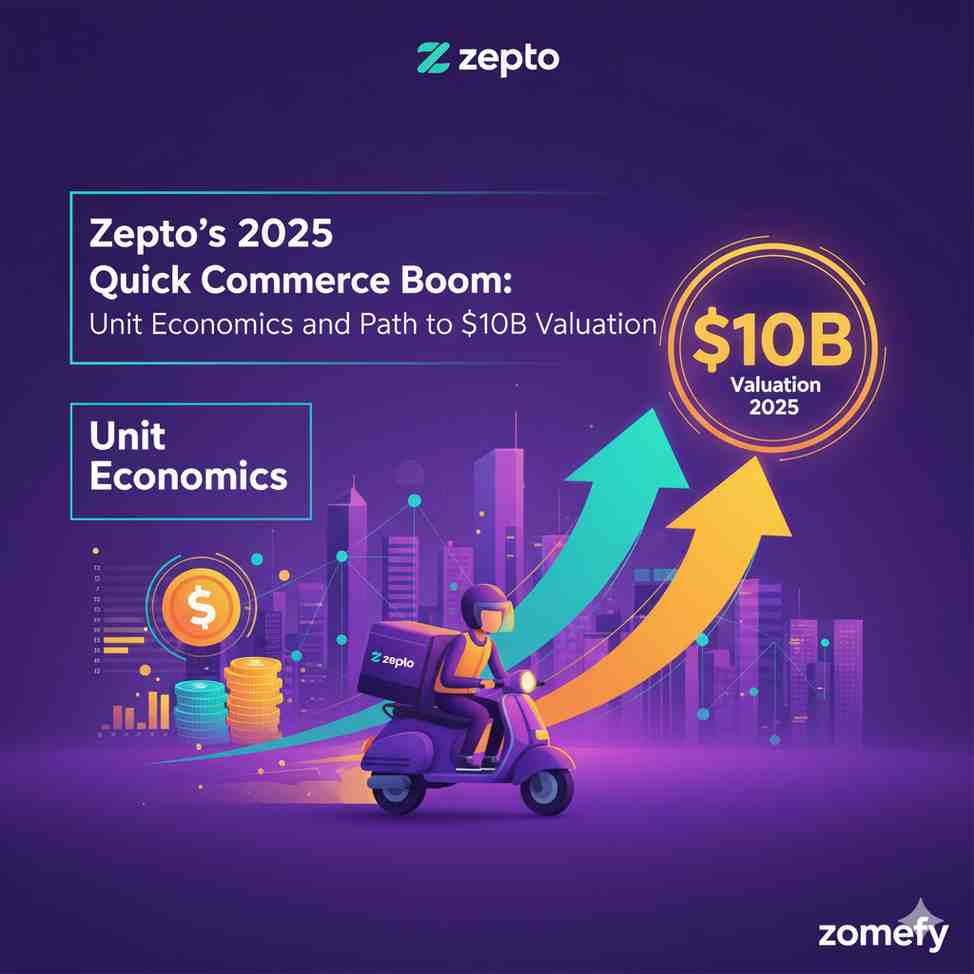
India's quick commerce sector has undergone a seismic transformation, with Zepto emerging as one of the most aggressive players reshaping the landscape of instant delivery. In FY25, Zepto reported total sales of Rs 9,668.8 crore, a staggering 129% year-on-year increase, yet simultaneously expanded its net losses by 177% to Rs 3,367.3 crore. This paradox—explosive growth coupled with accelerating losses—defines the new economics of Indian quick commerce. As Zepto prepares for its IPO confidential filing in December 2025, the company stands at an inflection point where dark store proliferation, subscription loyalty models, and unit economics optimization will determine whether rapid scaling translates into sustainable profitability. For Indian investors, understanding Zepto's strategic pivot and the sector's evolving dynamics is critical to evaluating both the opportunity and the risks inherent in this high-growth, capital-intensive business model.

The FY25 Performance Paradox: Growth vs. Profitability

Zepto's FY25 financial results present a compelling case study in the tension between growth and profitability that defines India's startup ecosystem. The company's total sales reached Rs 9,668.8 crore, more than doubling from Rs 4,223.9 crore in FY24. However, this impressive topline growth masks a concerning underlying trend: net losses expanded even faster, jumping 177% to Rs 3,367.3 crore compared to Rs 1,214.7 crore in the previous year. This means losses now represent approximately 35% of turnover, up from 29% in FY24—a deteriorating loss-to-revenue ratio that signals intensifying competitive pressure and rising operational costs. The quick commerce sector's unique accounting structure adds another layer of complexity. In quick commerce, companies typically recognize only 15-20% of gross merchandise value (GMV) as reported revenue. On this basis, Zepto's operational revenue for FY25 is estimated between Rs 1,495 crore and Rs 1,994 crore, despite reporting close to Rs 10,000 crore in total sales. This accounting distinction is crucial for investors: the reported revenue figure inflates the apparent scale of the business, while the actual operational revenue reveals a more constrained profitability picture. The widening loss margin reflects Zepto's aggressive expansion strategy, which prioritizes market share acquisition and customer retention over near-term profitability. The company has invested heavily in dark store infrastructure, customer acquisition costs, and competitive pricing to defend its position against rivals Blinkit (owned by Swiggy) and Instamart (owned by Reliance). This burn-first approach is characteristic of venture-backed startups, but the accelerating losses raise questions about the sustainability of this model as the company approaches public markets.

Comparative Financial Performance: Zepto vs. Competitors

Zepto's financial trajectory must be contextualized within the competitive quick commerce landscape. While Zepto achieved 129% revenue growth in FY25, its profitability metrics lag behind peers in certain dimensions. Blinkit, owned by Swiggy, reported FY25 revenue of Rs 5,206 crore, significantly higher than Zepto's estimated operational revenue of Rs 1,495-1,994 crore. However, Blinkit's higher reported revenue reflects its earlier market entry and established customer base. Swiggy's consolidated revenue for FY25 reached Rs 2,252 crore, indicating the broader ecosystem's monetization challenges. The competitive intensity has accelerated post-FY25, with all major players aggressively expanding dark store networks and investing in technology infrastructure. Zepto's $450 million fundraise prompted rivals to accelerate their own expansion, creating a sector-wide arms race in capital deployment. For investors, this competitive dynamic suggests that near-term profitability across the sector remains elusive, with market consolidation likely determining winners and losers in the medium term.

Click on any column header to sort by that metric. Click again to reverse the order.
Metric
Zepto FY25
Blinkit FY25
Swiggy FY25
Reported Revenue (₹ Cr)9,668.85,2062,252
Estimated Operating Revenue (₹ Cr)1,495-1,994~781-1,041~338-450
Net Loss (₹ Cr)3,367.3Not disclosedNot disclosed
Loss as % of Revenue35%TBDTBD
YoY Revenue Growth129%UndisclosedUndisclosed

Dark Stores: The Infrastructure Backbone of Quick Commerce Economics

Dark stores—fulfillment centers designed exclusively for quick commerce deliveries rather than walk-in retail—have become the critical infrastructure asset differentiating successful quick commerce players from aspirants. Zepto's aggressive expansion into dark store networks reflects management's conviction that scale in logistics infrastructure is essential to achieving unit economics breakeven. A dark store typically operates with 3,000-5,000 SKUs (stock keeping units), compared to 30,000-40,000 in traditional supermarkets, enabling rapid inventory turnover and reduced holding costs. The economics of dark stores are fundamentally different from traditional retail: they prioritize speed and density over margin, with the goal of serving a defined geographic radius (typically 2-3 km) within 10-15 minutes. For Zepto, dark store proliferation serves multiple strategic objectives. First, it reduces delivery times, which directly impacts customer retention and repeat purchase frequency—critical metrics in a market where switching costs are minimal. Second, dense dark store networks create geographic moats, making it economically difficult for competitors to enter saturated markets. Third, dark stores enable better inventory management and reduce waste, theoretically improving contribution margins as scale increases. However, the capital intensity of dark store expansion creates a profitability paradox: while each incremental dark store theoretically improves unit economics, the aggregate capital deployment required to build network density pushes the company deeper into losses in the near term. Zepto's FY25 losses of Rs 3,367 crore likely reflect substantial capital expenditure on dark store infrastructure, technology systems, and working capital. The company's path to profitability depends on achieving a critical mass of dark stores where incremental revenue growth exceeds incremental costs—a threshold that remains uncertain given sector-wide competitive intensity.

Dark Store Economics: Unit-Level Profitability Analysis

Industry analysts estimate that a mature dark store in a high-density urban market can achieve positive unit economics within 12-18 months of operation. Key metrics include: average order value (AOV), order frequency per customer, delivery cost per order, and customer acquisition cost (CAC). In Zepto's case, the company's rapid expansion suggests confidence in these unit economics, but the widening loss margin indicates that new store productivity may be lagging expectations or that competitive pricing pressures are eroding margins faster than anticipated. A typical high-performing dark store in tier-1 cities (Delhi, Mumbai, Bangalore) might achieve:

• AOV: ₹400-600 per order • Daily orders per store: 800-1,200 • Delivery cost: ₹40-60 per order • Customer acquisition cost: ₹200-400 (amortized over 12 months) • Contribution margin (after delivery and fulfillment): 15-25%

For Zepto to achieve profitability, the company needs to optimize these metrics while maintaining competitive pricing. The challenge is that all three major players (Zepto, Blinkit, Instamart) are competing aggressively on price, which compresses margins and extends the payback period for dark store investments. This creates a prisoner's dilemma dynamic where no player can unilaterally raise prices without losing market share. The resolution likely involves either market consolidation (reducing competitive intensity) or the emergence of differentiated value propositions beyond price—such as exclusive products, subscription loyalty models, or integration with adjacent services.

Click on any column header to sort by that metric. Click again to reverse the order.
Dark Store Metric
Tier-1 Cities (High Density)
Tier-2 Cities (Medium Density)
Tier-3 Cities (Low Density)
Estimated Payback Period (Months)12-1818-2424-36+
Expected Monthly Orders24,000-36,00012,000-18,0006,000-10,000
Estimated Contribution Margin (%)20-25%15-20%10-15%
Customer Density (per 1000 residents)HighMediumLow

Subscription Loyalty Models: The Path to Predictable Revenue

One of the most significant strategic pivots in quick commerce has been the introduction of subscription loyalty programs. While Zepto's FY25 financial statements don't provide explicit data on subscription revenue, the sector-wide trend toward subscription models reflects management recognition that unprofitable customer acquisition must be replaced with higher-frequency, higher-margin repeat purchases. Subscription models in quick commerce typically offer benefits such as: free or discounted delivery on orders above a minimum threshold, exclusive discounts on select products, priority customer service, and exclusive access to limited-time deals. The economics are compelling for platforms: a customer paying ₹99-299 per month for a subscription is signaling higher engagement and willingness to use the platform more frequently. This increases customer lifetime value (LTV) relative to customer acquisition cost (CAC), improving unit economics. For Zepto, implementing a successful subscription model requires several preconditions: (1) sufficient geographic density to enable consistent sub-10-minute delivery, (2) a product assortment that encourages frequent purchases, and (3) pricing that balances affordability with profitability. The challenge is that subscription adoption in India remains nascent compared to developed markets. Indian consumers are price-sensitive and skeptical of subscription models, particularly in categories like groceries where margins are thin and price competition is intense. However, the shift toward subscription models is likely inevitable as platforms recognize that unit economics cannot improve through volume alone—they must improve through higher customer retention and repeat purchase frequency. Zepto's IPO prospectus will likely highlight subscription revenue as a key metric, as it signals a transition from a growth-at-all-costs model to a more sustainable, recurring-revenue model. Investors should scrutinize subscription penetration rates, churn rates, and contribution margins from subscription customers relative to non-subscription customers.

Subscription Model Comparison: Industry Best Practices

The quick commerce sector is learning from adjacent industries like e-commerce and food delivery about subscription model design. Amazon Prime (in India) has achieved ~20 million paid members with a ₹499/year membership offering free fast shipping and exclusive deals. Swiggy One offers ₹199/month for free delivery and exclusive discounts on food delivery. These models have demonstrated that Indian consumers will pay for convenience and value, provided the value proposition is clear and the price is accessible. For quick commerce, a successful subscription model might look like:

• Entry tier: ₹99/month for free delivery on orders above ₹500 • Mid tier: ₹199/month for free delivery on orders above ₹300 + 10% discount on select products • Premium tier: ₹499/month for free delivery on all orders + 15% discount + exclusive products

The key metric for investors is the ratio of subscription revenue to total revenue. If Zepto can achieve 20-30% of revenue from subscriptions within 2-3 years, this would signal a meaningful shift toward more predictable, higher-margin revenue. Currently, subscription penetration in Indian quick commerce is estimated at 5-10%, indicating significant room for growth. The challenge is converting price-sensitive, habit-driven consumers into subscription customers—a task that requires both product excellence and behavioral psychology.

Click on any column header to sort by that metric. Click again to reverse the order.
Subscription Tier
Monthly Price (₹)
Free Delivery Threshold (₹)
Additional Benefits
Target Customer Segment
Basic99500Free delivery onlyOccasional users
Premium199300Free delivery + 10% discountRegular users
Elite4990Free delivery + 15% discount + exclusive productsPower users

The IPO Inflection: Governance, Capital Markets, and Profitability Expectations

Zepto's decision to confidentially file IPO papers in December 2025 marks a critical inflection point for the company and the quick commerce sector. The IPO process will force the company to articulate a path to profitability, address governance concerns, and submit to public market scrutiny in ways that private venture funding has not. This transition from venture-backed startup to public company will reshape Zepto's strategic priorities and operational discipline. Several factors make Zepto's IPO timing strategic. First, the company has achieved sufficient scale (Rs 9,668.8 crore in reported revenue) to justify a public listing and attract institutional investors. Second, the quick commerce sector has achieved category-level validation in India, with all major e-commerce and logistics players now competing in the space. Third, public markets have demonstrated appetite for high-growth, loss-making technology companies, particularly those with clear paths to profitability and strong unit economics. However, Zepto's IPO prospectus will face scrutiny on several fronts. The company's loss margin of 35% is significantly higher than mature quick commerce operations in developed markets, raising questions about whether the Indian market can support profitable quick commerce at scale. The company's audited financial statements have historically included qualified audit opinions regarding going concern assumptions, indicating auditor concerns about the company's ability to sustain operations without continued investor funding. For public market investors, these concerns will need to be addressed through either improved profitability metrics or credible management guidance on the path to breakeven. The appointment of founders Aadit Palicha and Kaivalya Vohra, along with CFO Ramesh Bafna, as whole-time directors signals management's commitment to governance and operational discipline ahead of the IPO. This board restructuring is designed to demonstrate to public market investors that the company has professional management infrastructure capable of scaling operations while improving profitability. Investors should monitor Zepto's IPO prospectus for specific guidance on: (1) the company's breakeven timeline, (2) dark store unit economics and payback periods, (3) subscription penetration rates and contribution margins, and (4) capital intensity of future expansion.

IPO Readiness Checklist: What Investors Should Monitor

As Zepto moves toward its IPO, several key metrics and disclosures will indicate the company's readiness for public markets and the sustainability of its business model:

• Profitability Timeline: Management should provide explicit guidance on when the company expects to achieve EBITDA breakeven and net profit breakeven. Current trajectory suggests this is 2-3 years away, but this depends on execution and competitive dynamics.

• Unit Economics Transparency: The company should disclose dark store-level profitability metrics, including payback periods, contribution margins, and customer acquisition costs. This will indicate whether the business model is fundamentally viable or dependent on continued capital infusions.

• Subscription Revenue Contribution: As noted above, subscription revenue should be highlighted as a key growth driver. Investors should scrutinize subscription penetration rates, churn rates, and LTV/CAC ratios.

• Capital Efficiency: The company should demonstrate improving capital efficiency—i.e., generating more revenue per rupee of capital deployed. Current metrics suggest capital efficiency is declining as the company expands into lower-density markets.

• Competitive Positioning: Zepto should articulate its competitive moat and explain how it will maintain market share against well-capitalized competitors like Blinkit (Swiggy) and Instamart (Reliance).

• Regulatory Risk: The company should address potential regulatory risks, including labor law compliance for gig workers, data privacy regulations, and potential restrictions on quick commerce operations in certain geographies.

Click on any column header to sort by that metric. Click again to reverse the order.
IPO Readiness Metric
Current Status (FY25)
IPO Requirement
Risk Level
Profitability (Net Margin %)-35%Path to 5-10% within 3 yearsHigh
Revenue Growth (YoY %)129%Maintain 50%+ growth for 2-3 yearsMedium
Unit EconomicsImproving but not transparentClear disclosure of dark store paybackHigh
Governance QualityQualified audit opinion in pastUnqualified audit opinionMedium
Capital EfficiencyDecliningStable or improvingHigh

Investment Perspective: Opportunities and Risks for Indian Investors

For Indian retail investors considering exposure to Zepto (either through pre-IPO secondary markets or post-IPO public listing), the investment case presents both compelling opportunities and significant risks. On the opportunity side, Zepto operates in a large and growing market (India's e-commerce and quick commerce sectors are expanding at 25-30% annually) with strong unit economics at the customer level (high order frequency, strong retention). The company has achieved scale faster than any previous Indian logistics or e-commerce company, suggesting strong execution and market fit. The founders (Aadit Palicha and Kaivalya Vohra) have demonstrated exceptional entrepreneurial capability and fundraising prowess, having raised over $2 billion in venture funding. The company's technology infrastructure and dark store network represent significant competitive advantages that would be difficult and capital-intensive for new entrants to replicate. On the risk side, several factors warrant caution. First, the company's path to profitability remains uncertain. At a 35% loss margin, Zepto would need to either dramatically improve operational efficiency or significantly raise prices—both of which face headwinds. Second, the competitive landscape is intensifying with well-capitalized players (Swiggy, Reliance) investing aggressively. Third, the company's dependence on continued venture funding to sustain operations creates refinancing risk if capital markets deteriorate. Fourth, regulatory risks around labor laws, data privacy, and potential restrictions on quick commerce operations could materially impact the business model. Fifth, the company's valuation (likely $5-8 billion based on recent funding rounds) already reflects significant growth expectations, leaving limited room for disappointment. For risk-averse investors, waiting for the IPO prospectus and initial public trading data is advisable before making investment decisions. This will provide greater transparency on unit economics, profitability timelines, and competitive positioning. For growth-oriented investors with higher risk tolerance, Zepto represents a compelling long-term opportunity if the company can execute on its profitability roadmap and maintain market share in a consolidating sector. The key investment decision point will be the IPO pricing and initial trading performance, which will signal market confidence in the company's business model and growth trajectory.

Risk-Return Analysis: Zepto Investment Scenarios

To evaluate Zepto as an investment, it's useful to model different scenarios based on the company's ability to improve profitability and maintain market share:

• Bull Case (Probability: 30%): The company achieves EBITDA breakeven by FY27 and net profitability by FY28. Subscription penetration reaches 25% of revenue by FY28, improving contribution margins. The company maintains 25-30% of the quick commerce market share. IPO valuation: $8-10 billion. Post-IPO 3-year return potential: 200-300%.

• Base Case (Probability: 50%): The company achieves EBITDA breakeven by FY28 and net profitability by FY29. Subscription penetration reaches 15% of revenue. Market share stabilizes at 20-25%. IPO valuation: $5-7 billion. Post-IPO 3-year return potential: 50-100%.

• Bear Case (Probability: 20%): The company fails to improve profitability due to competitive intensity and pricing pressure. Market consolidation results in Zepto being acquired by a larger player (Swiggy or Reliance) at a discount to current valuation. IPO is delayed or cancelled. Post-IPO 3-year return potential: -30 to 0%.

These scenarios highlight the importance of monitoring Zepto's execution on key metrics: dark store unit economics, subscription penetration, and competitive positioning. Investors should reassess their investment thesis quarterly based on new data and market developments.

Click on any column header to sort by that metric. Click again to reverse the order.
Scenario
Probability
FY28 Net Margin
Market Share
IPO Valuation (₹ Bn)
3-Year Return Potential
Bull Case30%5-10%25-30%60-75200-300%
Base Case50%2-5%20-25%37-5250-100%
Bear Case20%-10 to 0%10-15%15-25-30 to 0%

Conclusion: The New Economics of Indian Quick Commerce

Zepto's FY25 financial results encapsulate both the extraordinary potential and the significant challenges of building a venture-backed logistics company in India. The company's 129% revenue growth demonstrates strong market demand for quick commerce services and exceptional execution by the founding team. However, the simultaneous 177% expansion in losses signals that rapid scaling alone is insufficient—the company must now focus on improving unit economics, expanding higher-margin revenue streams (like subscriptions), and optimizing its dark store network for profitability. The dark store infrastructure that Zepto is building represents a genuine competitive advantage and a potential long-term moat, but only if the company can achieve unit-level profitability that justifies the capital investment. The introduction of subscription loyalty models offers a pathway to more predictable, higher-margin revenue, but requires behavioral change among Indian consumers who have historically been price-sensitive and resistant to subscription commitments. Zepto's IPO will be a watershed moment for the company and the Indian quick commerce sector. The public market scrutiny will force the company to articulate clear profitability timelines and demonstrate that the business model is fundamentally viable at scale. For Indian investors, Zepto represents a compelling long-term opportunity in a large and growing market, but one that requires careful monitoring of unit economics, competitive positioning, and execution against profitability targets. The investment decision should be made based on a thorough analysis of the IPO prospectus and a realistic assessment of the company's ability to balance growth with profitability in an increasingly competitive market. The next 12-24 months will be critical in determining whether Zepto can successfully transition from a venture-backed growth company to a profitable public company—a transition that will shape the future of Indian quick commerce and create significant value for investors who correctly assess the company's trajectory.
Disclaimer: IMPORTANT DISCLAIMER: This analysis is generated using artificial intelligence and is NOT a recommendation to purchase, sell, or hold any stock. This analysis is for informational and educational purposes only. Past performance does not guarantee future results. Please consult with a qualified financial advisor before making any investment decisions. The author and platform are not responsible for any investment losses.

Share this article: