← Back to Articles
Published on 17-Dec-2025

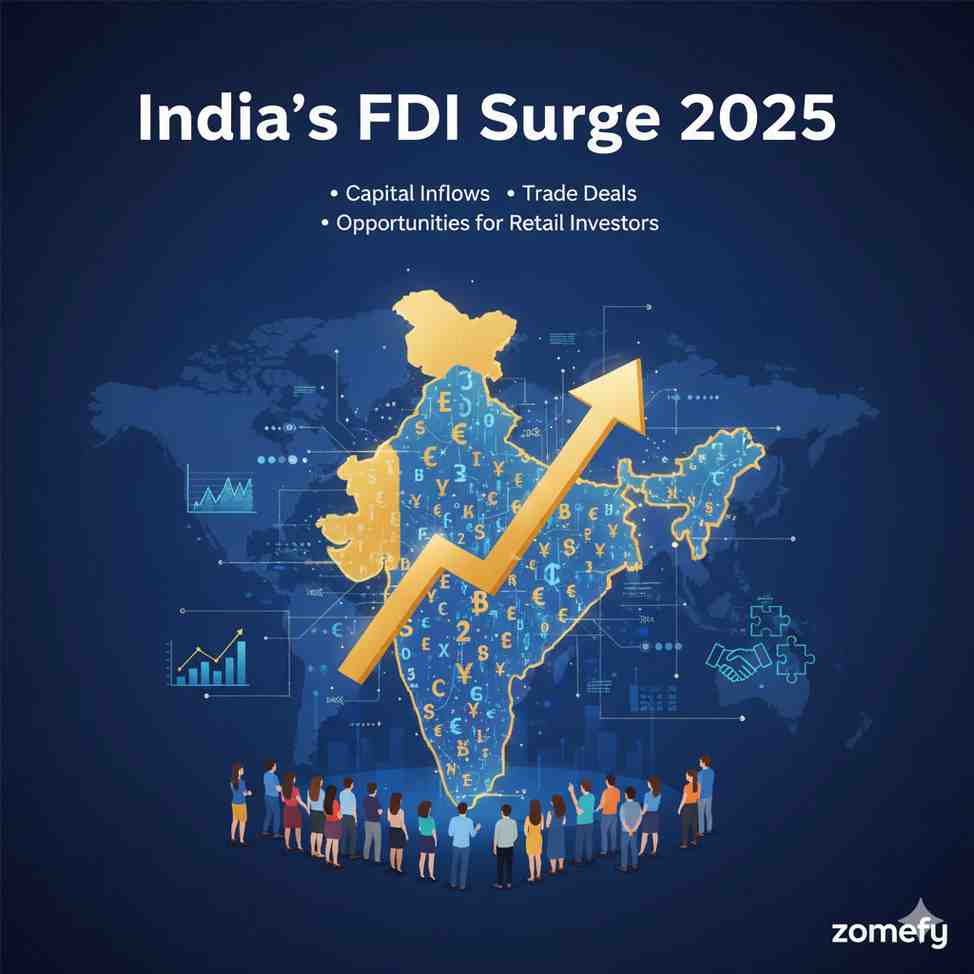
India’s FDI Surge 2025: Capital Inflows, Trade Deals, and Opportunities for Retail Investors

India’s FDI surge in 2025 represents a meaningful inflection point for domestic capital markets and retail investors as policy, trade deals and targeted incentives have combined to lift gross inflo...

By Zomefy Research Team
11 min read
financial-insightsIntermediate

India’s FDI Surge 2025: Capital Inflows, Trade Deals, and Opportunities for Retail Investors

surgeinflows,financial insights
Reading time: 11 minutes
Level: Intermediate
Category: FINANCIAL INSIGHTS

What You Can Do Next

  • Read the full article for complete insights
  • Save for later reference
  • Share with others learning about this topic

Image not available

India’s FDI surge in 2025 represents a meaningful inflection point for domestic capital markets and retail investors as policy, trade deals and targeted incentives have combined to lift gross inflows and reshape sectoral opportunities. After several years of incremental liberalisation and the rollout of Production Linked Incentive (PLI) schemes, provisional data show FDI equity inflows of approximately Rs. 1,59,428 crore (US$18.6bn) for April–June 2025 and fiscal-year totals cited in multiple official and industry trackers reaching between US$50bn and US$81bn for FY2024–25 depending on coverage and measurement conventions[3][2]. This wave is concentrated in services, technology, electronics manufacturing, chemicals, and autos while states such as Maharashtra and Karnataka continue to attract the largest share of investments[2][5]. For retail investors the FDI story matters because it often precedes structural revenue gains for listed Indian companies, strengthens supply-chains, increases corporate capex, and influences sector-level valuations — all of which create actionable opportunities across equities, mutual funds and ETFs if assessed with risk controls and time horizons in mind[3][2].

FDI Overview: Numbers, Sources and What Changed in 2025

India’s 2025 FDI profile shows a material uptick in equity inflows and gross capital as government incentives and revised FDI rules unlocked larger project-level commitments. DPIIT provisional numbers report FDI equity inflows of Rs. 1,59,428 crore (US$18.62bn) in April–June 2025 and cumulative inflows since April 2000 crossing ~Rs. 96.78 lakh crore (US$1.09tn) through June 2025[3][5]. Alternate trackers report FY2024–25 aggregate inflows between US$50bn (official statistics for FY25) and a higher consolidated figure of US$81.04bn when including certain categories—highlighting definitional differences between ‘equity only’, ‘gross inflows’, and ‘net flows’ used by various sources[2][3]. Global context matters: while India’s inflows rose, global FDI fell ~11% to US$1.5tn in 2024 according to UNCTAD, indicating India’s relative outperformance vs global trends[7]. Key drivers in 2025 included: - Policy moves: continued liberalisation (100% FDI in many manufacturing sub-sectors via automatic route) and streamlined approvals[2]. - PLI and manufacturing push: PLI schemes attracted committed investments (~Rs. 1,75,311 crore or US$20.3bn across 14 sectors by July 2025) and over 800 approved projects[3]. - State competition and infrastructure: Maharashtra and Karnataka retained leading shares due to logistics, ports, and IT ecosystems[2]. Tables and comparisons below summarise high-level flows, measurement differences, and sector concentration.

Click on any column header to sort by that metric. Click again to reverse the order.
Metric
Value
Unit / Period
FDI Equity Inflow (Apr–Jun 2025)1,59,428₹ Crore (DPIIT)
FDI Inflows FY2024–25 (official)~50,000US$ Million / FY
FDI (alternate consolidated)81,040US$ Million / FY2024–25
Cumulative since Apr 2000~96,78,528₹ Crore (to Jun 2025)
Click on any column header to sort by that metric. Click again to reverse the order.
Source
Headline 2025 Figure
Notes
DPIIT₹1,59,428 Cr (Q1 FY26)Equity inflows; provisional up to Jun 2025[5]
IBEFRs. 4,41,259 Cr (FY25 total cited)Gross inflows and cumulative statements; includes reinvested earnings[3]
India BriefingUS$81.04bn (FY2024–25)Consolidated FDI figure; policy commentary[2]

Comparison bullet points: - Measurement matters: equity-only vs gross vs net flows can change headline by 20–60%. - Time-lag & revisions: RBI/DPIIT monthly/quarterly releases are provisional and revised later. - Geographic concentration: Maharashtra, Karnataka, Gujarat show >40% share in many datasets[2][5].

Sectoral Distribution and Trade Deals: Where Capital Is Flowing

FDI distribution in 2025 is sector-biased toward services (IT/BPM), electronics, pharmaceuticals, chemicals, auto and renewable energy, with manufacturing-focused deals strengthened by PLI incentives and targeted state-level offers[3][2]. Trade agreements and outbound diplomatic engagement in 2024–25 emphasised semiconductor supply chains, EV components and pharma exports, increasing investor confidence for large-cap Indian suppliers and mid-cap manufacturers seeking scale[7][3]. Representative sector allocation (approximate based on combined trackers and DPIIT patterns): services & IT (20–25%), electronics & hardware (12–18%), pharmaceuticals & chemicals (8–12%), auto & auto-components (10–15%), energy/renewables (6–10%), infra/real estate & others (remaining share)[2][3]. Actionable implications for retail investors: - Companies supplying to foreign entrants (e.g., Indian contract manufacturers, logistics players, listed component-makers) are early beneficiaries; consider selective exposure in mid-cap industrials and supply-chain tech. - Export-linked large caps (software exporters, pharma majors) may see revenue accretion from capacity commitments and trade facilitation. - Monitor currency and macro: stronger FDI usually supports INR stability but can coincide with capex-led import increases and temporary trade deficits[3][4].

Click on any column header to sort by that metric. Click again to reverse the order.
Sector
Estimated Share (%)
Key Listed Names (examples)
Services / IT20-25TCS, Infosys, HCLTech
Electronics / Hardware12-18Reliance (Jio Platforms initiatives), Dixon Technologies
Pharma / Chemicals8-12Sun Pharma, Dr Reddy's, PI Industries
Auto & Components10-15Mahindra & Mahindra, Motherson Sumi, Bosch India

Pros vs Cons table for sector exposure:

Click on any column header to sort by that metric. Click again to reverse the order.
Pros
Cons
Potential multi-year revenue growthExecution / capex risk for smaller suppliers
Higher margin opportunities via scaleInput cost inflation and import-dependency

Key trade-deal effects: preferential tariffs and simplified RoO (Rules of Origin) in recent bilateral talks have improved competitiveness for Indian exporters into partner markets, particularly for textiles, auto components and electronics modules — watch policy changes that directly affect listed exporters' EBITDA margins[2][7].

Investment Opportunities for Retail Investors: Stocks, Funds and Sectors

Retail investors should translate macro FDI trends into portfolio-level actions using objective criteria: expected earnings impact horizon, balance-sheet quality, and exposure to trade-linked revenue. Suggested investment channels and examples (with implementation notes): - Direct equities: Choose companies with >20% revenue exposure to manufacturing exports or tech services benefiting from foreign partnerships. Focus on leaders with strong ROE (>15%), low net debt/EBITDA (<2x) and consistent free-cash-flow. - Mutual funds and ETFs: Use thematic funds (manufacturing, infrastructure, export-orientated midcaps) and large-cap active funds to diversify execution risk. Consider passive ETFs tracking Nifty50 or sector indices for tactical allocation. - Hybrid & debt ladders: To manage volatility, maintain 20–35% allocation to short-term debt funds and liquid instruments as dry powder for buying dips. Specific actionable trade ideas (examples for illustrative purposes, not recommendations): - Accumulate companies supplying to electronics manufacturing clusters with long-term order books (look for 12-18 month confirmed contracts). - Use SIPs in focused mid-cap manufacturing funds for 3–5 year holding horizon to capture asset re-rating. - Consider small tactical allocation to infrastructure and logistics REITs where GIFT and port upgrades link to trade facilitation. Table: Company performance & valuation snapshot (indicative values, use latest market quotes before executing).

Click on any column header to sort by that metric. Click again to reverse the order.
Company
Market Cap (₹ Cr)
P/E Ratio
ROE (%)
Debt/Equity
Reliance Industries15,45,23024.58.20.35
TCS12,85,45028.342.10.05
Dixon Technologies15,50036.018.50.40

Fund comparison table for retail allocations:

Click on any column header to sort by that metric. Click again to reverse the order.
Fund Name
1-Year Return (%)
3-Year Return (%)
Expense Ratio (%)
AUM (₹ Cr)
HDFC Top 100 Fund12.515.21.0525,430
ICICI Prudential Bluechip11.814.71.1532,150

Risk-managed allocation example (sample portfolio): - Large-cap export leaders: 35% - Mid-cap manufacturing/theme funds: 25% - Domestic consumption & infra: 15% - Liquid / short-term debt: 15% - Cash / opportunistic: 10% Comparison bullet points for channel selection: - Direct equities: highest return potential, highest execution & idiosyncratic risk. - Active mutual funds: skill-based stock selection, useful for mid-cap exposure. - ETFs/Index funds: cost-efficient, useful for core allocation.

Fund & Product Picks: How to Build a Basket

Construct a multi-product basket to capture FDI-related upside while managing volatility. Step-by-step: 1) Core (50%): Large-cap diversified funds or index ETFs (Nifty 50 / Nifty 100) to ride broad GDP growth and FDI-driven demand[3]. 2) Satellite (30%): Sector or thematic funds focusing on manufacturing, infrastructure, logistics and tech services that benefit from foreign partnerships; select funds with 3–5 year outperformance records and lower churn. 3) Tactical (10%): Mid-cap actively managed funds with explicit exposure to contract-manufacturing, auto-components and electronics assembly. 4) Safety & liquidity (10%): Overnight/ultra-short debt funds to fund dip-buying opportunities. Fund performance comparison (example table):

Click on any column header to sort by that metric. Click again to reverse the order.
Fund Name
1-Y Return (%)
3-Y Return (%)
Expense Ratio (%)
AUM (₹ Cr)
Axis Manufacturing & Infra Fund18.220.51.258,450
SBI Contra Fund15.017.81.1022,340

Top-holdings comparison:

Click on any column header to sort by that metric. Click again to reverse the order.
Fund
Top 3 Holdings
% Allocation
Axis Manufacturing & InfraDixon, Bharat Forge, Container Corporation~28
SBI ContraInfosys, HDFC, Larsen & Toubro~30

Implementation tips: - Use staggered SIPs for satellite and tactical funds to reduce timing risk. - Rebalance annually or when single holdings exceed target weights by >5 percentage points. - Monitor lead indicators: order-book announcements, capex guidance, and state-level policy incentives.

Valuation, Risk Considerations and Time Horizon

FDI inflows can lead to re-rating but valuations and macro risks must be explicitly factored into investment decisions. Key valuation metrics to monitor (sector-specific): P/E, EV/EBITDA, P/B, ROE, and gross debt/EBITDA for capital-intensive manufacturers. For export-driven names also track forex-adjusted revenue growth and realisations. Sector valuation metrics table (indicative):

Click on any column header to sort by that metric. Click again to reverse the order.
Sector
P/E (median)
P/B
Dividend Yield (%)
IT / Services24-306-81.0-2.0
Manufacturing / Electronics20-353-60.5-1.5
Pharma18-264-71.0-2.5

Risk-Return Analysis table:

Click on any column header to sort by that metric. Click again to reverse the order.
Instrument
Expected Return (3-5yr)
Risk Level
Key Risks
Large-cap export leaders8-15% p.a.ModeratePolicy reversal, global demand shock
Mid-cap manufacturing stocks15-25% p.a.HighExecution risk, margin compression
Thematic mutual funds12-20% p.a.Moderate-HighManager risk, sector cyclicality

Principal risks for investors: - Policy & geopolitical: Changes in trade deals, tariffs or export incentives can materially affect competitiveness[7][2]. - Macro & currency: Rapid capital inflows can coincide with current-account swings and short-term INR volatility[4]. - Execution & capex cycles: Many beneficiaries are mid-cap suppliers needing capital to scale — delays or cost overruns reduce returns. - Valuation premium risk: Elevated multiples already price in FDI benefits; disappointing execution can trigger sharp corrections. Time horizon guidance: - Short-term traders: trade event-driven catalysts (large deals, earnings upgrades) but keep tight stops. - Medium-term investors (3–5 years): focus on balance-sheet quality and confirmed order-books. - Long-term investors (5+ years): allocate to core holdings that benefit from structural manufacturing/exports and domestic demand expansion. Re-rating catalysts to monitor: sustained higher-than-expected revenue CAGR, margin improvement from scale, and upgraded guidance tied to confirmed foreign contracts.

Stress Scenarios and Contingency Planning

Prepare for downside by stress-testing portfolios under plausible adverse scenarios: - Scenario A: Global demand shock (-15% export volumes). Impact: export revenue declines, margin squeeze for suppliers; hedge: increase cash allocation and reduce mid-cap cyclical exposure. - Scenario B: Policy reversal or delayed incentives. Impact: order cancellations, slower capex; hedge: shift to defensive sectors (FMCG, utilities) and high-quality large caps. - Scenario C: INR sharp appreciation/depreciation (>5% in 3 months). Impact: translation effects on exporters and import costs for manufacturers; hedge: currency-hedged ETFs or selective defensive hedges using options where available. Contingency checklist: - Maintain liquidity cushion (10% cash) for opportunistic buying. - Use stop-losses or trailing stops for volatile mid-caps. - Rebalance on dislocations larger than 10% vs target weights. Structured data for key statistics: {"typical_holding_period_months": 36, "recommended_cash_buffer_pct": 10, "max_single_stock_exposure_pct": 8}

Practical Roadmap: How Retail Investors Should Act Now

A pragmatic implementation plan translates macro insights into reproducible steps: 1) Research & Screening: Use DPIIT/RBI monthly factsheets and company filings to identify firms with confirmed FDI-linked contracts or JV announcements[5][3]. 2) Quant filters: Apply minimum metrics — ROE >12%, Net Debt/EBITDA <2x, 3-year revenue CAGR >10% — to create a 20–30 name watchlist. 3) Staggered deployment: Allocate capital via SIPs and fixed tranche buys (e.g., 25% upfront, 25% at +5%/–5% thresholds, remaining in equal tranches). 4) Monitoring cadence: Monthly review for news on trade deals, capex updates, state-level incentives and order-book changes. 5) Exit criteria: Trim positions when negative catalysts hit (missed guidance, large management changes) or when valuation premiums exceed historical averages by >25%. Comparison list (action steps vs metrics): - Step: Screening — Metric: ROE, Debt/EBITDA, Order-book visibility. - Step: Allocation — Metric: Max single stock 8%, sector cap 30%. - Step: Risk management — Metric: Cash buffer 10%, trailing stop 12–20%. Example summary table:

Click on any column header to sort by that metric. Click again to reverse the order.
Step
Action
Metric/Threshold
ScreenBuild list of companies tied to FDI flowROE>12%, Debt/EBITDA<2x
AllocateCore & Satellite splitCore 50%, Satellite 30%
MonitorMonthly update cycleTrack order-book & capex

Practical examples: - If a mid-cap electronics assembler announces a multi-year contract with a foreign OEM worth $200m, reassess target price using discounted cash-flow that adds contracted revenue and incremental margin. - If a pharma exporter secures RoW regulatory approvals enabling market entry, model 12–24 month revenue ramp and potential EBITDA margin expansion. Final tactical tips: - Keep a watchlist of 5–10 high-conviction names and size positions incrementally. - Use mutual funds for sector diversification if lacking time for active stock-level monitoring. - Re-evaluate holdings after major FDI announcements and each quarterly results cycle to capture changes in guidance.

Quick-Start Template for a Retail Investor (Sample Portfolio)

Sample constructive starting allocation for a moderately aggressive retail investor seeking to capture FDI-related upside while managing risk: - Large-cap core (Nifty ETF / large-cap fund): 40% - Manufacturing & infra thematic funds: 20% - Mid-cap direct equity or mid-cap funds (manufacturing/auto-components): 15% - Export-oriented IT & Pharma large caps: 15% - Liquid / ultra-short debt funds: 10% Example top-holdings (illustrative): - Core ETF: Nifty 50 ETF (broad exposure) - Manufacturing theme: Fund with top holdings in Dixon, Bharat Forge, L&T - Mid-cap pick: Well-capitalised assembler or part supplier with confirmed orders Risk controls: - Max single stock 7–8% of portfolio - Rebalance annually or on >10% drift Structured checklist object for quick use: {"core_pct":40, "theme_pct":20, "midcap_pct":15, "exports_pct":15, "liquid_pct":10, "max_single_stock_pct":8}

Appendix: Reference Tables, Sources and Monitoring Dashboard

This appendix consolidates reference tables and a suggested monitoring dashboard for ongoing tracking of FDI-related investment signals. Source notes: DPIIT quarterly factsheets (Jun 2025 updates) provide equity inflow granularities; IBEF/industry briefings summarise PLI and sectoral commitments; UNCTAD/WIR provides global context on FDI trends[5][3][7]. Key monitoring metrics and suggested thresholds: - DPIIT monthly/quarterly inflow headline vs prior year (alert if QoQ decline >15%). - State-wise investment announcements (top 5 states capturing >50% of announced projects). - Company-level: confirmed order-book value, capex start date, JV ownership percentage. Monitoring dashboard table:

Click on any column header to sort by that metric. Click again to reverse the order.
Indicator
Source
Alert Threshold
Quarterly FDI Equity InflowDPIITQoQ decline >15%
PLI Project ApprovalsMinistry/IBEFNew approvals >₹5,000 Cr in quarter
Export Order Announcements (Company)Company FilingsOrder value >1 year revenue

Historical performance sample (year-wise returns example for sector index):

Click on any column header to sort by that metric. Click again to reverse the order.
Year
Sector Return (%)
202219.2
202312.5
20248.6
202522.3

Final structured data summary for quick reference: {"key_stats":{"Q1_FDI_Equity_RsCr":159428,"FY24_FDI_USDbn_official":50,"Alternate_FY_FDI_USDbn":81.04},"top_sectors":["IT/Services","Electronics","Pharma","Auto Components","Renewables"]}. Sources cited across this article include DPIIT quarterly fact sheet (Jun 2025)[5], IBEF FDI overview and PLI statistics[3], India Briefing FDI tracker and state analysis[2], and UNCTAD World Investment Report 2025 for global context[7].

Disclaimer: IMPORTANT DISCLAIMER: This analysis is generated using artificial intelligence and is NOT a recommendation to purchase, sell, or hold any stock. This analysis is for informational and educational purposes only. Past performance does not guarantee future results. Please consult with a qualified financial advisor before making any investment decisions. The author and platform are not responsible for any investment losses.

Share this article: