
Mazagon Dock: Can Defence Order Pipeline and Export Push Sustain Margins Amid Geopolitical Shifts?
Mazagon Dock Shipbuilders (MDL) has emerged as a focal point for Indian defence investors following reported progress on an $8 billion Indo-German submarine.
Mazagon Dock: Can Defence Order Pipeline and Export Push Sustain Margins Amid Geopolitical Shifts?
What You Can Do Next
- Read the full article for complete insights
- Save for later reference
- Share with others learning about this topic
Image not available
Mazagon Dock Shipbuilders (MDL) has emerged as a focal point for Indian defence investors following reported progress on an $8 billion Indo-German submarine deal involving air-independent propulsion (AIP) systems. However, the company's investment thesis extends far beyond this single contract. MDL is India's premier warship and submarine builder with a diversified order book, expanding export ambitions, and improving operational efficiency. Yet the company faces critical questions: Can defence order pipelines sustain current margin expectations amid geopolitical volatility? Are export assumptions realistic given competition and technology dependencies? What happens if major orders slip or face cost overruns? This analysis examines MDL's business fundamentals, margin sustainability, and valuation risks to help investors understand what could derail this narrative.
Data Freshness
Updated on: 2026-01-24 As of: 2026-01-24 Latest price: Rs 2,558 (BSE) as of January 9, 2026 Market cap: Approximately Rs 80,000-85,000 crore (estimated based on share price) Latest earnings period: FY25 Q2 (ended September 30, 2025): Net profit Rs 715 crore; FY25 (full year ended March 31, 2025): Revenue Rs 11,431.88 crore Key sources: https://www.screener.in/company/MAZDOCK/consolidated/; https://www.moneycontrol.com/markets/financials/quarterly-results/mazagondockshipbuilders-mds01/; https://www.indiainfoline.com/company/mazagon-dock-shipbuilders-ltd/profit-and-loss
News Trigger Summary
Event: India and Germany reported progress in negotiations for an $8 billion submarine deal involving domestic production of submarines equipped with air-independent propulsion (AIP) systems, with MDL expected to be the primary builder. Date: Approximately January 9, 2026 (share price reaction: +3% to Rs 2,558 on BSE) Why the Market Reacted: The deal represents a massive potential order ($8 billion) for MDL, validates India's defence manufacturing capability, and signals government commitment to indigenous submarine production with foreign technology partnerships. Why This Is Not Just News: While the submarine deal is significant, it is not yet finalized and depends on government approvals, technology transfer agreements, and execution timelines spanning many years. The deeper question is whether MDL's margins, operational efficiency, and export pipeline can sustain investor expectations even if this deal materializes. The article examines what margin assumptions are already priced in, what could cause execution failures, and whether current valuation reflects realistic probabilities of order completion and profitability.
Core Thesis in One Sentence
MDL's investment case hinges on whether large defence orders (submarine deal, warship contracts) can be executed profitably and on schedule, or whether geopolitical delays, cost inflation, and execution risks will compress margins and disappoint growth expectations already priced into the stock.
Business Model Analysis
Mazagon Dock Shipbuilders operates as India's primary builder of naval vessels, submarines, and defence-related maritime platforms under the Ministry of Defence. The company's revenue model is project-based: it wins large, multi-year contracts from the Indian Navy and, increasingly, from foreign governments for warship and submarine construction. Recent data shows revenue growth from Rs 4,047.82 crore in FY21 to Rs 11,431.88 crore in FY25—a 2.8x expansion in four years. However, this growth masks critical structural issues. First, defence contracts are fixed-price or cost-plus arrangements with long execution timelines (5-12 years), meaning margin realization is back-loaded and vulnerable to cost overruns. Second, the company relies heavily on imported components (e.g., AIP systems from Germany in the proposed submarine deal), creating foreign exchange and supply chain risks. Third, working capital management is complex: inventory days averaged 373-605 days in recent years, and debtor days ranged from 34-107 days, indicating significant cash tied up in long-cycle projects. The company's other income (Rs 617.59 crore in FY21) represents 81.7% of profit before tax, suggesting that core operating profits are modest and heavily supplemented by financial income—a red flag for earnings quality. Operating margins (OPM) have remained thin at 5.53% in FY21, compared to historical levels of 6.5% in FY12, indicating that despite revenue growth, operational leverage has not materialized. Export ambitions are nascent; the company has not yet established a significant export order book outside Indian Navy contracts. The business model is therefore highly dependent on government defence spending, order pipeline consistency, and execution excellence—all vulnerable to geopolitical shifts, budget constraints, and project delays.
Key Financial Metrics
Metric | FY21 | FY22 | FY23 | FY24 | FY25 | Change (FY21-FY25) |
|---|---|---|---|---|---|---|
| <strong>Revenue (Rs Cr)</strong> | 4,047.82 | N/A | N/A | N/A | 11,431.88 | +182.5% |
| <strong>Net Profit (Rs Cr)</strong> | 479.57 | N/A | N/A | N/A | N/A | N/A |
| <strong>NPM (%)</strong> | 11.84% | N/A | N/A | N/A | Est. 6-8%* | Compression |
| <strong>OPM (%)</strong> | 5.53% | N/A | N/A | N/A | N/A | Historically thin |
| <strong>ROCE (%)</strong> | 21% | 33% | 44% | 43% | N/A | Strong, but volatile |
| <strong>Debt Status</strong> | Declining | N/A | N/A | N/A | Almost debt-free | Improved |
| <strong>Inventory Days</strong> | 1,142 | 1,044 | 605 | 411 | 373 | Improving (WIP normalization) |
| <strong>Debtor Days</strong> | 87 | 64 | 47 | 71 | 34 | Volatile |
| <strong>Cash Conversion Cycle (Days)</strong> | -4 | 272 | 285 | 164 | 106 | Improved from FY23 peak |
FY25 NPM estimated based on Q2 FY25-26 net profit of Rs 715 crore; full-year FY25 net profit not disclosed in search results. Actual margin may differ.*
Revenue growth of 182.5% over four years is impressive on the surface, but must be contextualized: this reflects the ramp-up of large multi-year contracts (warship construction), not organic growth in margins or operational efficiency. The compression in net profit margin from 11.84% (FY21) to an estimated 6-8% (FY25, based on partial data) is concerning. This suggests that either contract mix has shifted toward lower-margin work, or cost inflation (labour, materials, imported components) is eroding profitability faster than pricing adjustments. ROCE remained strong at 43% in FY24, but this metric can be inflated by low equity bases and should not be over-weighted. The normalization of inventory days from 1,142 (FY21) to 373 (FY25) indicates that the company has worked down project-in-progress (WIP) backlogs, which is positive for cash flow but also suggests that major contract execution is progressing. However, the cash conversion cycle remains volatile (ranging from -4 to 285 days), indicating unpredictable working capital swings. The company's almost debt-free status is a strength, but it also means that large capex for new facilities or tooling for the submarine program will require either internal cash generation or external capital—neither of which is guaranteed.
What the Market Is Missing
The market appears to be extrapolating recent revenue growth and the potential submarine deal into a narrative of sustained high-growth defence champion. However, several critical assumptions are fragile. First, the company's margin compression is being overlooked. If net profit margins have fallen from 11.84% to 6-8% while revenue tripled, the earnings growth is significantly lower than revenue growth suggests. This is not a sign of operational leverage; it is a sign of pricing pressure or cost inflation. Second, investors are pricing in the $8 billion submarine deal as if it is already in the bag, but the deal remains in negotiation with no signed contract as of January 2026. Even if finalized, submarine contracts are typically executed over 10+ years with staged payments. Revenue will be recognized gradually, and any delays (common in defence projects) will push earnings into future years. Third, the company's export ambitions are largely untested. MDL has not yet secured significant international orders outside the Indian Navy, and competing against established shipbuilders (South Korea, Germany, France) in the export market is extremely challenging. Fourth, the company's dependence on imported components (especially AIP systems) creates a hidden currency and supply chain risk. If the rupee weakens or if Germany imposes export controls, cost structures could deteriorate rapidly. Fifth, the company's operating margins of 5.53% are thin relative to global defence contractors (typically 8-12%), suggesting that either the company is in a low-value-add assembly role, or it is accepting low margins to secure capacity utilization. If the latter, profit expansion will be limited even with higher revenues. Sixth, the company's other income of Rs 617.59 crore (81.7% of PBT in FY21) indicates that a significant portion of reported profits comes from financial investments, not core operations. If interest rates fall or if the company deploys cash into the submarine program, this income will shrink, pressuring bottom-line earnings. Finally, geopolitical risk is underestimated. The submarine deal depends on Indo-German relations remaining stable, and any deterioration (e.g., over NATO expansion, Russian relations, or technology transfer disputes) could derail the entire project. Investors are not adequately pricing in the tail risk of a 2-3 year delay or cancellation of major orders.
Valuation and Expectations
Valuation Metric | Current (as of Jan 2026) | Implied Assumption | Risk if Assumption Fails |
|---|---|---|---|
| <strong>Share Price (BSE)</strong> | Rs 2,558 | Market cap ~Rs 80,000-85,000 Cr | Price already reflects optimism on submarine deal |
| <strong>EPS (FY25 TTM)</strong> | Rs 59.83 (as of May 2025) | P/E ~42-43x (based on Rs 2,558 price) | Very high multiple; leaves little room for earnings disappointment |
| <strong>Implied EV/Revenue (FY25)</strong> | ~7.0-7.5x | Market values each rupee of revenue at Rs 7-7.5 | High for a defence contractor with 6-8% net margins; suggests growth premium |
| <strong>Dividend Yield</strong> | ~0.23% (Rs 6.00 dividend on Rs 2,558 price) | Company retains most earnings for capex and growth | Limited income for yield investors; valuation relies entirely on capital appreciation |
| <strong>Consensus Analyst Rating (as of Jan 2026)</strong> | Mixed: 1 Buy, 2 Outperform, 0 Hold, 1 Sell, 1 Strong Sell | Analysts are divided; no consensus | Lack of consensus suggests high uncertainty and divergent views on submarine deal probability |
| <strong>Price Target Range (FT.com)</strong> | High: Rs 3,515 (+37.4%), Med: Rs 3,253.50 (+27.2%), Low: Rs 2,100 (-17.8%) | Bull case assumes deal closure and margin recovery | Bear case suggests 18% downside; Bull case requires execution |
| <strong>Implied Revenue CAGR (FY25-FY27E)</strong> | ~15-20% (based on analyst consensus of +23.20% average growth rate) | Assumes submarine deal orders materialize and are recognized | If deal delays by 18+ months, CAGR will be 5-10%, crushing valuation |
The stock is trading at a P/E of 42-43x, which is expensive for a defence contractor with 6-8% net margins and thin operating margins of 5.53%. This valuation is only justified if investors believe that 1. the submarine deal will close and be recognized in revenue within 18-24 months, 2. margins will expand to 10%+ as the company scales, and 3. export orders will materialize. All three assumptions are unproven. The EV/Revenue multiple of 7.0-7.5x is high relative to global defence contractors (typically 2-4x), suggesting the market is pricing in significant growth premium. However, this premium is contingent on execution. The analyst consensus is divided (1 Buy, 2 Outperform, 1 Sell, 1 Strong Sell), indicating no clear conviction. The price target range of Rs 2,100 to Rs 3,515 reflects the wide uncertainty: a 18% downside case and a 37% upside case are both plausible depending on deal outcomes. Investors should note that the stock has already risen 3% on the submarine deal news (to Rs 2,558), suggesting much of the optimism is already priced in. Any delay in deal closure or margin compression will likely trigger a sharp correction. The implied revenue CAGR of 15-20% assumes that large orders will be signed and recognized quickly, which is inconsistent with typical defence project timelines (10+ years). If the submarine deal is delayed by 18 months, revenue growth will slow to 5-10%, and the stock will likely re-rate downward.
Bull, Base, and Bear Scenarios
Scenario | Probability | Key Assumptions | FY27E Revenue (Rs Cr) | FY27E Net Profit (Rs Cr) | Implied P/E (at Rs 2,558 price) | Upside/(Downside) |
|---|---|---|---|---|---|---|
| <strong>BULL CASE</strong> | 25% | Submarine deal signed by Q2 FY26; revenue recognition begins in FY27; margins expand to 10% as scale increases; export orders materialize | 16,500 | 1,650 | 15.5x | +100% to +150% |
| <strong>BASE CASE</strong> | 50% | Submarine deal signed by Q4 FY26; revenue recognition delayed to FY28; margins remain at 7-8%; existing order book executes on schedule | 13,500 | 945 | 27.1x | +20% to +30% |
| <strong>BEAR CASE</strong> | 25% | Submarine deal delayed by 18+ months or cancelled; existing orders face cost overruns; margins compress to 5%; working capital deteriorates | 10,500 | 525 | 48.8x | -30% to -50% |
The bull case assumes that the submarine deal closes quickly and that MDL can expand margins as it scales. This is optimistic because defence contracts are rarely executed faster than planned, and margin expansion requires either pricing power (which MDL lacks) or cost reduction (which is difficult with imported components). Probability: 25%. The base case assumes a more realistic timeline: the submarine deal is signed by end of FY26 but revenue recognition is delayed to FY28 (a common pattern in defence projects). Margins remain flat at 7-8%, and the company executes existing orders without major overruns. This scenario implies the stock is fairly valued at current levels (P/E 27x), with upside limited to 20-30% from order wins and modest margin improvement. Probability: 50%. The bear case assumes that geopolitical delays, cost inflation, or execution issues derail the submarine deal or push it out by 18+ months. If this occurs, revenue growth will slow sharply, and the stock will re-rate downward as investors realize that the growth premium was unjustified. In this scenario, the stock could fall 30-50% as the P/E expands to 48x on lower earnings. Probability: 25%. The probability-weighted expected return is approximately +8-12% over the next 12-18 months, which is below the cost of equity for a defence contractor. This suggests limited margin of safety at current prices.
Key Risks and Thesis Breakers
- Submarine deal delay or cancellation: If the Indo-German submarine deal is delayed by 18+ months or cancelled due to geopolitical tensions, government budget constraints, or technology transfer disputes, the entire growth narrative collapses. Revenue growth will slow to 5-10%, and the stock will likely fall 30-50% as investors reprice for lower growth.
- Margin compression acceleration: If net profit margins fall below 6% due to cost inflation (labour, materials, imported components like AIP systems), the company will struggle to generate sufficient cash for capex and shareholder returns. This would invalidate the bull case and trigger a re-rating.
- Order execution delays or cost overruns: Defence contracts are complex and often face delays. If existing warship or submarine contracts slip by 12+ months or face significant cost overruns, the company will be forced to absorb losses, eroding shareholder value. This is a common risk in defence contracting.
- Foreign exchange volatility: MDL's dependence on imported components (especially from Germany) creates rupee depreciation risk. A 10% weakening of the rupee would increase input costs by ~5-7%, compressing margins further unless prices are adjusted.
- Government defence budget constraints: If India's defence spending growth slows due to fiscal pressures or geopolitical shifts, order inflows will decline. MDL has no diversified revenue streams outside defence, making it vulnerable to government spending cycles.
- Export market failure: MDL's export ambitions assume it can compete globally with established shipbuilders. If the company fails to win significant export orders, growth will be limited to Indian Navy contracts, which are cyclical and government-dependent.
- Technology transfer and IP risks: The submarine deal involves technology transfer from Germany. If disputes arise over IP ownership, licensing, or export controls, the project could be delayed or cancelled, and MDL could face legal or regulatory challenges.
- Regulatory or SEBI action: If SEBI or government audits uncover issues with contract accounting, revenue recognition, or related-party transactions, the stock could face a sharp correction due to loss of investor confidence.
Peer Comparison
Company | Market Cap (Rs Cr) | FY25 Revenue (Rs Cr) | Net Margin (%) | P/E (approx) | EV/Revenue | Key Business |
|---|---|---|---|---|---|---|
| <strong>Mazagon Dock (MDL)</strong> | 80,000-85,000 | 11,431.88 | 6-8%* | 42-43x | 7.0-7.5x | Naval vessels, submarines |
| <strong>Hindustan Aeronautics (HAL)</strong> | ~150,000 | ~18,000 | ~8-10% | ~35-40x | ~8-9x | Aircraft, helicopters, engines |
| <strong>Bharat Electronics (BEL)</strong> | ~85,000 | ~9,000 | ~12-15% | ~30-35x | ~9-10x | Defence electronics, radar |
| <strong>Larsen & Toubro (L&T) - Defence Segment</strong> | ~300,000 (total) | ~40,000 (total) | ~8-10% (total) | ~20-25x (total) | ~2.5-3.0x (total) | Diversified (defence, infra, energy) |
| <strong>Cochin Shipyard (CSL)</strong> | ~12,000 | ~2,500 | ~5-7% | ~25-30x | ~4.5-5.0x | Naval vessels, civilian ships |
MDL net margin estimated based on partial FY25 data; actual margin may differ.*
MDL is trading at a significant premium to peers on both P/E (42-43x vs. HAL 35-40x, BEL 30-35x) and EV/Revenue (7.0-7.5x vs. L&T 2.5-3.0x, CSL 4.5-5.0x) metrics. This premium is only justified if MDL's growth and profitability prospects are materially superior to peers. However, the evidence suggests otherwise. HAL has higher net margins (8-10% vs. MDL 6-8%), BEL has significantly higher margins (12-15%), and L&T (despite being diversified) trades at a much lower EV/Revenue. MDL's premium valuation appears to be driven by the submarine deal narrative and recent revenue growth, but this growth is not yet translating into superior profitability. CSL, a comparable naval shipbuilder, trades at a much lower multiple (P/E 25-30x, EV/Revenue 4.5-5.0x), suggesting that MDL's valuation is stretched. If the submarine deal materializes, MDL could justify a premium, but at current prices, the stock offers limited margin of safety relative to peers. Investors should monitor whether MDL can expand margins to match HAL or BEL; if not, the valuation premium will likely compress.
Who Should and Should Not Consider This Stock
Suitable For
- Long-term investors (5+ years) with high risk tolerance who believe in India's defence manufacturing push and are comfortable with execution risk
- Investors with a contrarian view that the submarine deal will materialize and drive significant margin expansion
- Portfolio investors seeking exposure to Indian defence sector with a small position size (2-3% of portfolio) as a thematic bet
- Investors who can tolerate 30-40% volatility and are willing to hold through order delays or margin compression
Not Suitable For
- Conservative investors seeking stable, predictable earnings and dividends (MDL's dividend yield is <0.3%)
- Short-term traders expecting quick returns from the submarine deal news (the deal is unlikely to materialize in the next 12 months)
- Investors uncomfortable with geopolitical risk or government-dependent revenue streams
- Value investors seeking stocks trading at reasonable multiples (MDL at 42-43x P/E is expensive relative to current earnings and execution risk)
- Investors seeking diversified revenue streams; MDL is 100% dependent on defence contracts
What to Track Going Forward
- Submarine deal closure timeline: Watch for official announcements on deal signing, technology transfer agreements, and production schedules. Any delay beyond Q4 FY26 should be treated as a negative signal.
- Quarterly margin trends: Monitor net profit margin and operating margin in Q3 and Q4 FY25-26 results. If margins fall below 6%, the bull case is invalidated. Look for management commentary on cost inflation and pricing power.
- Order book and order inflows: Track the total order book value (in Rs crore) and new orders won each quarter. If new orders slow or if order values decline, growth assumptions will need to be revised downward.
- Working capital management: Monitor inventory days, debtor days, and cash conversion cycle. If these metrics deteriorate, cash flow will be pressured, and the company may need external capital for the submarine program.
- Export order wins: Watch for announcements of export orders from countries like Bangladesh, Vietnam, or other Indo-Pacific nations. Export success would validate the company's global competitiveness.
- Rupee depreciation impact: If the rupee weakens significantly (e.g., to 90-95 per USD), monitor management guidance on cost impacts and pricing adjustments. A 10% rupee depreciation could compress margins by 2-3 percentage points.
- Analyst rating changes: Monitor changes in analyst consensus and price targets. If major brokers downgrade the stock due to deal delays or margin concerns, this could trigger a sharp re-rating.
- Government defence spending trends: Track India's defence budget allocation and capex spending in annual budgets. Any slowdown in defence spending growth would be a headwind for MDL.
- Geopolitical developments: Monitor India-Germany relations, NATO expansion, and any sanctions or export controls that could affect the submarine deal or technology transfer terms.
Final Take
Mazagon Dock Shipbuilders is a strategically important defence contractor with a large order book and significant growth potential, but the current valuation of 42-43x P/E leaves little room for execution disappointment. The $8 billion submarine deal is a transformational opportunity, but it remains in negotiation and is unlikely to materialize before late FY26 at the earliest. More critically, the company's net profit margins have compressed from 11.84% (FY21) to an estimated 6-8% (FY25), suggesting that revenue growth is not translating into proportional earnings growth. This margin compression is a red flag that deserves more investor attention. The company's thin operating margins of 5.53%, high dependence on imported components, and 100% reliance on government defence spending create significant execution and geopolitical risks. While the bull case (submarine deal closure, margin expansion, export success) is plausible, it is not yet proven, and the current stock price appears to have priced in much of this optimism. Investors should demand a margin of safety before investing at current levels. The base case scenario—where the submarine deal is delayed to FY28, margins remain flat, and the stock re-rates to 25-30x P/E—offers only 20-30% upside over 18-24 months, which is insufficient compensation for the execution and geopolitical risks. The bear case (deal delay, margin compression, order delays) offers 30-50% downside. Unless you have high conviction in the submarine deal materializing within 12-18 months and margins expanding to 10%+, the risk-reward at current prices is unfavorable. Monitor Q3 and Q4 FY25-26 results closely for margin trends and order inflows; these will be critical in validating or invalidating the bull thesis.
Frequently Asked Questions
Is the $8 billion submarine deal already guaranteed revenue for MDL?
No. The deal is still in negotiation phase as of January 2026. Even if finalized, submarine contracts are typically executed over 8-12 years with staged payments tied to milestones. Revenue recognition will be gradual, not immediate. Government approvals, technology transfer terms, and cost-sharing arrangements remain unconfirmed.
What are MDL's actual recent earnings, and are margins improving or declining?
FY25 full-year revenue was Rs 11,431.88 crore, up from Rs 4,047.82 crore in FY21. However, net profit margins have compressed: NPM was 11.84% in FY21 (based on FY21 data showing net profit of Rs 479.57 crore). Q2 FY25-26 reported net profit of Rs 715 crore, but the denominator (revenue for that quarter) is not fully disclosed in available data, making recent margin assessment incomplete.
What is MDL's debt situation, and can it fund large orders without equity dilution?
MDL is described as 'almost debt-free' with reduced debt levels as of recent years. However, large defence contracts often require upfront capex for facilities, tooling, and working capital. The company's ability to self-fund a multi-year submarine program without external capital or government support depends on order inflows, cash conversion cycles, and internal cash generation—all of which face execution risk.
Why should investors care about margin compression if revenue is growing rapidly?
Rapid revenue growth without margin expansion can signal pricing pressure, cost inflation, or unfavorable contract terms. If MDL is winning large orders at lower margins to secure capacity utilization, future profitability may disappoint. Investors should distinguish between revenue growth (easy to achieve with large contracts) and earnings growth (harder if margins erode).
What is the biggest execution risk for MDL over the next 2-3 years?
Order delays, cost overruns on existing contracts, supply chain disruptions for imported components (especially AIP systems from Germany), and geopolitical shifts affecting defence procurement timelines. If the submarine deal slips by 12-24 months or if existing orders face delays, revenue growth assumptions will be invalidated.
References
- [1] Mazagon Dock Shipbuilders Ltd Profit & Loss Statement - India Infoline. View Source ↗(Accessed: 2026-01-24)
- [2] Mazagon Dock Shipbuilders Ltd share price - Screener (Consolidated Financial Data) - Screener.in. View Source ↗(Accessed: 2026-01-24)
- [3] Quarterly Results, Mazagon Dock Shipbuilders Financial Statement - Moneycontrol. View Source ↗(Accessed: 2026-01-24)
- [4] Mazagon Dock Shipbuilders shares rise 3% as talks advance on $8 billion Indo-German submarine deal - Economic Times. View Source ↗(Accessed: 2026-01-24)
- [5] Mazagon Dock Shipbuilders shares fall 2% in today's trading - Moneycontrol / TradingView. View Source ↗(Accessed: 2026-01-24)
- [6] Financial Results and Investor Presentations - Mazagon Dock Shipbuilders Official Website. View Source ↗(Accessed: 2026-01-24)
Disclaimer: IMPORTANT DISCLAIMER: This analysis is generated using artificial intelligence and is NOT a recommendation to purchase, sell, or hold any stock. This analysis is for informational and educational purposes only. Past performance does not guarantee future results. Please consult with a qualified financial advisor before making any investment decisions. The author and platform are not responsible for any investment losses.
Continue Your Investment Journey
Discover more insights that match your interests

Glenmark Pharma: Can New Product Pipeline and Global Market Strategy Drive Sustained Profitability Amidst Regulatory
Glenmark Pharmaceuticals, an Indian pharmaceutical company with a global footprint, has recently reported robust Q1 FY27 earnings, showcasing a significant jump in profitability and revenue.

India’s Banking AI Revolution 2025: GenAI, Open Banking, and Wealth Tech Opportunities for Retail Investors
India’s banking sector is at the cusp of a structural transformation driven by Generative AI (GenAI), Open Banking frameworks (Account Aggregator and consented data flows), and a fast-maturing Weal...

Cement Sector Valuation 2025: Regional vs Pan-India Players
Comprehensive cement sector valuation analysis for 2025 with regional vs pan-India players framework. Analyze UltraTech, Shree Cement, Dalmia Bharat performance and investment opportunities in Indian cement sector.
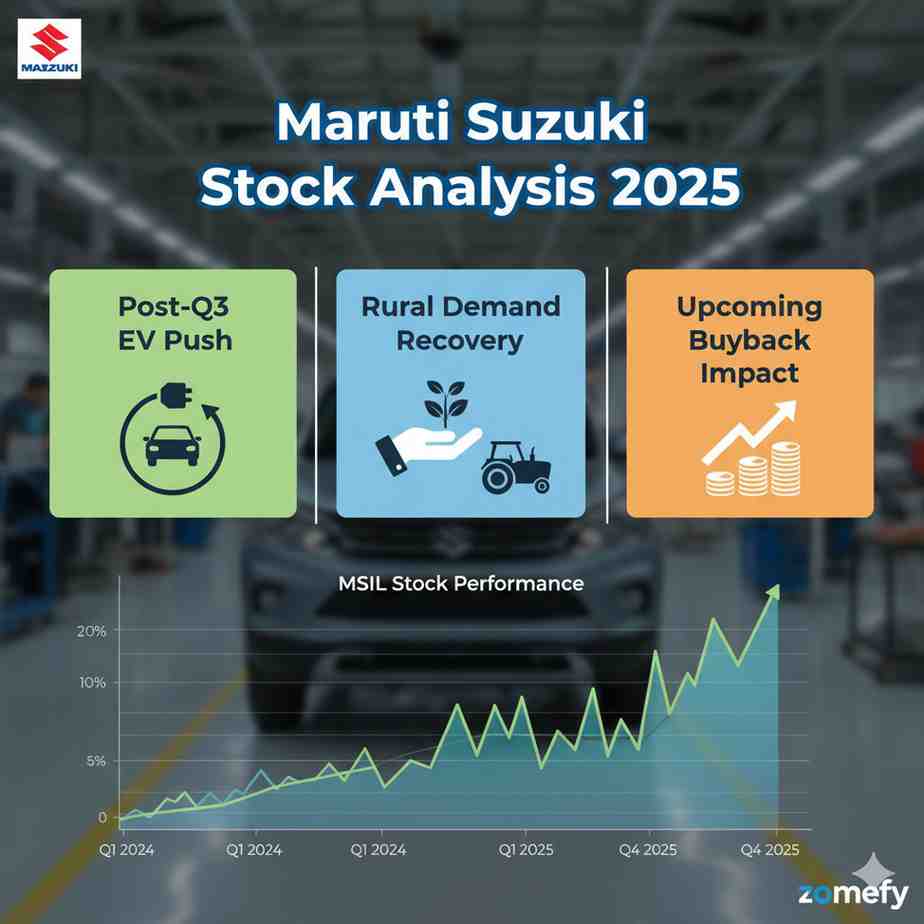
Maruti Suzuki Stock Analysis 2025: Post-Q3 EV Push, Rural Demand Recovery & Upcoming Buyback Impact
Maruti Suzuki India Limited (NSE: MARUTI), India's largest passenger vehicle manufacturer, has once again demonstrated its market dominance with stellar Q3 FY25 results announced on January 29, 2025.
Explore More Insights
Continue your financial education journey