
JK Lakshmi Cement: Can Strategic Acquisitions and Mining Leases Drive Sustainable Market Share Growth?
JK Lakshmi Cement, a prominent player in the Indian cement industry, has recently been in the news for its strategic initiatives aimed at bolstering market.
JK Lakshmi Cement: Can Strategic Acquisitions and Mining Leases Drive Sustainable Market Share Growth?
What You Can Do Next
- Read the full article for complete insights
- Save for later reference
- Share with others learning about this topic
Image not available
JK Lakshmi Cement, a prominent player in the Indian cement industry, has recently been in the news for its strategic initiatives aimed at bolstering market share and operational scale. The company announced its Q3 FY26 results, which, alongside the successful amalgamation of subsidiary companies and ambitious capacity expansion plans, have drawn investor attention. This analysis aims to look beyond the headlines, providing Indian retail investors with a non-consensus view of JK Lakshmi Cement's business fundamentals, the sustainability of its growth drivers, and the inherent valuation risks. We will delve into what the broader market might be overlooking and, crucially, identify the conditions under which this investment thesis could falter, enabling a more informed long-term investment decision.
Data Freshness
Updated on: 2026-03-13 As of: 2026-03-13 Latest price: Rs 608.60 (NSE) as of 2026-03-12 Market cap: Rs 7,490 crore Latest earnings period: FY26 Q3 (Oct-Dec 2025) Key sources: https://vertexaisearch.cloud.google.com/grounding-api-redirect/AUZIYQFsMRZj7G5q0JJa0J-m8ack54EM1Ahn4JvrsPfptMVlyCEbHnWsmgGZZU1zgx2ubMQd70M6M7SyYs4qOZ5phvEITxWA9u2Uo1XbH-fPP4vETJqrP_StD0KfBU5emGFpQ0FPe39lPPix; https://vertexaisearch.cloud.google.com/grounding-api-redirect/AUZIYQGfvR94H-FoPPB8Mo5lDxjDG0S-NsF_RFePsX_6D45W3Yf7pC3tV8dHZ9Txn9pAHPCwE4bwYT8xBo2ZfHV6DC5lm3vOqJncESwKk86fPfJR5kJhU-lUvzSMJYyuHSKMo2ZkcwcXb9wXYg==; https://vertexaisearch.cloud.google.com/grounding-api-redirect/AUZIYQEhOr6LT90EMYm4mzoPVKE21YEv6PfhMesQbc3nEYJv5GT8q-35n5gkK3MsMJqXT1BW4fgiUIZ8uqOkoev5UhZvINorZM4OcsUbJqs6l8IGcAeNOwm0nd811OeJ0wJbjKECvhBWJoPGmRxnmal2InE8v15I81_OQlC5STnXqAGtFj3EkBdxbwxhNcw=
News Trigger Summary
Event: JK Lakshmi Cement announced its Q3 FY26 results, reporting a net profit of Rs 58.12 crore. Concurrently, the company highlighted the successful implementation of its Composite Scheme of Amalgamation & Arrangement, effective July 31, 2025, with an appointed date of April 1, 2024. Furthermore, the company detailed significant expansion plans involving a Rs 3,000 crore investment to add 12 million tonnes per annum (MTPA) capacity by 2028, aiming for a total capacity of 30 MTPA by 2030. Date: Q3 FY26 results announced on February 3, 2026. Amalgamation effective July 31, 2025. Why the Market Reacted: The market likely reacted to the combination of steady Q3 performance (despite a profit decline year-on-year), coupled with the strategic clarity provided by the amalgamation and the aggressive capacity expansion roadmap. The merger is expected to yield synergies, while the expansion signals long-term growth ambitions in a buoyant infrastructure environment, potentially leading to market share gains. The improvement in Net Debt to EBITDA to 1.29x was also a positive signal. Why This Is Not Just News: While these announcements are significant, they represent future potential and ongoing execution. This article moves beyond summarizing these events to critically assess the underlying assumptions, the sustainability of the projected growth, and the risks associated with such large-scale capital deployment and integration. It aims to provide a deeper understanding of how these strategic moves might play out against a competitive and cyclical industry backdrop, and what could derail the optimistic narrative.
Core Thesis in One Sentence
JK Lakshmi Cement's aggressive capacity expansion and strategic amalgamation aim to drive market share, but the success of this thesis hinges on effective execution, favorable regional demand dynamics, and the ability to mitigate intense competitive pressures and volatile input costs.
Business Model Analysis
JK Lakshmi Cement operates primarily in the manufacturing and sale of cement and allied products, serving a diverse customer base across Northern, Western, and Eastern India. Its product portfolio includes Ordinary Portland Cement (OPC), Portland Pozzolana Cement (PPC), and Portland Slag Cement (PSC), catering to various construction needs from individual home builders to large infrastructure projects. The company generates revenue through direct sales to institutional buyers and a wide network of dealers and sub-dealers for retail sales. Profitability is largely driven by sales volumes, pricing power, and efficient cost management, particularly concerning raw materials (limestone, coal, pet coke) and energy (power and fuel). The company's strategic focus on expanding its grinding units and clinker capacity, alongside establishing railway sidings, aims to enhance logistical efficiencies and reduce transportation costs, which are critical in the bulk nature of the cement business. Furthermore, JK Lakshmi Cement is actively pursuing 'Green Initiatives,' with renewable power constituting 48% of its power mix in Q3 FY26, which can contribute to cost savings and sustainability goals in the long run. The recent amalgamation of subsidiary companies, including Udaipur Cement Works Ltd., is expected to streamline operations and unlock synergies, potentially improving overall profitability and market reach by consolidating regional presence. The company's ability to maintain high plant utilization rates and optimize its product mix towards higher-margin specialty cements will be key determinants of its financial performance. The Indian cement sector's growth is inherently linked to infrastructure development and housing demand, making JK Lakshmi Cement's fortunes tied to the broader economic trajectory of the country.
Key Financial Metrics
Metric (Rs Crore) | FY23 | FY24 | FY25 | Q3 FY26 |
|---|---|---|---|---|
| Revenue | 6,451.50 | 6,788.47 | 6,192.62 | 1,588.40 |
| EBITDA | 896.23 | 1,120.26 | 911.01 | 235.13 |
| Net Profit (PAT) | 369.13 | 488.15 | 302.61 | 58.12 |
| Total Debt | 1,846.31 | 2,024.89 | 2,527.17 | NA |
| ROCE (%) | 15.57 | 12.43 | 10.11 | NA |
| ROE (%) | 12.43 | 8.24 | 8.07 | NA |
A review of JK Lakshmi Cement's recent financial performance reveals a mixed picture. While revenue has shown growth from FY23 to FY24, FY25 saw a dip, and Q3 FY26 revenue of Rs 1,588.40 crore indicates a 6% year-on-year growth for the quarter. However, net profit has been volatile, with a significant decline in FY25 and a 26% year-on-year drop in Q3 FY26 profit to Rs 58.12 crore, despite higher revenue. This suggests ongoing margin pressures. Both Return on Capital Employed (ROCE) and Return on Equity (ROE) have seen a declining trend from FY23 to FY25, indicating a reduction in capital efficiency and shareholder returns. The total debt has been on an increasing trajectory, reaching Rs 2,527.17 crore in FY25. While the company reported an improved Net Debt to EBITDA ratio of 1.29x in Q3 FY26 from 2.41x previously, the absolute debt levels and the declining profitability metrics warrant careful observation, especially with significant capital expenditure planned for expansion. The ability to reverse the trend in profitability and capital efficiency will be crucial for sustainable value creation.
What the Market Is Missing
The market appears to be largely factoring in the potential upsides of JK Lakshmi Cement's ambitious capacity expansion to 30 MTPA by 2030 and the synergies from its recent amalgamation. However, a deeper look suggests several nuances that may be overlooked. Firstly, the Indian cement sector is prone to cyclicality, and while current demand drivers from infrastructure are strong, a slowdown could quickly lead to overcapacity, particularly with multiple players aggressively expanding. The assumption that new capacity will automatically translate into proportionate market share and pricing power might be fragile. Secondly, the execution risk associated with a Rs 3,000 crore expansion, involving new clinker lines and multiple grinding units across different states, is substantial. Delays in regulatory approvals, land acquisition, or project execution could lead to significant cost overruns and deferred revenue generation, impacting the return on capital employed. Thirdly, while the amalgamation of subsidiaries is expected to bring synergies, the integration process itself can be complex and time-consuming, potentially distracting management and delaying the realization of promised benefits. Investors may be underestimating the challenges of harmonizing operations, supply chains, and corporate cultures. Lastly, the company's declining trend in ROCE and ROE over the past few years, coupled with volatile profit growth, indicates that improving operational efficiency and profitability from existing assets has been a challenge even before this massive expansion. The market might be overly optimistic about the immediate and smooth turnaround in these metrics purely due to scale, without adequately accounting for sustained competitive pressures and the inherent volatility of input costs in the cement industry.
Valuation and Expectations
Metric | JK Lakshmi Cement (TTM/Latest) | Industry Median (Approx.) |
|---|---|---|
| P/E Ratio (x) | 18.81 | 30-35 |
| P/B Ratio (x) | 2.36 | 3-4 |
| EV/EBITDA (x) | ~6.73 (FY22) | 10-15 |
| Dividend Yield (%) | 0.91 | 0.5-1.5 |
JK Lakshmi Cement's current valuation metrics, with a P/E of 18.81x and P/B of 2.36x, appear to be at a discount compared to the broader industry median and some larger peers. This suggests that the market is not pricing in aggressive growth or exceptional profitability, possibly reflecting the recent dip in profits and declining capital efficiency. However, the valuation still implies expectations of a turnaround and successful execution of expansion plans. For the stock to justify a significant re-rating, the company would need to demonstrate consistent improvement in profitability, robust cash flow generation from new capacities, and a sustained increase in ROCE and ROE. The market is likely anticipating that the benefits from economies of scale and geographical diversification post-expansion will outweigh the execution risks and competitive pressures. Any failure to deliver on these operational improvements, or a prolonged period of subdued cement demand, could lead to a downward revision of these implicit growth expectations, making the current valuation appear less attractive.
Bull, Base, and Bear Scenarios
Scenario | Key Assumptions | Potential Outcome (FY28) |
|---|---|---|
| Bull Case | - Capacity expansion by 12 MTPA completed on time & budget.<br>- High utilization rates (80%+) for new capacity.<br>- Favorable cement demand & pricing in target regions.<br>- Successful integration of amalgamated entities, achieving full synergies.<br>- Raw material & energy costs remain stable or decline.<br>- Net Debt/EBITDA below 1.0x. | - Revenue growth >15% CAGR.<br>- EBITDA margins expand to 18-20%.<br>- ROCE improves to 15%+.<br>- Significant market share gains.<br>- Stock re-rates closer to larger peers. |
| Base Case | - Capacity expansion with minor delays (6-9 months) & slight cost overruns (5-10%).<br>- Moderate utilization rates (70-75%) for new capacity.<br>- Stable, but competitive, cement pricing.<br>- Partial realization of amalgamation synergies.<br>- Volatile but manageable raw material & energy costs.<br>- Net Debt/EBITDA around 1.3-1.5x. | - Revenue growth 10-12% CAGR.<br>- EBITDA margins stable at 14-16%.<br>- ROCE remains around 10-12%.<br>- Modest market share gains.<br>- Stock performs in line with industry average. |
| Bear Case | - Significant delays (12-18 months) & major cost overruns (>15%) in expansion.<br>- Low utilization rates (<65%) due to oversupply or weak demand.<br>- Intense price wars, impacting realizations.<br>- Integration challenges negate amalgamation benefits.<br>- Sharp increase in raw material & energy costs.<br>- Net Debt/EBITDA rises above 2.0x. | - Revenue growth <8% CAGR.<br>- EBITDA margins contract below 12%.<br>- ROCE deteriorates below 8%.<br>- Market share stagnation or loss.<br>- Significant de-rating of stock valuation. |
The probability of these scenarios is highly dependent on both company-specific execution and broader macroeconomic factors. The base case appears to have a moderate probability, acknowledging the inherent challenges of large-scale projects in a competitive industry, even with strong demand tailwinds. The bull case requires near-perfect execution and a consistently supportive external environment, which is difficult to achieve in the cyclical cement sector. The bear case highlights the significant downside if execution falters, or if the industry faces a prolonged period of oversupply and cost pressures. Investors should carefully weigh these potential outcomes and consider the sensitivity of their investment returns to deviations from the base case assumptions, especially regarding capacity utilization and pricing power for the newly added capacities.
Key Risks and Thesis Breakers
Peer Comparison
Company | Market Cap (Rs Crore) | Capacity (MTPA) | P/E (x) | EV/EBITDA (x) | ROCE (%) | ROE (%) | Debt/Equity (x) |
|---|---|---|---|---|---|---|---|
| UltraTech Cement | 3,24,147 | ~138 | 44.06 | ~17-20 | 10.9-11.72 | 9.29-9.64 | NA |
| Shree Cement | 84,699 | 46.4 | 47.39 | ~25-30 | 6.71-7.32 | 5.29-5.75 | NA |
| Ambuja Cement | 1,10,355 | 102.95 | 22.77 | ~12-15 | 8.9-10.5 | 8.73-9.07 | ~0.0 (Debt Free) |
| Dalmia Bharat | 34,981 | 38.6 | 28.95 | ~12-15 | NA | 2.43-6.36 | 0.4 |
| JK Lakshmi Cement | 7,490 | 16.4 (Current) | 18.81 | ~6.73 | 10.11-10.23 | 8.07-8.24 | 0.71 |
Compared to its larger peers like UltraTech Cement, Shree Cement, and Ambuja Cement, JK Lakshmi Cement trades at a significant discount on P/E and EV/EBITDA multiples. This discount is partly justified by its smaller scale, lower current capacity, and the recent dip in profitability and capital efficiency metrics (ROCE, ROE). While the planned expansion to 30 MTPA by 2030 could significantly narrow the capacity gap with some mid-tier players like Dalmia Bharat, achieving a premium valuation similar to industry leaders will require not just scale but also sustained operational excellence, superior margins, and consistent cash flow generation. The current lower valuation reflects the market's cautious stance, likely factoring in the execution risks of its aggressive growth strategy and the competitive landscape. For JK Lakshmi Cement to command a premium, it must demonstrate a clear path to improved profitability, higher asset turnover, and a stronger balance sheet post-expansion, proving its ability to effectively compete against more established and financially robust players.
Who Should and Should Not Consider This Stock
Suitable For
- Long-term investors with a high-risk appetite comfortable with cyclical industries and execution risks associated with large capital expenditure projects.
- Investors seeking exposure to the potential upside of India's infrastructure growth story, believing in the company's ability to successfully scale operations and gain market share.
- Value investors who believe the current discount to peers adequately compensates for the risks and that the company can significantly improve its profitability and capital efficiency over the next 3-5 years.
Not Suitable For
- Short-term traders or investors seeking immediate returns, as the benefits of expansion will take time to materialize and the stock may experience volatility.
- Conservative investors or those with a low-risk tolerance, given the cyclical nature of the cement industry, capital-intensive expansion plans, and potential for margin pressures.
- Investors who are uncomfortable with companies exhibiting volatile profit growth and declining capital efficiency metrics in recent periods, preferring more consistent performers.
What to Track Going Forward
Final Take
JK Lakshmi Cement is at an inflection point, with ambitious plans for capacity expansion and strategic amalgamation poised to reshape its market standing. While the Q3 FY26 results and strategic announcements paint a picture of growth intent, investors must approach this opportunity with a critical eye. The market's current valuation seems to reflect a cautious optimism, acknowledging the potential scale benefits but also the inherent risks. The success of the investment thesis hinges less on the 'what' of the expansion and more on the 'how' – specifically, the company's ability to execute its large-scale projects efficiently, integrate its acquired entities seamlessly, and navigate the fiercely competitive Indian cement landscape without sacrificing margins. The declining trend in ROCE and ROE in recent years is a notable concern, suggesting that improving operational efficiency is a pre-requisite for sustainable value creation from new capacities. Investors should therefore focus on tangible improvements in capacity utilization, EBITDA per tonne, and a reversal of the capital efficiency trend. Until these operational metrics demonstrate consistent strength, the long-term growth story remains speculative, requiring a high degree of patience and tolerance for potential volatility. This is a stock for those who believe in management's execution capabilities and India's long-term infrastructure growth, but are prepared for a potentially bumpy ride, demanding continuous vigilance on key operational and financial indicators.
Frequently Asked Questions
How will the recent amalgamation and capacity expansion impact JK Lakshmi Cement's market position?
The amalgamation of subsidiary companies and the planned 12 MTPA capacity expansion by 2028, targeting 30 MTPA by 2030, are intended to strengthen JK Lakshmi Cement's presence, particularly in Northern, Western, and Eastern India. If executed effectively, these initiatives could lead to economies of scale, improved logistics, and a larger market share. However, success hinges on seamless integration and favorable demand conditions.
What are the key risks to monitor given the company's aggressive growth plans?
Investors should closely monitor execution risks related to the Rs 3,000 crore expansion, including potential delays and cost overruns. Additionally, the highly competitive nature of the Indian cement industry, volatility in raw material and energy costs, and the cyclicality of cement demand pose significant risks. The ability to maintain pricing power and achieve targeted utilization rates for new capacities will be crucial.
References
- [1] JK Lakshmi Cement share price - Finology Ticker - Finology Ticker. View Source ↗(Accessed: 2026-03-13)
- [2] JK Lakshmi Cement Stock Price Live NSE/BSE - Groww - Groww. View Source ↗(Accessed: 2026-03-13)
- [3] JK LAKSHMI CEMENT LTD. : Latest Quarterly Results Analysis - ICICI Direct - ICICI Direct. View Source ↗(Accessed: 2026-03-13)
- [4] JK Lakshmi Cement Ltd Quarterly Results, 06 Mar 2026 - NSE 637.60, BSE 638.20 - NSE. View Source ↗(Accessed: 2026-03-13)
- [5] JK Lakshmi Cement Net Profit Reaches ₹58.12 Crores in Q3FY26 | InvestyWise - InvestyWise. View Source ↗(Accessed: 2026-03-13)
- [6] ROCE - JK Lakshmi Cement Ltd (NSE:JKLAKSHMI) - Alpha Spread - Alpha Spread. View Source ↗(Accessed: 2026-03-13)
- [7] JK Lakshmi Cement Reports ₹58 Cr Q3 Profit, Announces ₹3,000 Cr Expansion Plan - PSU Connect - PSU Connect. View Source ↗(Accessed: 2026-03-13)
- [8] Total Debt/Equity of JK LAKSHMI CEMENT -Mar2025 - Smart-Investing.in - Smart-Investing.in. View Source ↗(Accessed: 2026-03-13)
- [9] ROCE analysis of JK Lakshmi Cement Ltd., FY Ratio 9.47 - Top Stock Research - Top Stock Research. View Source ↗(Accessed: 2026-03-13)
- [10] Debt to Equity analysis of JK Lakshmi Cement Ltd., FY Ratio 0.732 - Top Stock Research - Top Stock Research. View Source ↗(Accessed: 2026-03-13)
- [11] Jk Lakshmi Cement Quarterly Results - Income Statement, Balance Sheet, Cash Flow - Trendlyne. View Source ↗(Accessed: 2026-03-13)
- [12] Return on Capital Employed (ROCE) of JK LAKSHMI CEMENT -Mar2025 - Smart-Investing.in. View Source ↗(Accessed: 2026-03-13)
- [13] JK Lakshmi Cement Ltd NSE/BSE Share - Kuvera - Kuvera. View Source ↗(Accessed: 2026-03-13)
- [14] JK Lakshmi Cement Share Price Today | NSE: JKLC Stock - Investing.com India - Investing.com India. View Source ↗(Accessed: 2026-03-13)
- [15] JK Lakshmi Cement Ltd (BSE:500380) Market Cap - Stock Analysis - Stock Analysis. View Source ↗(Accessed: 2026-03-13)
- [16] JK Lakshmi Cement Live Share Price Today, Share Analysis and Chart - Trendlyne.com - Trendlyne. View Source ↗(Accessed: 2026-03-13)
- [17] JK Lakshmi Cement Ltd share price - Screener - Screener. View Source ↗(Accessed: 2026-03-13)
- [18] JK Lakshmi Cement - Quarterly Results and Financial Statement as of Dec, 2025 - Trendlyne.com - Trendlyne. View Source ↗(Accessed: 2026-03-13)
- [19] UltraTech Cement Ltd share price | About UltraTech Cem. | Key Insights - Screener - Screener. View Source ↗(Accessed: 2026-03-13)
- [20] Shree Cement Ltd share price - Screener - Screener. View Source ↗(Accessed: 2026-03-13)
- [21] Dalmia BharatLtd share price | About Dalmia BharatLtd | Key Insights - Screener - Screener. View Source ↗(Accessed: 2026-03-13)
- [22] Ambuja Cements Ltd share price - Screener - Screener. View Source ↗(Accessed: 2026-03-13)
- [23] JK Lakshmi Cement Share Price Today - JKLAKSHMI Live Updates NSE/BSE - Dhan - Dhan. View Source ↗(Accessed: 2026-03-13)
Disclaimer: IMPORTANT DISCLAIMER: This analysis is generated using artificial intelligence and is NOT a recommendation to purchase, sell, or hold any stock. This analysis is for informational and educational purposes only. Past performance does not guarantee future results. Please consult with a qualified financial advisor before making any investment decisions. The author and platform are not responsible for any investment losses.
Continue Your Investment Journey
Discover more insights that match your interests

Thomas Cook India: Can Corporate Restructuring Unlock Value Amidst Evolving Travel Trends?
Thomas Cook India (NSE: THOMASCOOK) stands at a pivotal juncture, navigating the robust yet competitive landscape of India's resurgent travel and tourism sector.

ESG Investing in India 2025: How Green Bonds and Climate Finance Are Reshaping Retail Investment Strategies
ESG (Environmental, Social, and Governance) investing has emerged as a transformative force in the Indian financial landscape, reshaping how retail investors and financial professionals approach po...
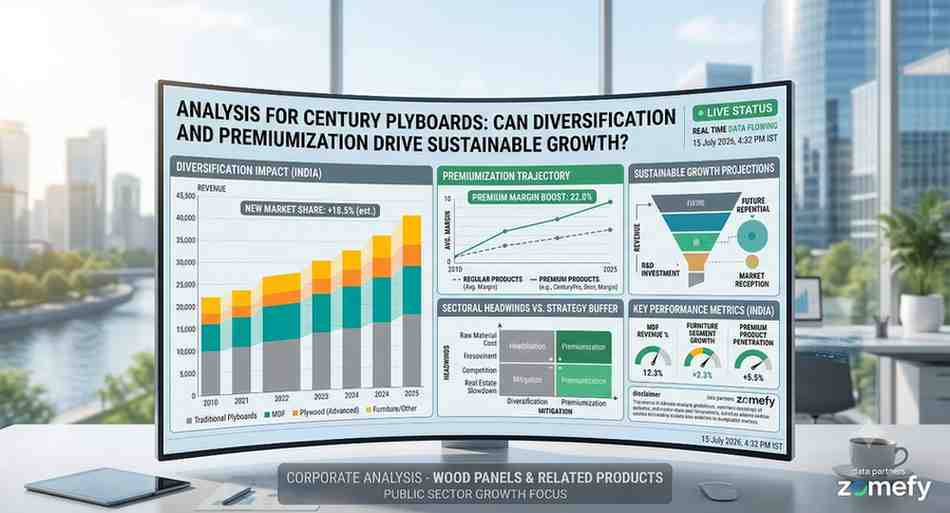
Century Plyboards: Can Diversification and Premiumization Drive Sustainable Growth Amidst Sectoral
Century Plyboards (India) Ltd.

Persistent Systems Stock Analysis 2026: Record Q3 Deal Wins & US Growth Ignite IT Services Rally
Persistent Systems, a mid-tier Indian IT services firm listed on NSE (PERSISTENT) and BSE (533179), operates in a hyper-competitive sector where growth hinges on US client spending and talent reten...
Explore More Insights
Continue your financial education journey