
Jio Financial Services: Can Diversified Financial Offerings Drive Sustainable Profitability Amidst Market
Jio Financial Services (JFSL) has emerged as a significant player in the Indian financial landscape since its demerger from Reliance Industries, aiming to.
Jio Financial Services: Can Diversified Financial Offerings Drive Sustainable Profitability Amidst Market
What You Can Do Next
- Read the full article for complete insights
- Save for later reference
- Share with others learning about this topic
Image not available
Jio Financial Services (JFSL) has emerged as a significant player in the Indian financial landscape since its demerger from Reliance Industries, aiming to disrupt traditional financial services through a digital-first approach and leveraging the vast Jio ecosystem. The company's ambition to offer a diversified suite of financial products, including lending, payments, insurance, and asset management, positions it as a potential long-term growth story. This analysis is triggered by the company's recent Q4 FY26 results, which, despite a substantial increase in total income, reported a decline in net profit. This article will delve into JFSL's business fundamentals, assess the sustainability of its growth trajectory, and highlight the valuation risks and underlying assumptions that retail investors need to scrutinize beyond the initial market optimism.
Data Freshness
Updated on: 2026-04-18 As of: 2026-04-18 Latest price: Rs 243.86 (NSE) as of April 18, 2026 Market cap: Rs 1,54,928 crore Latest earnings period: FY26 Q4 Key sources: https://vertexaisearch.cloud.google.com/grounding-api-redirect/AUZIYQE_16oadnNPpH6E-FKfNkY3Cv925cFaR_IyBNDrUme6ef3oATpnH94wCh2F1qPzcELPFgR6MVv4ioM_-QCwrQkBczs0qb1gv134QfOx47yBcuYQDZ-k59J_jW8Um7aZL8xcqiDrctVQZ6YeZgLEEQaTbkv1cE1dL4sCb6P4pts=; https://vertexaisearch.cloud.google.com/grounding-api-redirect/AUZIYQGuHZMpa-v-bcN_i74DufBpVbJeO1Xsc_nJ9vBwWKCQuN70CZuMVNkHRcsYi5RpGp3kf4AADK7X4r0QyM21ITPNlE562DNCfFnKiVEyc0cALps258QyW_79oWs0YgFdMUZLy6Vgg9viBZHAzAjbvqLY-q_EXg==; https://vertexaisearch.cloud.google.com/grounding-api-redirect/AUZIYQENyFtNfG5bl5OPVFN2HoYTlLYLrX4RWyAqxojBPgzkSBiqp3xKdTAPsXYrLi9nBWwb81uBLmBVufjK6Govbma0L5NjpHdCvHC9wbeKzR5TCahUTKDiJeNfsLRs7tNzHFsuchmzOjwf79CcDAYvyXiaotwcfyxSF2t7TfiXMek=
News Trigger Summary
Event: Jio Financial Services (JFSL) announced its Q4 FY26 and full-year FY26 financial results. Date: April 17, 2026 Why the Market Reacted: The market observed a nearly 14% year-on-year drop in consolidated net profit to ₹272 crore for Q4 FY26, despite a significant 106% surge in total income to ₹1,019 crore. This profit decline, attributed to higher expenses and lower treasury gains, along with a change in Group CFO, likely led to investor scrutiny regarding profitability amidst rapid expansion. Why This Is Not Just News: While the Q4 FY26 results provide a snapshot of current performance, they are merely a data point in JFSL's long-term journey. This article moves beyond headline numbers to analyze whether the reported profit contraction is a transient operational challenge or indicative of deeper structural issues in its aggressive diversification strategy. It aims to evaluate the sustainability of its business model, the effectiveness of its digital-first approach, and the realistic growth expectations against its current valuation, which remains at a premium over peers.
Core Thesis in One Sentence
Jio Financial Services' ambitious digital-first, diversified financial offerings strategy, leveraging the vast Reliance ecosystem, faces the critical challenge of translating rapid top-line growth and asset accumulation into sustainable, bottom-line profitability amidst intense competition and significant execution costs.
Business Model Analysis
Jio Financial Services operates as a Core Investment Company (CIC) registered with the Reserve Bank of India, driving investments across various financial services verticals through its subsidiaries and joint ventures. Its core business segments include: <ul><li><b>Lending (Jio Credit Limited):</b> Offers consumer durable loans, personal loans, merchant loans, and MSME working capital products, primarily through digital channels and Reliance's retail touchpoints. As of March 31, 2026, its Assets Under Management (AUM) surged to ₹25,711 crore. The company aims to provide loans against securities, home loans, and loans against property.</li><li><b>Payments (Jio Payment Solutions Limited & Jio Payments Bank Limited):</b> Jio Payments Bank offers savings accounts, money transfers, bill payments, and UPI services, while Jio Payment Solutions handles merchant acquiring, point-of-sale, and soundbox solutions. Jio Payments Bank's deposit base reached ₹544 crore in Q4 FY26, with total income growing 11x year-on-year.</li><li><b>Asset Management (Jio BlackRock Asset Management Private Limited):</b> A 50:50 joint venture with BlackRock, it offers asset management services, including mutual funds and investment advisory. Its AUM crossed ₹15,200 crore within nine months of launch by the end of FY26.</li><li><b>Insurance Broking (Jio Insurance Broking Limited):</b> Partners with various insurance companies to offer a range of products including general, life, health, and embedded insurance. Total premium facilitated reached ₹982 crore in FY26. JFSL also has a reinsurance joint venture with Allianz Group.</li></ul>The company's strategy is fundamentally built on leveraging the extensive reach of the Reliance ecosystem, including its vast customer base from Jio telecom and Reliance Retail, to achieve low customer acquisition costs and drive cross-selling. The digital-first model emphasizes AI-enabled underwriting and embedded finance to offer accessible solutions across India. Profits are expected to flow from net interest income from lending, fee and commission income from payments and insurance, and asset management fees.
Key Financial Metrics
Metric | FY25 (Rs Crore) | FY26 (Rs Crore) | Q3 FY26 (Rs Crore) | Q4 FY26 (Rs Crore) |
|---|---|---|---|---|
| Total Income | 2,078.92 | 3,513.26 | 900.90 | 1,018.51 |
| Net Profit (PAT) | 1,612.59 | 1,560.90 | 268.98 | 272.22 |
| AUM (Jio Credit) | 10,053 (FY25 end) | 25,711 (FY26 end) | 19,049 (Dec 2025) | 25,711 (Mar 2026) |
| Jio Payments Bank Deposits | 295 (FY25 end) | 544 (FY26 end) | 507 (Dec 2025) | 544 (Mar 2026) |
Jio Financial Services demonstrates significant top-line momentum, with total income surging from ₹2,078.92 crore in FY25 to ₹3,513.26 crore in FY26, representing a 70% year-on-year growth. This growth is further evident in the quarterly figures, with Q4 FY26 total income at ₹1,018.51 crore, more than doubling from Q4 FY25. The Assets Under Management (AUM) for Jio Credit has shown remarkable expansion, growing from ₹10,053 crore at FY25 end to ₹25,711 crore at FY26 end, a 156% increase. Similarly, Jio Payments Bank deposits have grown from ₹295 crore to ₹544 crore over the same period, an 84% rise. However, this aggressive expansion has come at the cost of immediate profitability. Net profit for FY26 slightly declined to ₹1,560.90 crore from ₹1,612.59 crore in FY25. More critically, the Q4 FY26 net profit of ₹272.22 crore represents a nearly 14% year-on-year drop, primarily driven by a substantial increase in operating expenses and lower treasury gains. This trend suggests that while JFSL is successfully building scale and market presence, the path to sustainable, high-margin profitability is still in its early, investment-heavy stages. The transition from treasury-led income to operational earnings is underway, but margins remain under pressure.
What the Market Is Missing
The market, in its enthusiasm for the Reliance brand and the sheer scale of the Jio ecosystem, might be underestimating the inherent challenges and long gestation period involved in building a profitable, diversified financial services powerhouse from scratch. The current valuation, with a P/E ratio around 96.86, appears to price in significant future growth and profitability that is yet to materialize consistently. Investors may be overlooking the 'cost of customer acquisition' disguised within the 'ecosystem leverage' narrative. While JFS benefits from a captive user base, converting these users into profitable financial services customers requires substantial investment in technology, infrastructure, and human capital, as evidenced by the sharp rise in operating expenses. The decline in net profit despite surging revenue in Q4 FY26 highlights that the 'digital-first' model, while promising efficiency in the long run, demands upfront investment that compresses near-term margins. Furthermore, the competitive landscape in India's financial services is brutal, with entrenched public and private sector banks, agile NBFCs like Bajaj Finance, and a rapidly evolving fintech sector. JFS's ability to differentiate beyond convenience and pricing, especially in lending, will be crucial. The market might also be underplaying regulatory risks. The RBI's tightening of risk weights on unsecured consumer loans, as seen in 2024-2025, can directly impact the profitability and capital requirements for NBFCs like Jio Credit, which is rapidly expanding its lending book. The assumption that scale will automatically translate into profitability, without significant credit underwriting prowess, robust risk management, and sustained operational efficiency, could prove fragile. The 'network effect' of the Jio ecosystem is a powerful advantage, but its monetization in financial services is a complex, multi-year endeavor, not a guaranteed linear progression.
Valuation and Expectations
Metric | Jio Financial Services (As of Apr 18, 2026) | Peer Average (Approx.) |
|---|---|---|
| Market Cap (Rs Crore) | 1,54,928 | Varies widely |
| Latest Price (Rs) | 243.86 | N/A |
| P/E Ratio (TTM) | ~96.86 | ~21.78 (Sector Avg.) |
| P/B Ratio | ~1.15 | ~2.5 - 4.0 |
| ROE (FY26) | ~1.19% | ~10-18% |
Jio Financial Services commands a significant market capitalization of approximately ₹1,54,928 crore, reflecting high investor expectations. However, its valuation metrics, particularly the P/E ratio of ~96.86 (as of April 17, 2026), stand at a substantial premium compared to the sector average of around 21.78. While the P/B ratio of ~1.15 appears modest, it needs to be viewed in conjunction with its relatively low Return on Equity (ROE) of ~1.19% for FY26. This suggests that the current stock price is not justified by present earnings or book value, but rather by aggressive future growth and profitability assumptions. Investors are essentially pricing in a rapid and successful scaling of all its diversified offerings, leading to superior market share, operational efficiency, and eventually, strong bottom-line growth and high returns on capital. The implied expectations are for JFSL to not only achieve but also sustain a growth trajectory significantly higher than established financial players, while simultaneously improving its profitability margins drastically from current levels. Any slowdown in customer acquisition, higher-than-anticipated operating costs, or increased credit losses could severely challenge these lofty expectations, making the stock vulnerable to de-rating.
Bull, Base, and Bear Scenarios
Scenario | Key Assumptions | FY28 Revenue (Rs Crore) | FY28 PAT (Rs Crore) | Implied Share Price (Rs) |
|---|---|---|---|---|
| Bull Case | Rapid cross-sell, market leadership in digital lending/payments, high operational efficiency, strong credit quality. Jio BlackRock AUM > Rs 1,00,000 Cr. | ~15,000 - 18,000 | ~4,000 - 5,000 | ~450 - 550 |
| Base Case | Steady ecosystem leverage, moderate market share gains, gradual improvement in profitability, AUM growth in line with market. Jio BlackRock AUM ~ Rs 50,000 Cr. | ~8,000 - 10,000 | ~1,500 - 2,000 | ~280 - 320 |
| Bear Case | Intense competition, higher-than-expected credit losses, slow market penetration, sustained margin pressure, regulatory headwinds. Jio BlackRock AUM < Rs 20,000 Cr. | ~4,000 - 5,000 | ~500 - 800 | ~150 - 180 |
The probability-weighted outcomes for Jio Financial Services vary significantly based on the successful execution of its multi-pronged strategy. In a Bull Case, JFSL successfully leverages its parent's ecosystem to achieve rapid cross-selling and establishes market leadership in digital lending and payments, while maintaining excellent credit quality. Operational efficiencies kick in, driving strong profitability, and its asset management venture with BlackRock scales significantly, leading to AUM exceeding ₹1,00,000 crore by FY28. This could see the stock price appreciate considerably. The Base Case assumes a more moderate trajectory, where ecosystem leverage yields steady but not spectacular market share gains. Profitability improves gradually as initial investments mature, and AUM growth is in line with broader market trends, with Jio BlackRock reaching around ₹50,000 crore. This scenario implies a modest upside from current levels. The Bear Case envisions a scenario where JFSL struggles against intense competition, particularly from established players and nimble fintechs. Higher-than-expected credit losses, persistent margin pressure due to ongoing investment costs, and adverse regulatory changes significantly hamper growth and profitability. Jio BlackRock's AUM remains subdued, falling below ₹20,000 crore. In this scenario, the stock could face significant downside, as current expectations are re-rated to reflect the tougher operating environment and slower path to profitability.
Key Risks and Thesis Breakers
- <b>Execution Risk & Profitability Lag:</b> Despite robust revenue growth, JFSL's net profit declined in Q4 FY26 due to surging operating expenses. If the company fails to translate its rapid scale-up and AUM growth into sustainable, improving net profit margins within the next 2-3 years, the market could re-evaluate its growth narrative.
- <b>Intense Competition & Market Share Erosion:</b> JFSL operates in a highly competitive Indian financial services market, facing established players like Bajaj Finance, HDFC Bank, ICICI Bank, and agile fintechs. Aggressive pricing or superior product offerings from competitors could limit JFSL's market share gains or force it to incur higher customer acquisition and retention costs.
- <b>Regulatory Headwinds & Credit Quality:</b> Changes in RBI regulations, particularly regarding unsecured lending or digital payment norms, could impact JFSL's business model and profitability. A deterioration in credit quality, especially as its lending book grows rapidly, leading to higher Non-Performing Assets (NPAs) and increased provisioning, would be a major thesis breaker.
- <b>Dependence on Parent Ecosystem:</b> While the Reliance ecosystem is a strength, over-reliance on cross-selling to existing Jio/Reliance Retail customers without developing independent competitive advantages could limit its long-term growth and resilience. Any slowdown or adverse development in the parent's core businesses could indirectly affect JFSL's growth levers.
- <b>Talent Acquisition & Retention:</b> Building a diversified financial services entity requires specialized talent across lending, risk management, asset management, and technology. Failure to attract and retain top talent in these competitive domains could hinder execution and innovation.
Peer Comparison
Company | Market Cap (Rs Crore) | P/E (TTM) | P/B | ROE (FY25/26) | Primary Focus |
|---|---|---|---|---|---|
| Jio Financial Services | 1,54,928 | ~96.86 | ~1.15 | ~1.19% (FY26) | Diversified (Lending, Payments, AMC, Insurance) |
| Bajaj Finance Ltd. | ~4,40,000 | ~30-35 | ~6-8 | ~20-23% | Consumer & SME Lending |
| Shriram Finance Ltd. | ~75,000 | ~10-12 | ~1.5-2.0 | ~14-16% | Commercial Vehicle & SME Lending |
| Aditya Birla Capital Ltd. | ~55,000 | ~20-25 | ~1.0-1.5 | ~8-10% | Diversified (Lending, AMC, Insurance) |
Jio Financial Services, despite its nascent stage, commands a market capitalization comparable to or exceeding several established diversified NBFCs and financial services conglomerates. Its P/E ratio of ~96.86 is significantly higher than peers like Bajaj Finance, Shriram Finance, or Aditya Birla Capital, which trade at P/E multiples in the range of 10-35. This premium is primarily attributed to the 'Reliance' brand equity, the vast addressable market through the Jio ecosystem, and the perceived potential for disruptive digital-first growth. However, this premium is not currently supported by its Return on Equity (ROE) of ~1.19% for FY26, which is substantially lower than the 10-23% seen in more mature and profitable peers. While the P/B ratio of ~1.15 appears lower than Bajaj Finance, it's crucial to note the difference in asset quality, seasoning of the loan book, and profitability. JFSL deserves a premium for its unique ecosystem advantage and long-term growth runway, but the current valuation suggests that a significant portion of its future success is already priced in. A discount might be warranted until the company demonstrates consistent and improving profitability, strong asset quality, and a clear path to generating superior returns on its capital, akin to the more seasoned players in the industry.
Who Should and Should Not Consider This Stock
Suitable For
- Long-term investors with a high-risk appetite comfortable with pre-profitability growth stories, who believe in the long-term monetization potential of the Reliance/Jio ecosystem in financial services.
- Investors seeking exposure to India's burgeoning digital finance and fintech space, willing to endure a potentially long gestation period for returns.
- Those who have conviction in the management's ability to execute a complex, multi-vertical financial services strategy against formidable competition.
Not Suitable For
- Risk-averse investors or those seeking immediate profitability, stable dividends, or valuation comfort based on current earnings.
- Short-term traders or investors with a short investment horizon, as the stock is likely to remain volatile based on operational updates and market sentiment around its growth versus profitability trade-off.
- Investors who prefer companies with a proven track record of consistent profitability, high ROE, and strong free cash flow generation.
What to Track Going Forward
- <b>Net Interest Income (NII) and Fee Income Growth:</b> Monitor the growth of NII from its lending business and fee/commission income from payments, insurance, and asset management as a proportion of total income, indicating a shift towards core operational earnings rather than treasury gains.
- <b>Operating Expense Management:</b> Closely track the trajectory of operating expenses relative to revenue growth. A sustained increase in expenses outpacing revenue could signal continued pressure on profitability and execution challenges.
- <b>Asset Quality and Provisioning:</b> As the lending book (AUM) expands rapidly, monitor Gross NPA and Net NPA ratios, along with provisioning coverage, to assess the quality of its loan portfolio and risk management effectiveness.
- <b>AUM Growth and Market Share in Jio BlackRock:</b> Track the Assets Under Management (AUM) of the Jio BlackRock AMC joint venture and its market share gains, as successful penetration in asset management can be a significant long-term value driver.
- <b>Regulatory Developments:</b> Keep an eye on any new regulations or changes in existing policies by the RBI or SEBI impacting NBFCs, digital lending, payments, or asset management, as these can significantly alter the operating environment and profitability.
Final Take
Jio Financial Services is undeniably a fascinating play on India's rapidly digitizing financial sector, backed by the formidable distribution and capital of the Reliance group. Its strategy of building a full-stack, digital-first financial services ecosystem across lending, payments, insurance, and asset management is ambitious and has immense long-term potential. However, the recent Q4 FY26 results, showcasing a decline in net profit despite surging revenue, serve as a crucial reminder that scaling a financial services business is an expensive and time-consuming endeavor. The market's current valuation of JFSL heavily discounts future success, implying a near-flawless execution and a swift transition to high profitability that is yet to be consistently demonstrated. Investors must critically assess whether the 'ecosystem advantage' can truly translate into sustainable, high-margin earnings without succumbing to intense competition or higher-than-anticipated operational and credit costs. The journey from a promising concept to a profitable financial powerhouse is fraught with execution risks, regulatory uncertainties, and the challenge of converting a vast user base into loyal, profitable customers. For now, JFSL remains a high-potential, high-risk investment, suitable only for those with a long-term horizon and a deep understanding of the inherent complexities and potential pitfalls in India's competitive financial landscape. Close monitoring of its operating expenses, asset quality, and the conversion of top-line growth into bottom-line profits will be paramount.
Frequently Asked Questions
Why did Jio Financial Services' profit decline in Q4 FY26 despite robust revenue growth?
Jio Financial Services' consolidated net profit declined by nearly 14% year-on-year in Q4 FY26, primarily due to a sharp increase in operating expenses and lower treasury gains. This indicates that while the company is rapidly scaling its operations and growing its top line, the investments in expansion and associated costs are currently outpacing profitability.
What are the key risks to Jio Financial Services' valuation, given its current market positioning?
JFSL trades at a significant valuation premium, with a P/E ratio around 96.86 as of April 17, 2026, much higher than the sector average. Key risks include the long gestation period for new financial businesses to achieve sustainable profitability, intense competition from established banks and NBFCs, and regulatory changes impacting unsecured lending or digital payments.
References
- [1] Jio Financial Services Share Price Today Live NSE/BSE Graph & Chart - Kotak Securities - Kotak Securities. View Source ↗(Accessed: 2026-04-18)
- [2] Jio Financial Services Ltd Stock Price Today | NSE: JIOF Live - Investing.com - Investing.com. View Source ↗(Accessed: 2026-04-18)
- [3] JIO Financial Services Q3 FY26 Results: Revenue Growth vs Profit Decline - Finology Ticker - Finology Ticker. View Source ↗(Accessed: 2026-04-18)
- [4] Jio Financial Q3 PAT drops 8% YoY to Rs 269 cr - The Economic Times. View Source ↗(Accessed: 2026-04-18)
- [5] JIO Financial Services Q3 Results 2026: Net Profit Falls 8.75% YoY - Univest - Univest. View Source ↗(Accessed: 2026-04-18)
- [6] What is Competitive Landscape of Jio Financial Services Company? - Matrix BCG - Matrix BCG. View Source ↗(Accessed: 2026-04-18)
- [7] Jio Financial Q3 FY26: Core Businesses Scale Rapidly, Profit Softens on Higher Costs and Lower Treasury Gains - Moneycontrol. View Source ↗(Accessed: 2026-04-18)
- [8] Jio Financial Services Q3 Results FY25–26: Net Profit ₹269 Cr, Total Income ₹901 Cr - LatestLY. View Source ↗(Accessed: 2026-04-18)
- [9] Jio Financial Services Share Price Today - JIOFIN Live Updates NSE/BSE - Dhan - Dhan. View Source ↗(Accessed: 2026-04-18)
- [10] Jio Financial Services (JIOFIN.NS) - Market capitalization - Companies Market Cap - Companies Market Cap. View Source ↗(Accessed: 2026-04-18)
- [11] Jio Financial Services Ltd share price - Screener - Screener. View Source ↗(Accessed: 2026-04-18)
- [12] Jio Financial Q4 net profit falls 14% as expenses spike to Rs 692 crore - The Economic Times. View Source ↗(Accessed: 2026-04-18)
- [13] Jio Financial Profit Drops 3% Despite Revenue Surge; CFO Exits | Whalesbook - Whalesbook. View Source ↗(Accessed: 2026-04-18)
- [14] Jio Financial Services Q4 PAT slumps 14% YoY to Rs 272 cr | Capital Market News - Business Standard. View Source ↗(Accessed: 2026-04-18)
- [15] Jio Financial Services Stock Price Live NSE/BSE - Groww - Groww. View Source ↗(Accessed: 2026-04-18)
- [16] Jio Financial Services Ltd Share Price Today Live NSE/BSE - Bajaj Finserv - Bajaj Finserv. View Source ↗(Accessed: 2026-04-18)
- [17] Jio Financial Services FY26 topline jumps 78% to ₹3,274 crore; lending, payments and AMC fuel growth - Fortune India - Fortune India. View Source ↗(Accessed: 2026-04-18)
- [18] Jio Financial Services: Business Model And SWOT Analysis - Pocketful - Pocketful. View Source ↗(Accessed: 2026-04-18)
- [19] Jio Financial Services Limited (JIOFIN) Price and Market Cap | MarketCapOf - MarketCapOf. View Source ↗(Accessed: 2026-04-18)
- [20] Jio Financial Services Ltd (JIOF) Financial Ratios - Investing.com - Investing.com. View Source ↗(Accessed: 2026-04-18)
- [21] Jio Financial Services Q4 results: PAT drops 14% YoY to ₹272 crore; final dividend recommended - Upstox - Upstox. View Source ↗(Accessed: 2026-04-18)
- [22] Jio Financial Services Ltd Summary | IIFL Capital - IIFL Capital. View Source ↗(Accessed: 2026-04-18)
- [23] Jio Financial Services Limited Reports Earnings Results for the Fourth Quarter Ended March 31, 2026 | MarketScreener - MarketScreener. View Source ↗(Accessed: 2026-04-18)
- [24] [LIVE] JIO Financial Serv. Share Price | 52 Week High/Low Stocks - Nirmal Bang - Nirmal Bang. View Source ↗(Accessed: 2026-04-18)
- [25] Jio Financial Q4 Results Highlights: PAT slumps 14% YoY to ₹272 crore; dividend of ₹0.60 announced | Stock Market News - Mint - Mint. View Source ↗(Accessed: 2026-04-18)
- [26] Jio Financial Q4 Results: Cons PAT declines 14% YoY to Rs 272 crore despite 106% surge in revenue - The Economic Times - The Economic Times. View Source ↗(Accessed: 2026-04-18)
- [27] Jio Financial Services Ltd Key Ratios - India Infoline - India Infoline. View Source ↗(Accessed: 2026-04-18)
- [28] Jio Financial Services: All you need to know - ICICIdirect - ICICIdirect. View Source ↗(Accessed: 2026-04-18)
- [29] Know about JFS - Jio Financial Services - Jio Financial Services. View Source ↗(Accessed: 2026-04-18)
- [30] Jio Financial Services: India's First Large-Scale Fintech-NBFC Stack in Motion - Alpha Spread. View Source ↗(Accessed: 2026-04-18)
- [31] Jio Financial - Competitors/Peers Analysis - Trendlyne.com - Trendlyne. View Source ↗(Accessed: 2026-04-18)
- [32] Jio Financial Services Ltd. - Stocks - The Economic Times - The Economic Times. View Source ↗(Accessed: 2026-04-18)
- [33] Jio Financial Services Posts Analyst Call Recording on FY26 Results - TipRanks.com - TipRanks.com. View Source ↗(Accessed: 2026-04-18)
- [34] Jio Financial Services Ltd Key Ratios - India Infoline - India Infoline. View Source ↗(Accessed: 2026-04-18)
- [35] Jio Financial Services: All you need to know - ICICIdirect - ICICIdirect. View Source ↗(Accessed: 2026-04-18)
- [36] Jio Financial Services Limited Reports Earnings Results for the Fourth Quarter Ended March 31, 2026 | MarketScreener - MarketScreener. View Source ↗(Accessed: 2026-04-18)
Disclaimer: IMPORTANT DISCLAIMER: This analysis is generated using artificial intelligence and is NOT a recommendation to purchase, sell, or hold any stock. This analysis is for informational and educational purposes only. Past performance does not guarantee future results. Please consult with a qualified financial advisor before making any investment decisions. The author and platform are not responsible for any investment losses.
Continue Your Investment Journey
Discover more insights that match your interests

India's SaaS Unicorns: The Next Infosys Generation?
Explore India's booming SaaS sector with analysis of Freshworks, Zoho, Chargebee, and emerging unicorns. Can Indian SaaS companies replicate Infosys's global success?

India’s SIP Revolution 2025: Driving Retail Shift to Long-Term Mutual Fund Wealth Building
India's Systematic Investment Plan (SIP) landscape is undergoing a profound transformation in 2025, marking a seismic shift in retail investor behavior towards disciplined, long-term wealth buildin...
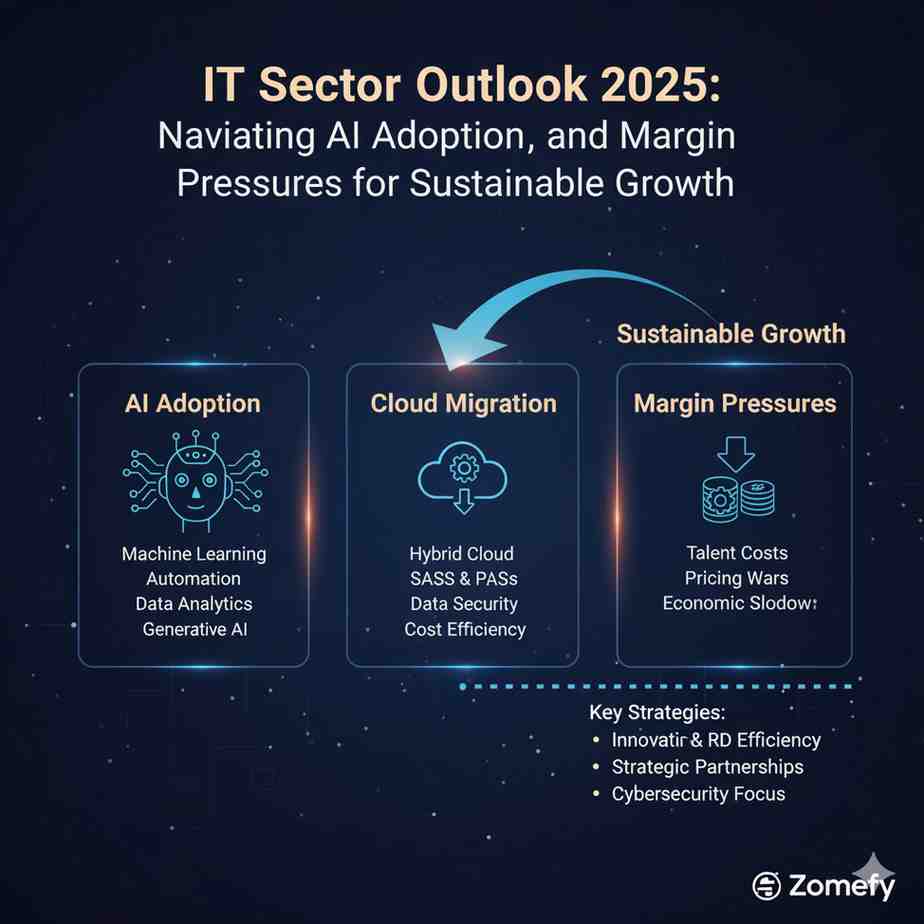
IT Sector Outlook 2025: Navigating AI Adoption, Cloud Migration, and Margin Pressures for Sustainable Growth
India’s IT sector is at a pivotal juncture in 2025, shaped by rapid AI adoption, accelerating cloud migration, and persistent margin pressures.

Startup Unicorns 2025: Navigating New SEBI Regulations and Their Impact on Indian Startup Valuations and Fundraising
The Indian startup ecosystem has witnessed phenomenal growth over the past decade, with the number of startups soaring from approximately 20,000 in 2015 to over 1,59,000 by early 2025.
Explore More Insights
Continue your financial education journey