
Exicom Tele-Systems: Can EV Charging Infrastructure Drive Sustained Growth Amidst Sectoral Competition
Exicom Tele-Systems, an Indian company with a dual focus on Critical Power solutions and Electric Vehicle (EV) charging infrastructure, has been gaining.
Exicom Tele-Systems: Can EV Charging Infrastructure Drive Sustained Growth Amidst Sectoral Competition
What You Can Do Next
- Read the full article for complete insights
- Save for later reference
- Share with others learning about this topic
Image not available
Exicom Tele-Systems, an Indian company with a dual focus on Critical Power solutions and Electric Vehicle (EV) charging infrastructure, has been gaining investor attention, particularly following its recent Q4 FY26 financial results. The company announced achieving consolidated EBITDA breakeven for the first time since its acquisition of global EV charger manufacturer Tritium, alongside robust standalone performance. However, this milestone was accompanied by continued consolidated net losses for both the quarter and the full financial year. This article aims to delve beyond the headlines, providing Indian retail investors with a comprehensive analysis of Exicom's business fundamentals, the sustainability of its growth drivers, and the inherent valuation risks. We will explore what the market might be overlooking and identify critical factors that could challenge the investment thesis, enabling a more informed decision-making process for long-term investors.
Data Freshness
Updated on: 2026-06-16 As of: 2026-06-16 Latest price: Rs 166.6 (NSE) as of June 16, 2026 Market cap: Rs 2,247.10 crore Latest earnings period: FY26 Q4 Key sources: https://www.bajajfinserv.in/stocks/exicom-tele-systems-ltd-fundamentals; https://www.kotakneo.com/stocks/company-profile/Exicom-Tele-Systems-Ltd/EXICOM; https://www.screener.in/company/EXICOM/consolidated/
News Trigger Summary
Event: Exicom Tele-Systems announced its Q4 FY26 and full-year FY26 financial results. Date: May 19, 2026 Why the Market Reacted: The market likely reacted positively to the news of Exicom achieving consolidated EBITDA breakeven in Q4 FY26, a significant milestone following the acquisition of Tritium, indicating a potential turnaround for the international operations. The strong standalone (India) business performance also contributed to positive sentiment. Why This Is Not Just News: While the Q4 FY26 results indicate operational improvements, particularly with the Tritium integration, the company still reported a consolidated net loss for the quarter and the full year. This article moves beyond the immediate news to assess the sustainability of this 'breakeven' amidst high competition, execution risks in global expansion, and the long-term path to consolidated profitability, which are critical for long-term retail investors.
Core Thesis in One Sentence
Exicom Tele-Systems' investment case hinges on its ability to translate strong EV charging segment growth and the turnaround of its acquired global business, Tritium, into sustained consolidated profitability, while navigating intense competition and potential cyclicality in its legacy Critical Power segment.
Business Model Analysis
Key Financial Metrics
Metric (Rs Crore) | FY24 (Consolidated) | FY25 (Consolidated) | FY26 (Consolidated) | FY26 Q4 (Consolidated) |
|---|---|---|---|---|
| Revenue from Operations | 867.61 | 867.61 | 1,151.73 | 387.95 |
| Net Profit / (Loss) | -110.03 | -110.03 | -274.13 | -54.31 |
| EBITDA | -49.37 | -49.37 | -103.00 | 0.3 |
| ROCE (%) | NA | -14.7 | -14.7 | NA |
| Total Debt | NA | NA | ~630.00 | NA |
Exicom Tele-Systems has demonstrated significant revenue growth, with consolidated revenue rising from Rs 867.61 crore in FY25 to Rs 1,151.73 crore in FY26, a 33% year-on-year increase. This growth is largely attributable to the strong performance of its EV Charger segment, which saw an 83.2% YoY increase in Q4 FY26, and the inclusion of Tritium's operations for a full year. However, this expansion has come at the cost of profitability on a consolidated basis. The company reported a net loss of Rs 274.13 crore for FY26, widening from Rs 110.03 crore in FY25. The full-year consolidated EBITDA was also a loss of Rs 103 crore. While the standalone Indian business remained EBITDA positive, the acquisition and integration costs, along with the turnaround efforts for Tritium, have weighed heavily on the consolidated bottom line. A notable highlight is the Q4 FY26 consolidated EBITDA reaching breakeven at Rs 0.3 crore, suggesting that the turnaround efforts for Tritium might be starting to yield results. The Return on Capital Employed (ROCE) remains negative at -14.7% for FY26, reflecting the capital-intensive nature of expansion and the current loss-making status. Total debt is estimated at approximately Rs 630 crore for FY26, which needs to be monitored in the context of persistent losses.
What the Market Is Missing
The market appears to be primarily pricing Exicom as an EV charger growth story, with significant optimism surrounding the burgeoning Indian EV market and the potential turnaround of its acquired global entity, Tritium. However, this narrative might be overlooking several critical nuances and underlying risks. Firstly, while the consolidated EBITDA breakeven in Q4 FY26 is a positive signal, the company still reported substantial consolidated net losses for the quarter and the full year. The path to sustained, consolidated net profitability, especially with Tritium, remains long and fraught with execution challenges. Integrating a global entity with a history of financial headwinds requires flawless operational efficiency and market penetration, which are not guaranteed. The market might also be underestimating the fierce competition in the Indian EV charging space, with established players like Tata Power, Delta Electronics, and new entrants vying for market share. Price wars or aggressive expansion by larger, better-capitalized players could compress margins for Exicom. Secondly, a potentially underappreciated aspect is Exicom's 'GRID-FLEX' product – an 800-950V DC bi-directional inverter for data centers and Battery Energy Storage Systems (BESS). This product, launched in December 2025 and currently in Factory Acceptance Testing (FAT) with a global hyperscaler, represents a significant optionality that could position Exicom as an 'AI/DC proxy' play, diversifying its revenue streams beyond just EV charging. If successful, this could unlock a new revenue potential of ~$30-35 million from 2027-28, which is a binary catalyst. However, this opportunity is still in its early stages, and its success is not yet priced into the core EV narrative. The market's focus on EV charging might be overshadowing the risks and rewards of this nascent, high-potential segment. Lastly, the Critical Power segment, while stable, operates in a telecom capex cycle that can be volatile. Reliance on this segment to fund EV expansion, especially during periods of consolidated losses, could strain the balance sheet if EV growth or Tritium's turnaround falters. Investors need to question whether the current valuation fully accounts for the ongoing consolidated losses, the competitive intensity, and the inherent risks associated with a global turnaround story, rather than simply extrapolating recent revenue growth.
Valuation and Expectations
Metric | FY26 (Consolidated) | Latest (as of 2026-06-16) |
|---|---|---|
| Market Cap (Rs Crore) | NA | 2,247.10 |
| Revenue (Rs Crore) | 1,151.73 | NA |
| P/B Ratio (x) | NA | 3.51 |
| Market Cap / Sales (x) | 1.95 | 1.95 |
| EPS (TTM, Rs) | -19.71 | -19.71 |
As of June 16, 2026, Exicom Tele-Systems commands a market capitalization of approximately Rs 2,247.10 crore. Given its consolidated net loss for FY26 (EPS of -19.71 Rs), traditional P/E valuation is not meaningful as it yields a negative figure. The Price-to-Book (P/B) ratio stands at 3.51x, based on a book value of Rs 46.8 per share. The Market Cap to Sales ratio is approximately 1.95x (2247.10 / 1151.73). This valuation suggests that the market is currently pricing in significant future growth and a strong turnaround in profitability, particularly from the EV charging segment and the Tritium acquisition. To justify a P/B of 3.51x with negative ROCE, the company would need to demonstrate a substantial and sustained improvement in its return ratios and achieve positive, growing consolidated net profits in the coming fiscal years. This implies expectations of aggressive revenue growth (likely double-digit percentage annually) and a rapid expansion of consolidated EBITDA margins, moving from breakeven to healthy positive levels. Any delays in Tritium's profitability, slower-than-expected EV adoption, or increased competitive pressures could lead to a re-rating of these expectations and a potential downside risk to the current valuation.
Bull, Base, and Bear Scenarios
Scenario | FY27 Consolidated Revenue (Rs Crore) | FY27 Consolidated EBITDA (Rs Crore) | Key Assumptions |
|---|---|---|---|
| Bull Case | 1,800 - 2,000 | 80 - 100 (Positive) | Tritium achieves EBITDA breakeven by Q4 FY27 and shows strong growth. Indian EV market grows rapidly. GRID-FLEX gains commercial traction. Critical Power remains stable. |
| Base Case | 1,500 - 1,700 | -20 - 0 (Near Breakeven) | Tritium turnaround is slower, achieving breakeven in late FY27 or early FY28. Indian EV market grows steadily. GRID-FLEX pilots continue without significant revenue contribution. Critical Power faces moderate headwinds. |
| Bear Case | 1,100 - 1,300 | -100 - -50 (Loss) | Tritium turnaround faces significant delays or fails. Intense competition impacts EV charging margins. Telecom capex cycle weakens further. GRID-FLEX does not materialize. |
The Bull Case assumes a faster-than-expected turnaround for Tritium, achieving its Q4 FY27 EBITDA breakeven target and demonstrating strong order inflows. It also factors in robust growth in the Indian EV charging market, supported by favorable government policies and increasing EV adoption. Crucially, the GRID-FLEX product for data centers and BESS starts contributing meaningfully to revenue, offering a new high-margin segment. The Base Case reflects a more tempered outlook, where Tritium's profitability is delayed, reaching breakeven in late FY27 or early FY28. Indian EV market growth is steady but not explosive, and competitive pressures keep margins in check. The GRID-FLEX opportunity remains in pilot stages without significant commercial revenue. The Critical Power segment experiences some cyclicality. The Bear Case outlines a scenario where Tritium's turnaround efforts falter, leading to continued losses and cash burn. Intense competition in India results in significant margin erosion in the EV charging segment. The Critical Power business faces a prolonged downturn due to reduced telecom spending, and the promising GRID-FLEX product fails to gain commercial viability. This scenario would significantly impact Exicom's financial health and investor confidence, potentially leading to substantial downside.
Key Risks and Thesis Breakers
Peer Comparison
Company | Market Cap (Rs Crore) | FY26 Revenue (Rs Crore) | FY26 Net Profit (Rs Crore) | P/B Ratio (x) | ROCE (%) |
|---|---|---|---|---|---|
| Exicom Tele-Systems | 2,247.10 | 1,151.73 | -274.13 | 3.51 | -14.7 |
| Servotech Power Systems* | ~1,800 - 2,000 | ~350 - 400 | ~20 - 30 | ~10 - 12 | ~15 - 20 |
| Delta Electronics India* | NA (Part of larger global entity) | NA | NA | NA | NA |
| Tata Power (EV Charging division)* | ~1,40,000 - 1,50,000 (Total) | NA (Segmental) | NA | ~3 - 4 | ~8 - 10 |
*Note: Financials for Servotech, Delta, and Tata Power's EV division are approximate estimates or consolidated company figures, as direct comparable segment-level data for the latest period is not readily available for all. Servotech Power Systems is a smaller, pure-play EV charger manufacturer, often showing higher P/B ratios due to high growth expectations in a nascent sector. Exicom's P/B of 3.51x is lower than some high-growth peers but still significant given its consolidated net losses and negative ROCE. Its larger revenue base (including Tritium) compared to a pure-play like Servotech, implies a different scale and set of challenges. Tata Power, a diversified utility, has a robust EV charging network (Tata Power EZ Charge) but its EV business is a small part of its overall operations, benefiting from a strong parent balance sheet and brand. Delta Electronics India, a subsidiary of a global major, brings significant technological prowess and financial backing. Exicom's current valuation, especially with negative profitability, suggests investors are placing a high premium on its growth potential, particularly the successful turnaround of Tritium and the expansion in the Indian EV market. The discount to a pure-play like Servotech might reflect the complexity of its dual business model and the ongoing losses, while the comparison to a giant like Tata Power highlights the challenges of competing with deep pockets.
Who Should and Should Not Consider This Stock
Suitable For
- Investors with a high-risk appetite comfortable with turnaround stories and long investment horizons (5+ years).
- Those who believe in the long-term structural growth of the Indian EV market and global EV charging infrastructure, and are confident in Exicom's ability to execute its Tritium integration.
- Investors seeking exposure to emerging technologies like high-power DC conversion for data centers and BESS, viewing GRID-FLEX as a significant optionality.
Not Suitable For
- Risk-averse investors seeking stable, profitable companies with consistent earnings and positive cash flows.
- Short-term traders or those focused on immediate profitability and low valuation multiples.
- Investors uncomfortable with companies reporting consolidated losses, negative ROCE, and significant execution risks in international acquisitions.
What to Track Going Forward
Final Take
Exicom Tele-Systems presents a complex investment proposition, balancing the significant growth potential of the EV charging sector with the inherent risks of a global turnaround story. The Q4 FY26 consolidated EBITDA breakeven is an encouraging sign, suggesting that the challenging integration of Tritium might be moving in the right direction. However, the persistent consolidated net losses underscore the long path to sustained profitability. The market's enthusiasm for EV charging could be overlooking the intense competition in India and the significant execution hurdles for Tritium's global operations. The hidden optionality of the GRID-FLEX product for data centers and BESS offers an intriguing, non-consensus growth driver, but it remains nascent. Investors should approach Exicom with a clear understanding that this is a high-risk, high-reward bet on future execution and market expansion, rather than a play on current profitability. The thesis is fragile and can be broken by a slower-than-anticipated turnaround for Tritium, aggressive competition, or a failure of new product lines to materialize. Close monitoring of Tritium's profitability, overall consolidated net profits, and the commercial progress of GRID-FLEX will be crucial to assess whether the company can successfully navigate these challenges and justify its current valuation.
Frequently Asked Questions
Why did Exicom Tele-Systems report a consolidated net loss for FY26 despite achieving Q4 FY26 consolidated EBITDA breakeven and strong revenue growth?
Exicom Tele-Systems reported a consolidated net loss of Rs 274.13 crore for FY26 primarily due to the full-year accounting of Tritium's operations, which it acquired in 2024. While the standalone Indian business was profitable, the international operations, particularly Tritium, incurred significant turnaround costs, leading to a consolidated loss despite achieving a positive consolidated EBITDA of Rs 0.3 crore in Q4 FY26.
What are the primary risks to Exicom's investment thesis that investors should closely monitor?
Key risks include the successful execution of Tritium's turnaround to achieve sustained profitability, intense and growing competition in the Indian EV charging market, and potential fluctuations in the Critical Power segment due to telecom capital expenditure cycles. Investors should also track the company's ability to manage its balance sheet given accumulated losses and its reliance on imports for certain components.
References
- [1] Exicom Tele-Systems reports consolidated net loss of Rs 54.31 crore in the March 2026 quarter - Axis Direct (via Capital Market - Live News). View Source ↗(Accessed: 2026-06-16)
- [2] Exicom Tele Systems Ltd Share Price Today Live NSE/BSE - Bajaj Finserv. View Source ↗(Accessed: 2026-06-16)
- [3] Exicom TeleSystems Ltd Stock Price Today | NSE: EXIC Live - Investing.com. View Source ↗(Accessed: 2026-06-16)
- [4] Exicom Tele-Systems (NSE:EXICOM) Market Cap & Net Worth - Stock Analysis. View Source ↗(Accessed: 2026-06-16)
- [6] Exicom Tele-Systems Ltd share price - Screener. View Source ↗(Accessed: 2026-06-16)
- [7] Exicom Tele-Systems Share Price - The Economic Times. View Source ↗(Accessed: 2026-06-16)
- [8] Exicom Tele-systems Stock Price Live NSE/BSE - Groww. View Source ↗(Accessed: 2026-06-16)
- [9] Exicom Tele-Systems Share Price - Stocks - Kotak Neo. View Source ↗(Accessed: 2026-06-16)
- [10] Exicom Hits Breakeven, Signals Global Ambition After Strongest Quarter - BriefGlance.com. View Source ↗(Accessed: 2026-06-16)
- [11] Exicom Tele-Systems Share Price Today - Live NSE/BSE - ICICI Direct. View Source ↗(Accessed: 2026-06-16)
- [12] Exicom Delivers its Strongest Quarter of FY26 as Both Businesses Return to Sharp Growth - ANI News. View Source ↗(Accessed: 2026-06-16)
- [13] Exicom Tele Systems - by Pankaj Garg - Learning Lifelong. View Source ↗(Accessed: 2026-06-16)
- [15] Exicom Tele-systems Ltd. Stock price: Live updates - Tijori Finance. View Source ↗(Accessed: 2026-06-16)
- [17] Exicom Tele-Systems Ltd (NSE:EXICOM) Q4 2026 Earnings Call Highl - GuruFocus. View Source ↗(Accessed: 2026-06-16)
- [18] EXICOM Tele-Systems 2026 Company Profile: Stock Performance & Earnings - PitchBook. View Source ↗(Accessed: 2026-06-16)
- [19] List of Top EV Charger Manufacturers in India - Servotech Renewable Power System. View Source ↗(Accessed: 2026-06-16)
- [20] Exicom Tele-Systems Ltd, EXICOM:NSI profile - FT.com - Markets data. View Source ↗(Accessed: 2026-06-16)
- [21] TOP 10 EV Charger Manufacturers In India - ZinstarEV. View Source ↗(Accessed: 2026-06-16)
- [22] Exicom Tele-systems Ltd. Q4 Results Update - Latest Quarterly Results 2026 - 5paisa. View Source ↗(Accessed: 2026-06-16)
- [26] Exicom Investor Relations: Trusted Growth in EV Industry - Exicom Tele-Systems Ltd.. View Source ↗(Accessed: 2026-06-16)
- [28] Top 10 Electric Vehicle Charging Station providers in India - DIYguru. View Source ↗(Accessed: 2026-06-16)
- [29] List of Top Car Charging Station Manufacturers in India - Industry Wired. View Source ↗(Accessed: 2026-06-16)
- [30] India Electric Vehicle (EV) Charging Station Companies - Top Players' List - Mordor Intelligence. View Source ↗(Accessed: 2026-06-16)
Disclaimer: IMPORTANT DISCLAIMER: This analysis is generated using artificial intelligence and is NOT a recommendation to purchase, sell, or hold any stock. This analysis is for informational and educational purposes only. Past performance does not guarantee future results. Please consult with a qualified financial advisor before making any investment decisions. The author and platform are not responsible for any investment losses.
Continue Your Investment Journey
Discover more insights that match your interests
India’s 2025 Fintech Revolution: Exploring the Rise of Embedded Lending and UPI-Driven Financial Inclusion for Retail Investors
India's fintech sector is entering a transformative phase as we approach 2025, characterized by the rapid rise of embedded lending and the deepening impact of UPI-driven financial inclusion.
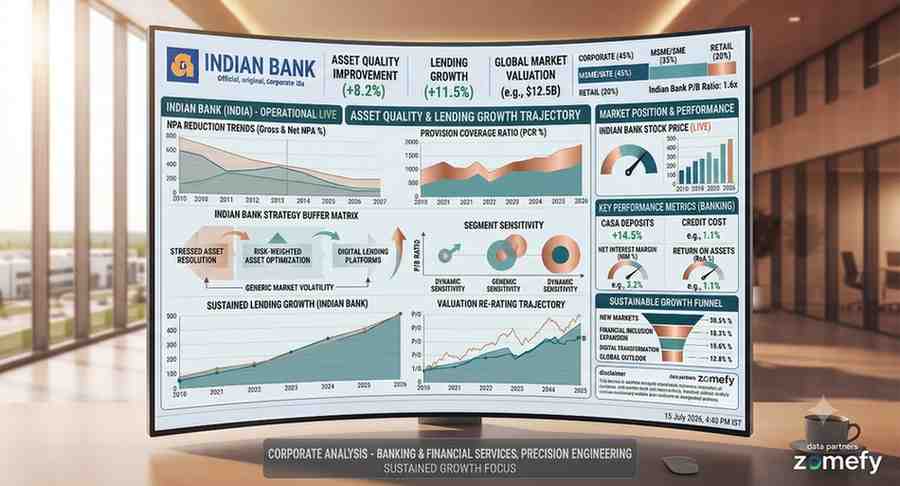
Indian Bank: Can Asset Quality Improvement Drive Sustained Lending Growth and Valuation Re-rating?
Indian Bank, a prominent public sector lender, has recently captured market attention with its robust Q1 FY27 results, signaling continued improvements in asset quality and sustained lending growth.
Zomato Stock Analysis 2025: Record Q3 Profit Surge & Quick Commerce Expansion Driving Delivery Dominance
Zomato's Q3FY25 results and management commentary mark a critical inflection point in the company's multi-year growth playbook: aggressive quick-commerce (Blinkit) expansion alongside recovery in c...
Samvardhana Motherson International: Can Global Acquisitions Sustain Growth Amidst Auto Sector Volatility?
Samvardhana Motherson International Ltd.
Explore More Insights
Continue your financial education journey